



Air Circuit Breaker (ACB) Manufacturer in China

Protect your main power lines with Sincede Air Circuit Breakers. Designed for easy installation, they ensure stable electricity and safety for factories and commercial buildings.

We focus on durability and simplicity. These breakers help you avoid power outages and reduce maintenance costs, making them a reliable choice for your daily operations.

Get consistent performance directly from the manufacturer. Explore our series below to find the right solution for your needs.

  • IEC 60947-2
  • CE
  • CB
  • SAA
  • ISO
  • RoHS
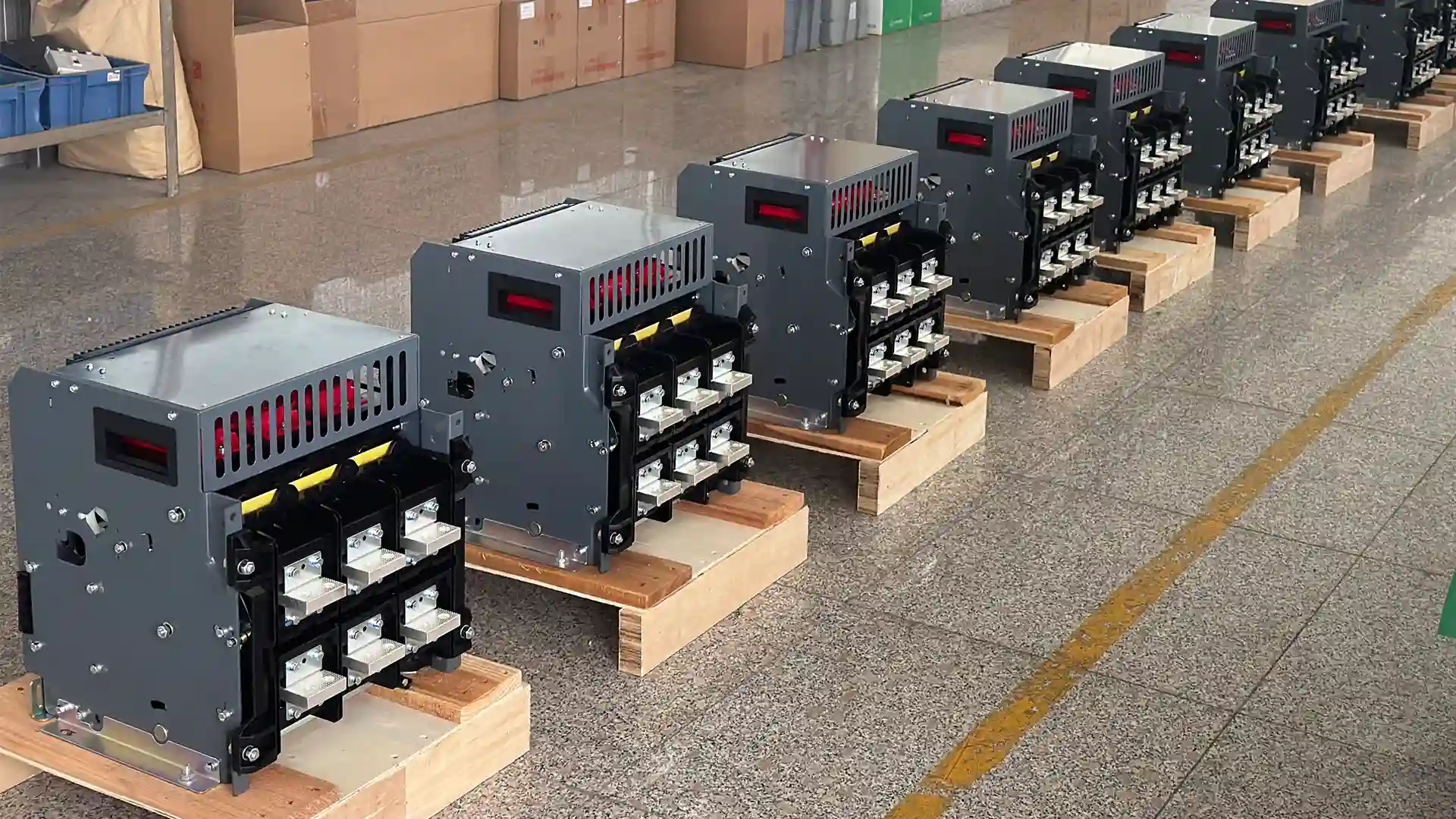
Multiple gray air circuit breakers (ACBs) arranged in a neat row on wooden pallets inside a workshop or factory assembly area. Each unit features ventilation slots, exposed busbar terminals with white connectors, red internal components visible through openings, and a clean industrial design, with cardboard boxes and equipment in the background.

Air Circuit Breaker for Sale

Choose between our heavy-duty W1 series for maximum power or the compact W2 series for efficiency.

  • W1 - 2000 Series

    Rated Current: 200A - 6300A
    Short Circuit Breaking Capacity: 85kA ~ 120kA

    Overview: The W1-2000 is our flagship series featuring complete intelligence, high breaking capacity, and Zero Arc technology.

    • Rated Current: 200A – 6300A
    • Breaking Capacity: 85kA – 120kA
    • Poles: 3P & 4P (Fixed or Draw-out Type)
    • Installation: Supports inverted wire installation
    • Smart Protection: Instantaneous, Short delay, Long delay, Single-phase grounding protection.
    • Intelligent Controller: Features Display, Setting, Monitoring, and Fault Memory functions.
    • Communication: Interface for remote measurement, adjustment, control, and communication (Telemetry).
  • W2 - 1600 Series

    Rated Current: 200A ~ 1600A
    Short Circuit Breaking Capacity: 20kA ~ 42kA

    Overview: The W2-1600 offers the same intelligent features in a more compact design, suitable for standard distribution needs.

    • Rated Current: 200A – 1600A
    • Breaking Capacity: 20kA – 42kA
    • Poles: 3P & 4P (Fixed or Draw-out Type)
    • Installation: Supports inverted wire installation
    • Smart Protection: Instantaneous, Short delay, Long delay, Single-phase grounding protection.
    • Intelligent Controller: Includes Fault Memory, Monitoring, and Setting functions.
    • Communication: Full remote capability (Remote control, adjustment, and communication).
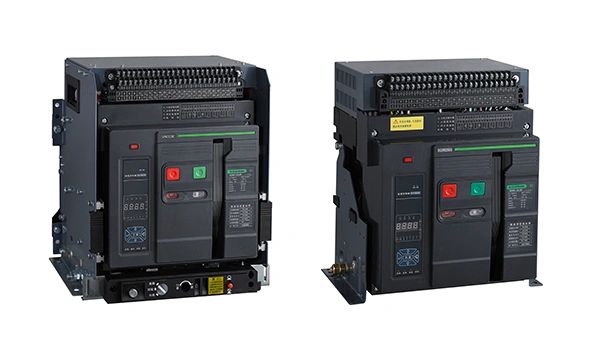
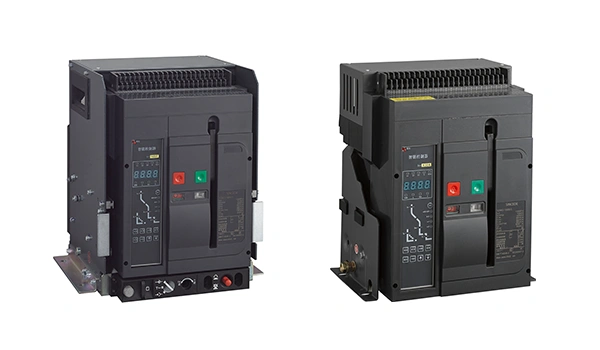
    Two side-by-side images of Sincede W2 series 1600A 3-pole air circuit breakers (ACBs). On the left is the draw-out type with a black housing, black handle in the ON position, red and green status indicators, a digital trip unit display, and visible withdrawal frame with mounting base. On the right is the fixed type showing a similar front panel with indicators, digital trip unit, and rear busbar connections. Both units feature a compact black enclosure, ventilation slots, and robust industrial construction.

What Is an Air Circuit Breaker?

Air Circuit Breaker, usually called ACB, is a low-voltage circuit breaker used to protect electrical systems from overloads, short circuits, and ground faults in high-current applications. It’s basically a bigger version of MCCB, with far more features, using air as the arc extinguishing medium, allowing it to safely interrupt fault currents and ensure reliable operation in main power distribution systems.

ACBs are commonly installed as main incoming or bus-tie breakers in low-voltage switchgear, generator panels, and large distribution boards. With rated currents typically ranging from 630A to 6300A, they are ideal for industrial and commercial power systems that require high breaking capacity, system stability, and long-term operational reliability.

Types of Air Circuit Breakers

Air Circuit Breakers are available in several standard forms used in low-voltage power distribution systems, allowing them to meet different system designs and operating needs.

By Installation Methods

  • Fixed Type

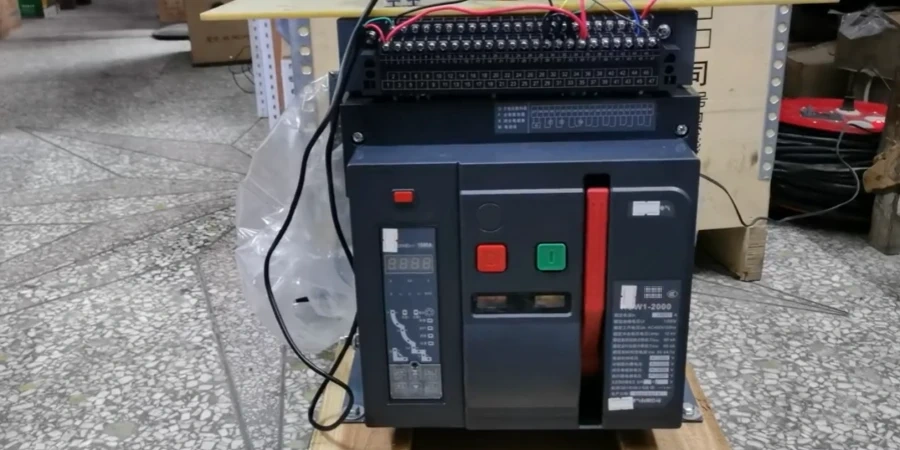
    Fixed type ACBs are installed directly onto the switchboard busbars and remain in place during operation. This design is simple and compact, and is widely used in standard distribution panels.

    Large dark gray fixed-type air circuit breaker (ACB) placed on a wooden pallet in a workshop. The unit features a digital display, red and green push buttons, a long red vertical operating handle in the center, a control panel with buttons and indicators on the left side, multiple terminal blocks with red, blue, and black wires connected at the top, Chinese labels, and protective plastic wrapping nearby.
  • Draw-out Type

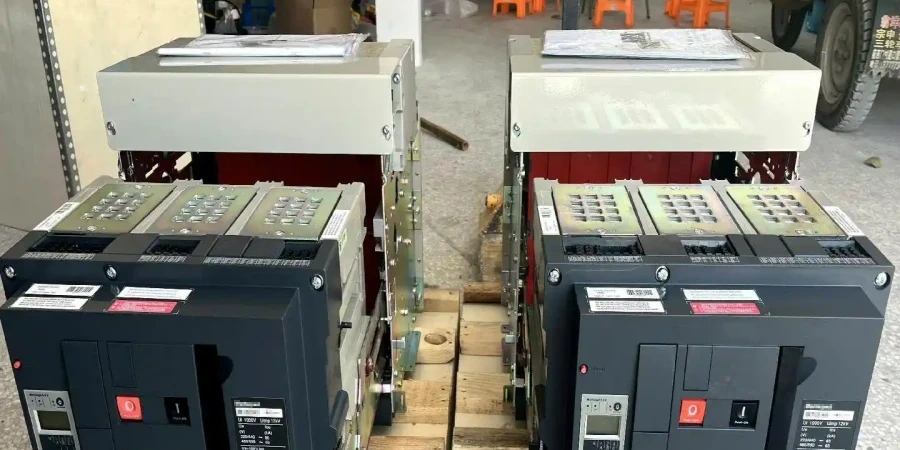
    Draw-out ACBs are mounted on a cradle that allows the breaker to be moved to test or isolated positions. This structure is commonly used in systems where regular inspection or replacement is required.

    Two large draw-out type air circuit breakers (ACBs) mounted side by side on wooden pallets in a workshop. Each black breaker has a removable cassette-style frame, silver top cover, visible trip unit with digital display and keypad, red ON/OFF handle in the OFF position, multiple connection terminals, Chinese labels, and mounting hardware. The units are partially wrapped and positioned ready for installation or shipping, with a truck tire and orange stools in the background.

By Pole Configuration

  • 3-Pole (3P)

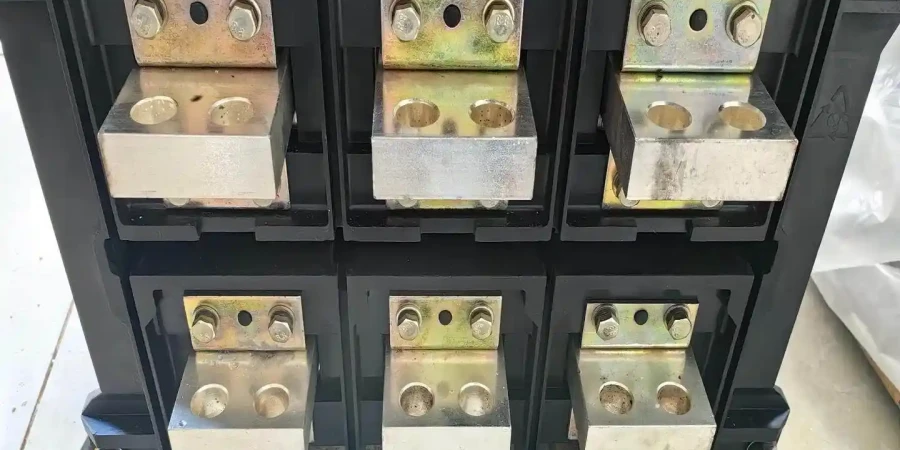
    3-pole ACBs are designed for three-phase systems without neutral protection. They are commonly used in balanced loads such as motors and standard industrial power circuits.

    Close-up of metal busbars mounted in a black plastic holder at the rear of an 3P air circuit breaker, arranged in two rows with bolted connections and holes for cables
  • 4-Pole (4P)

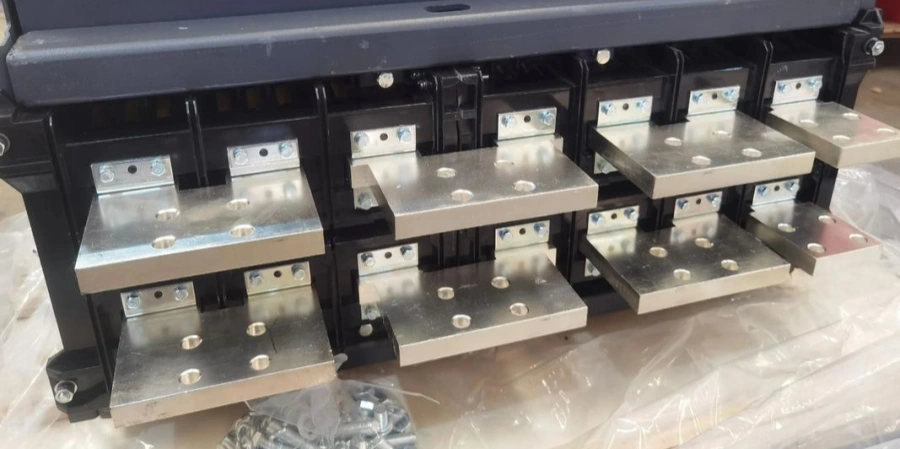
    4-pole ACBs include an additional pole for the neutral conductor. They are used in systems where neutral protection is required, such as circuits with unbalanced or non-linear loads.

    Close-up of the rear terminal section of a 4-pole air circuit breaker (ACB), showing four sets of silver-plated copper connection pads or busbar terminals arranged in a row. Each pole has multiple drilled holes for bolting cables or busbars, mounted on black insulating supports with visible mounting brackets and hardware. The breaker housing is dark gray at the top, and small bags of bolts and nuts are visible in the foreground on plastic wrapping in a workshop setting.

By Operation Mechanisms

  • Manual ACB

    Manual ACBs are mainly used for local, on-site control. They provide a simple mechanical interface and do not require any auxiliary power, making them suitable for small to medium distribution systems.

    The breaker is operated using a front-mounted handle. The handle charges the internal spring, and the breaker is opened or closed with the physical buttons on the front panel.

    This type is simple, highly reliable, and cost-effective. It is commonly found in local distribution boards where remote operation or automation is not needed.

  • Motorized ACB

    Motorized ACBs are designed for remote and automated control, allowing integration with control rooms or monitoring systems. They are commonly used in facilities that require reliable remote management.

    A built-in motor automatically charges the internal spring after each operation, enabling the breaker to open or close via control signals from PLCs, SCADA, or other centralized systems.

    This type is suitable for automated power systems, such as Automatic Transfer Systems (ATS) or energy management setups, where remote operation and status feedback are essential.

Air Circuit Breaker Internal Parts

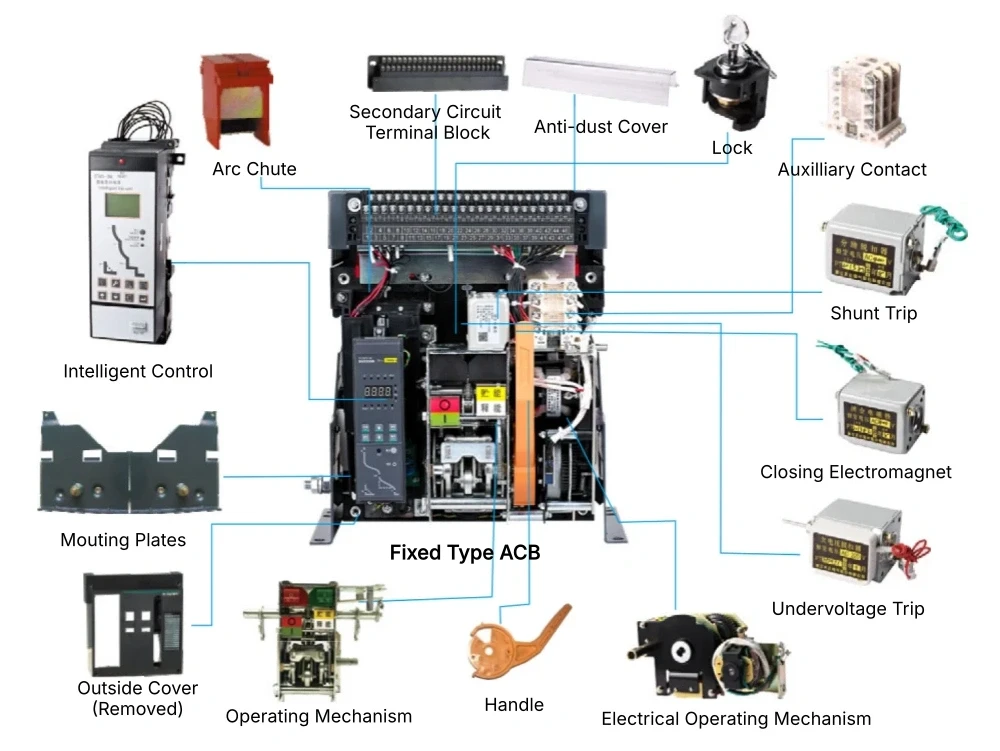
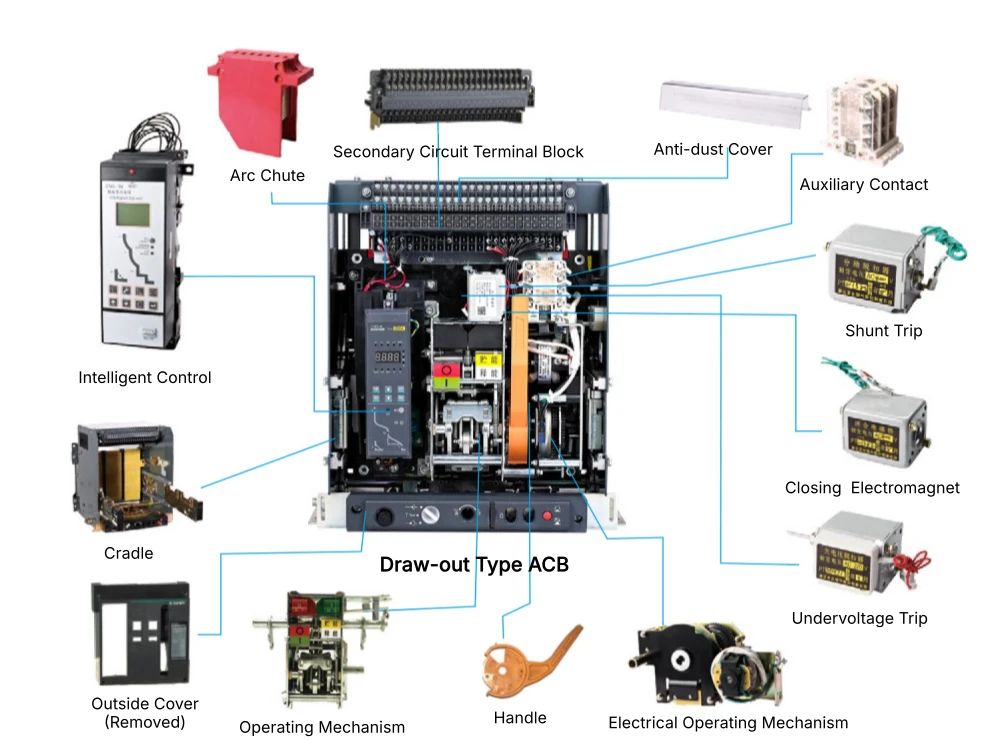
An Air Circuit Breaker consists of multiple mechanical and electrical components designed for safe and reliable power protection. The diagrams below show the internal structure of fixed type and draw-out type ACBs, with key components clearly labeled for easy understanding.

Component Function
Intelligent Control Unit Monitors current and system status in real time. It trips the breaker during overload, short circuit, or ground fault, and allows users to set protection parameters, view data, and connect to monitoring systems.
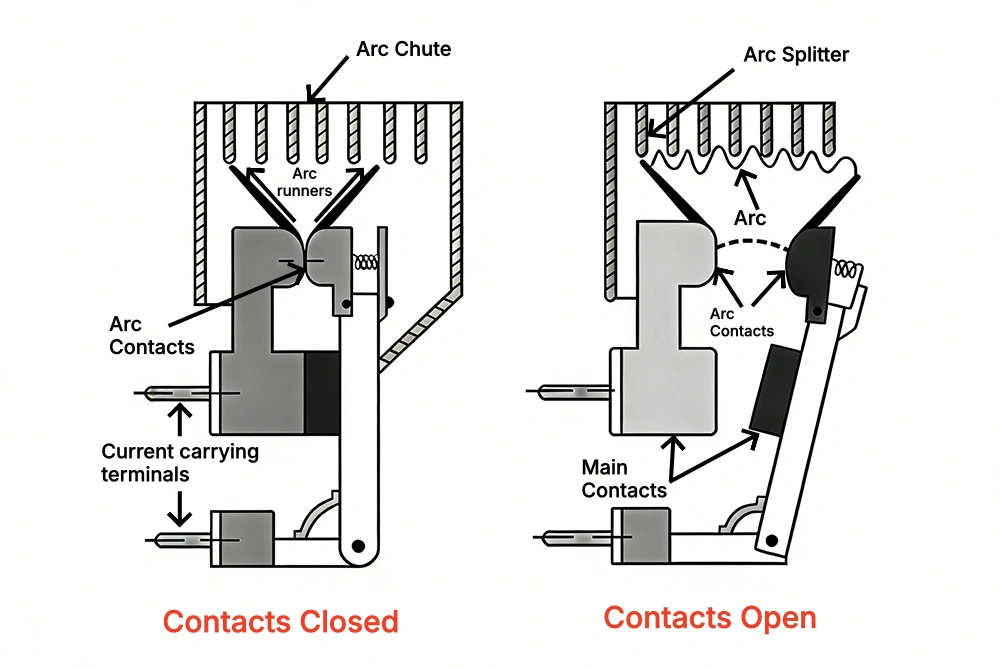
Arc Chute Extinguishes the electric arc when the breaker opens by cooling and splitting it into smaller arcs. This protects contacts and allows safe interruption of high fault currents.
Secondary Circuit Terminal Block Provides connection points for control, signal, and communication wiring. It simplifies installation, testing, and future maintenance.
Anti-dust Cover Protects internal mechanisms from dust and debris. It helps maintain reliable performance in industrial and harsh environments.
Lock Used to prevent incorrect or unauthorized operation of the breaker during maintenance or inspection. It supports mechanical locking or key interlock systems to improve operational safety, mainly for fixed type ACBs.
Auxiliary Contact Sends ON, OFF, and TRIP status signals to external control systems. It is used for indication, alarm, and system interlocking.
Shunt Trip Trips the breaker remotely when an external signal is applied. It is often used for emergency shutdown or safety interlock systems.
Closing Electromagnet Receives a control signal to close the breaker remotely. It is commonly used in automatic transfer and remote control applications.
Undervoltage Trip Automatically trips the breaker when the control voltage drops below a set level. This prevents unsafe operation and protects connected equipment.
Electrical Operating Mechanism Enables remote opening and closing of the breaker through electrical signals. It is widely used in automated and unmanned power distribution systems.
Handle Used for manual operation, including charging the spring and opening or closing the breaker during installation, inspection, or maintenance.
Operating Mechanism Controls the mechanical opening and closing of the breaker. The spring-charged system ensures fast, stable, and reliable operation during normal and fault conditions.
Outside Cover Covers live parts and internal components to provide electrical insulation and user protection. It also improves the overall appearance of the breaker.
Mounting Plates Used to securely install fixed type ACBs inside switchgear or panels. They provide mechanical stability and proper alignment.
Cradle Used in draw-out type ACBs to allow the breaker to be inserted, withdrawn, tested, and isolated. It improves safety and simplifies maintenance.
  • A labeled structural diagram showing the internal and external components of a Sincede fixed type air circuit breaker. The breaker is shown in the open position, with key parts clearly visible, including arc chutes, operating mechanism, intelligent trip unit with display, and terminal blocks. Components are identified with lines and labels, such as arc chute, shunt trip, closing electromagnet, undervoltage trip, auxiliary contact, lock, anti-dust cover, secondary circuit terminal block, side mounting plates, operating handle, electrical operating mechanism, and the outside cover (removed).
  • A labeled internal structure diagram of a draw-out type Sincede air circuit breaker (ACB). The draw-out breaker unit is shown in the open position, with key components clearly visible, including arc chutes, intelligent control unit, operating mechanism, handle, and internal assemblies. Lines indicate labeled parts such as arc chute, secondary circuit terminal block, anti-dust cover, auxiliary contact, shunt trip, closing electromagnet, undervoltage trip, cradle, intelligent control unit, electrical operating mechanism, and the outside cover (removed).

How Air Circuit Breaker Works?

ACB uses atmospheric air to quench electrical arcs. Explore the precision mechanism that ensures safety in low voltage power distribution.

  1. Step 1: Detection and Monitoring

    The Electronic Trip Unit acts as the brain, watching for overloads, short circuits, and Ground Faults. It can also include an Undervoltage Release that trips the breaker if the voltage drops too low, protecting your motors from damage.

  2. Step2: Rapid Tripping

    When a fault occurs—or a remote Shunt Trip signal is received for an emergency stop—the breaker releases its stored spring energy. This snaps the contacts open in milliseconds. A Motorized Mechanism can be used to reset and close the breaker from a remote control room.

  3. Step 3: Arc Transfer and Extinction

    As the contacts separate, a hot electrical arc forms. The ACB uses magnetic force to pull this arc away from the main contacts and into the Arc Chute. There, metal splitter plates chop the arc into small pieces, cooling and extinguishing it in milliseconds to keep the system safe.

Technical diagram showing the arc extinction system in an air circuit breaker. Left side: Contacts Closed – main contacts touching, arc contacts engaged, arc runners directing arc into arc chute with parallel metal plates. Right side: Contacts Open – main contacts separated, arc drawn between arc contacts, arc stretched and split by arc splitter plates inside the arc chute. Includes labeled parts like arc chute, arc runners, arc splitter, arc contacts, main contacts, current-carrying terminals, and operating mechanism with spring.

Pros and Cons of ACB

Like any main breaker, ACBs have both strengths and limits. The list below helps you see the difference.

Limitations

  • Large Installation Space

    ACBs are larger than MCCBs and need more space in the switchboard, best used in main panels where space is not an issue.

  • Higher Purchase Cost

    ACBs cost more because they are built for high current and heavy-duty use. They are usually chosen for important circuits where safety matters.

  • Regular Maintenance Needed

    To keep protection accurate, ACBs should be checked and tested from time to time, especially in harsh working conditions.

  • Heavy and Hard to Handle

    High-current ACBs are heavy and need proper tools and strong cabinets during installation and replacement.

  • Sensitive to Environment

    In dusty or corrosive areas, ACBs may need extra enclosure protection to work reliably for a long time.

  • Low Voltage Only

    ACBs are made for low-voltage systems and cannot be used in medium or high-voltage power networks.

Advantages

  • Built for High Current

    ACBs handle large currents from 630A up to 6300A and are mainly used as main breakers in power distribution systems.

  • Safe Arc Control

    When a fault happens, ACBs safely break the circuit by cooling and stopping the electric arc inside the breaker.

  • Smart Protection Options

    ACBs can use electronic trip units that offer accurate protection, system monitoring, and communication with control systems.

  • Easy to Maintain

    Draw-out ACBs can be removed for testing or service without shutting down the whole system, saving time and effort.

  • Strong Fault Protection

    ACBs can safely interrupt very high fault currents, which makes them suitable for industrial and infrastructure projects.

  • Long Service Life

    Strong materials and reliable design allow ACBs to work for many years with stable performance.

ACB Control Wiring Overview

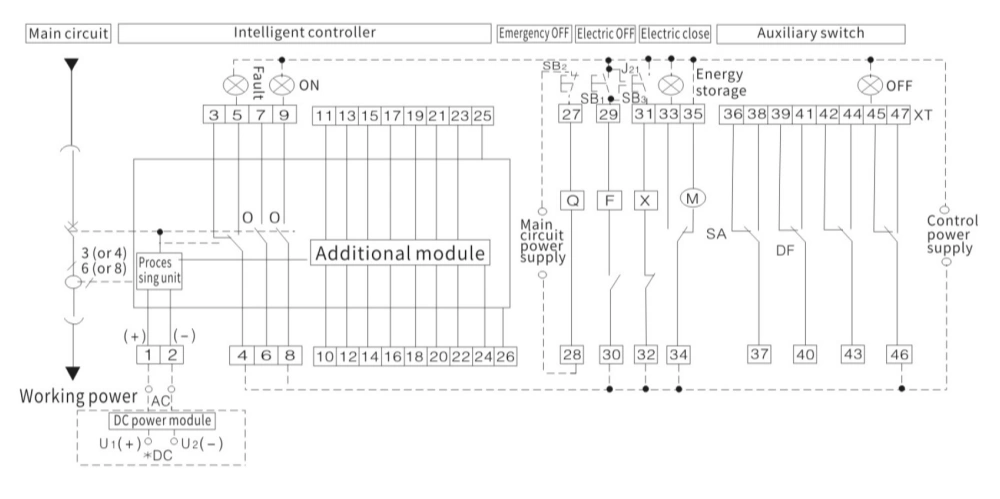
Get a clear understanding of ACB control wiring with our visual guides. This section helps engineers and technicians quickly navigate installation and operation considerations for W1 Series air circuit breakers.

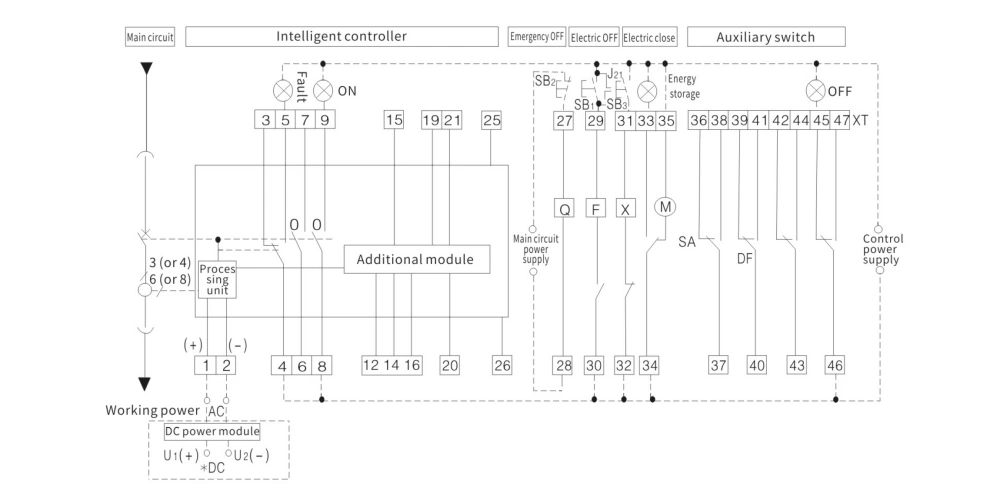
Secondary Circuit Wiring Diagrams

  • Complete secondary wiring schematic for W1 series air circuit breaker (ACB) equipped with M or L type basic intelligent controller. The diagram shows connections from the main circuit to the intelligent controller, including terminals for fault indication, ON/OFF status, emergency OFF, electric open/close operations, auxiliary switches, signal lights (Fault, ON, OFF, Energy Stored), push buttons (SB1, SB2, SB3), disconnect switch (SA), door frame switch (DF), additional modules, processing unit, DC/AC power supply module, and terminal block XT with numbered terminals (e.g., 1–47). Includes working power input (AC/DC), control power supply lines, and dashed connections for process signals and auxiliary functions. Designed for basic protection, control, and indication in M/L-type controllers.
     W1 Series ACB (M/L-Type Controller)
  • Complete secondary circuit wiring schematic for W1 series air circuit breaker equipped with H-type intelligent controller, including RS485 communication terminals. The diagram shows connections from the main circuit to the intelligent controller with terminals for status signals (e.g., 3, 5, 7, 9, 11, 13, 15, 17, 19, 21, 23, 25), fault and ON indicators, emergency OFF, electric OFF, electric close push buttons (SB1, SB2, SB3), energy storage and OFF signal lights, auxiliary switches, disconnect switch (SA), door frame switch (DF), additional modules, processing unit, DC/AC working power module (positive and negative terminals), main circuit power supply, control power supply, and terminal block XT with numbered terminals up to 47. RS485 communication lines are highlighted for remote monitoring and control. Dashed lines represent interconnections for process signals, auxiliary functions, and communication interfaces in the H-type controller system.
    W1 Series ACB (H-Type Intelligent Controller with RS485 Communication)

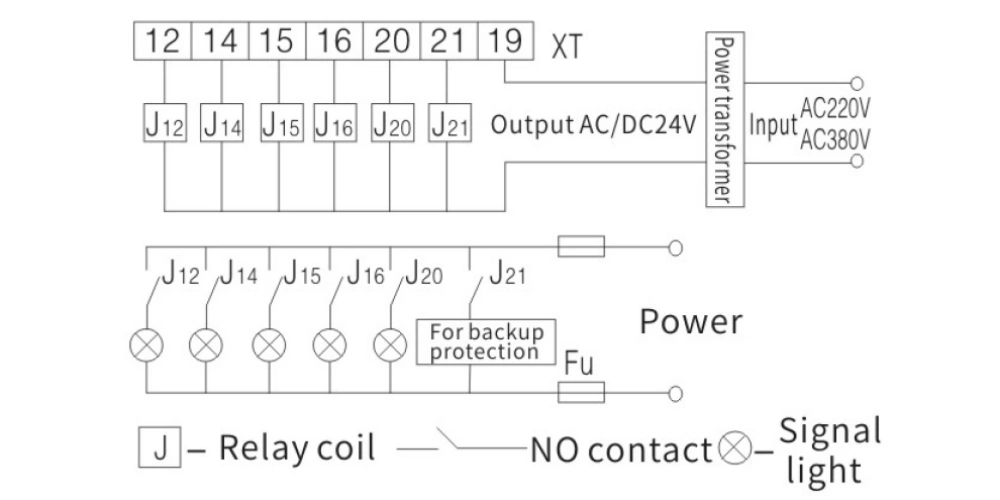
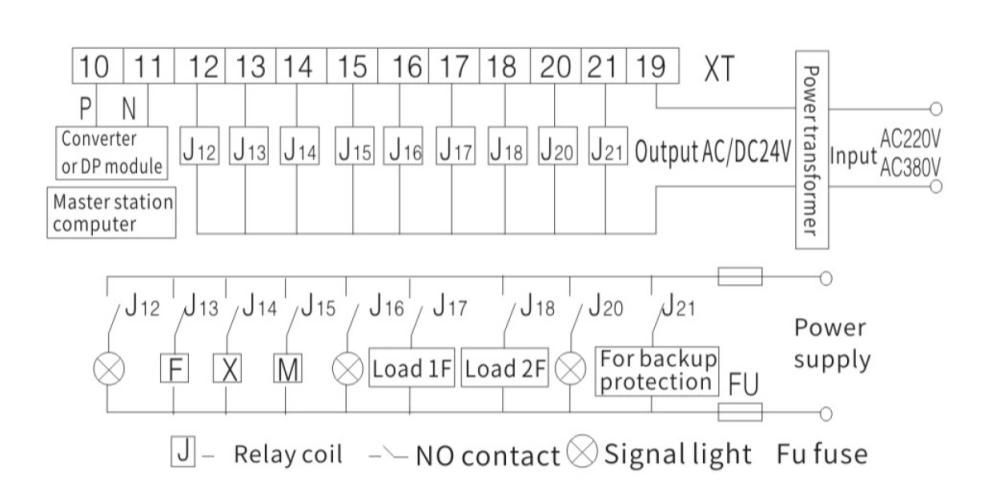
Relay Wiring Diagrams

  • Schematic diagram of relay wiring for M/L-type air circuit breaker (ACB) controller, focused on basic protection and alarm functions. Top section shows selected terminals (12, 14, 15, 16, 20, 21, 19) on terminal block XT connected to relay coils J12, J14, J15, J16, J20, and J21, powered by a transformer with input AC380V and output AC/DC24V. Bottom section illustrates the relay coils controlling normally open (NO) contacts in series with signal lights for indications such as overload alarm and fault trip, plus a backup protection indicator, all protected by fuse FU on the power supply line. Includes legend: J for relay coil, dashed line for NO contact, circle with X for signal light, and FU for fuse. Designed for essential functions like overload alarm and fault trip signaling in M/L controllers.
    M/L-Type ACB Controller
  • Schematic diagram of advanced relay wiring for H-type air circuit breaker (ACB) controller. Top section shows terminal block XT with terminals 10 to 21 connected to power transformer (input AC380V, output AC/DC24V), converter or DP module, and master station computer (P and N lines). Bottom section displays relay coils J12 to J21 controlling normally open contacts for signal lights (F, X, M), Load 1F, Load 2F, backup protection indicator, and fuse (FU) in series on AC380V power supply. Includes legend: J for relay coil, dashed line for NO contact, circle with X for signal light, FU for fuse. Designed for remote control, status indication, and unloading signal outputs in H-type ACB system.
    H-Type ACB Controller

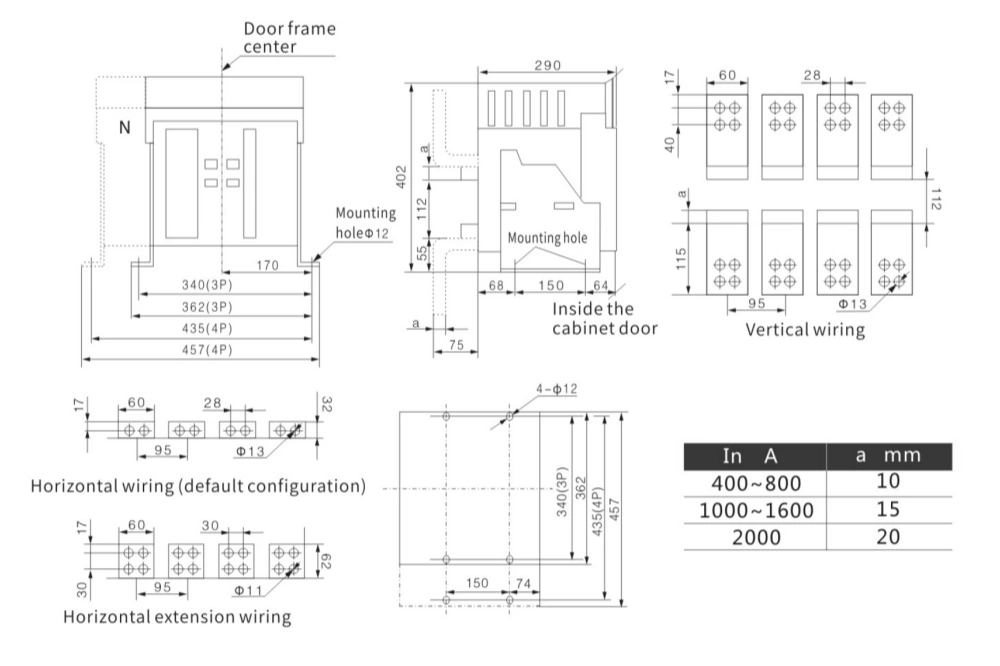
Outline & Installation Dimensions

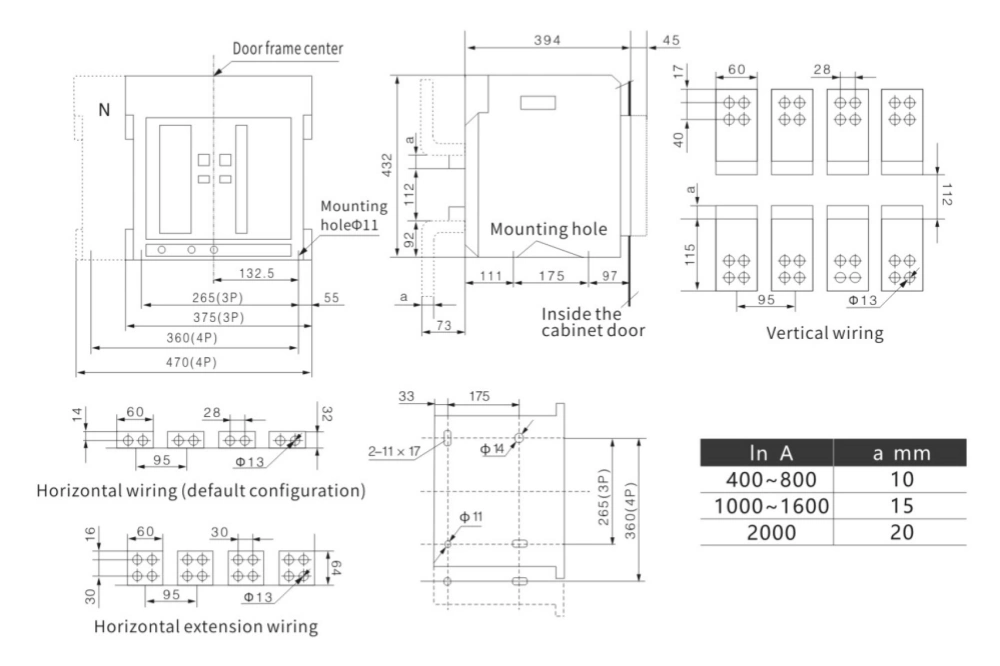
  • Technical engineering drawing showing the outline, mounting, and wiring dimensions for a fixed type air circuit breaker model W1-2000 (2000A, 4-pole). Includes front view with door frame center line and overall panel dimensions (e.g., 290 mm width, 402 mm height), side view of the breaker mounted inside the cabinet door, mounting hole locations (Φ12 and others), vertical wiring terminal layout for 3-pole and 4-pole, default horizontal wiring configuration, horizontal extension wiring option, and a table listing current ratings (In A) from 400 to 2000A with corresponding dimension 'a' values (10 mm for 400–800A, 15 mm for 1000–1600A, 20 mm for 2000A). All measurements in millimeters, with labels for mounting holes, inside cabinet door, and pole configurations (3P and 4P).
    Fixed type ACB (W1-2000, 2000, 4P)
  • Technical engineering drawing showing the outline, mounting, and wiring dimensions for a draw-out type air circuit breaker model W1-2000 (2000A, 4-pole). Includes front view with door frame center line and overall panel dimensions, side view of the breaker inside the cabinet door, mounting hole locations (Φ11 and Φ13), vertical wiring terminal layout, default horizontal wiring configuration, horizontal extension wiring option, and a table listing current ratings (In A) from 400 to 2000A with corresponding dimension 'a' values (10 mm for 400–800A, 15 mm for 1000–1600A, 20 mm for 2000A). All measurements are in millimeters, with labels for mounting holes, inside cabinet door, and different pole configurations (3P and 4P).
    Draw-out type ACB (W1-2000, 2000, 4P)

ACB Price: What Affects the Cost?

The price of an Air Circuit Breaker is not fixed. Understanding the key cost drivers below will help you evaluate quotations more accurately and avoid hidden project risks.

Applications of ACB

Air Circuit Breakers (ACBs) play a critical role in modern low-voltage power systems. From factories to infrastructure projects, they provide essential protection and reliability.

  • Industrial Power Distribution

    ACB protects main switchboards and critical feeders in factories, safeguarding machines, motors, and production lines. It handles high loads and frequent start/stop cycles, ensuring continuous and safe operations.

    Wide interior view of a large, bright factory floor with automated production lines. Rows of complex conveyor systems, robotic arms, orange and white machinery, conveyor belts carrying gray plastic crates filled with test tubes or vials, overhead monitors displaying data, workers in blue uniforms visible in the background, and bright ceiling lights illuminating the high-tech assembly environment.
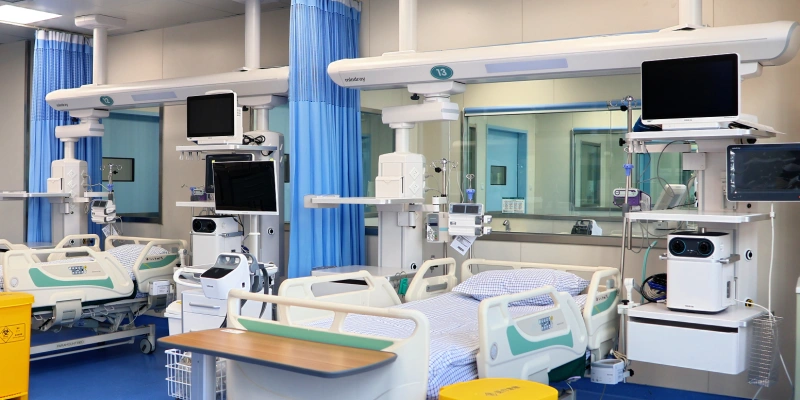
  • Commercial and Public Buildings

    ACB is used in malls, hospitals, hotels, offices, and convention centers to protect main circuits. It minimizes downtime from faults and keeps the building’s power system safe and stable.

    A clean, modern hospital ward showing multiple patient beds with blue privacy curtains, ceiling-mounted articulated arms holding monitors and medical devices, flat-screen displays, IV poles, ventilators, and other equipment. The beds have green and white bedding, and the floor is blue with yellow medical waste bins visible.
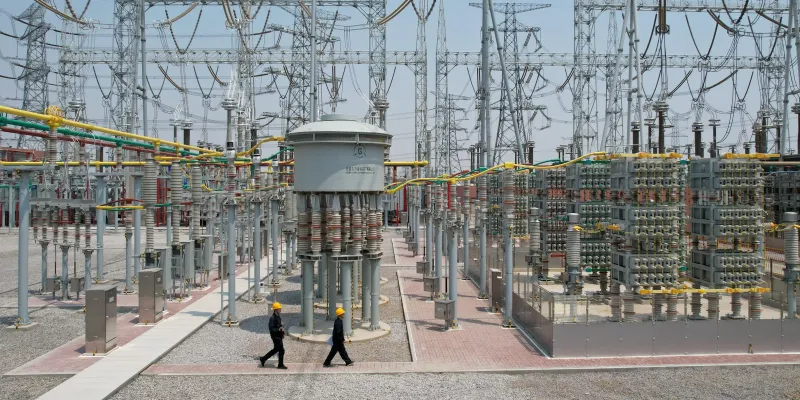
  • Power Plants and Substations

    In power plants and substations, ACB safeguards transformers, main feeders, and auxiliary circuits. Its high breaking capacity ensures the low-voltage system remains safe and reliable under heavy loads.

    Wide view of a large outdoor electrical substation on a sunny day, featuring tall metal lattice structures supporting thick overhead power lines, numerous gray transformers and insulators, colorful yellow and green insulated busbars and cables, large cylindrical equipment, and two workers in yellow hard hats and dark uniforms walking along a gravel path between the equipment.
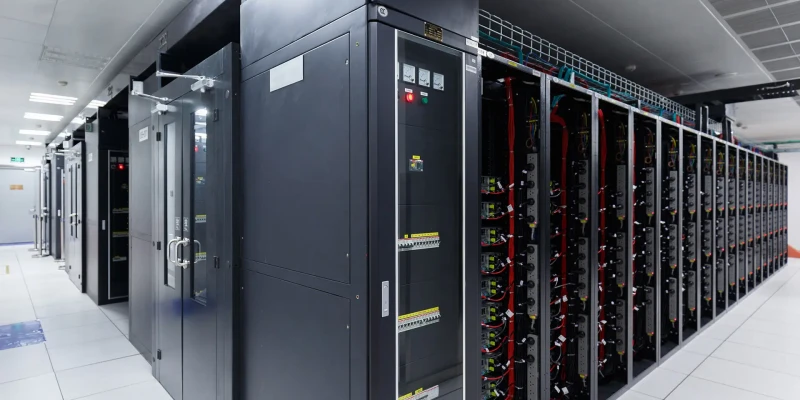
  • Data Centers and Critical Facilities

    ACB protects UPS systems, PDU feeders, and backup circuits in data centers and other critical facilities. Fast response and precise protection reduce the risk of downtime for essential equipment.

    Rows of tall black server racks in a data center, with front panels open showing cables, wiring, indicator lights, and networking equipment under bright ceiling lights.
  • Renewable Energy and Storage

    ACB is ideal for solar, wind, and energy storage projects. It manages fluctuating loads and ensures safe, stable operation, keeping renewable power systems reliable over time.

    A row of tall white wind turbines with three blades each standing on a grassy green hill under a bright blue sky with scattered white clouds. More turbines stretch into the distance along the rolling landscape, with rugged brown mountains visible in the background on a clear sunny day.
  • Generator and Backup Systems

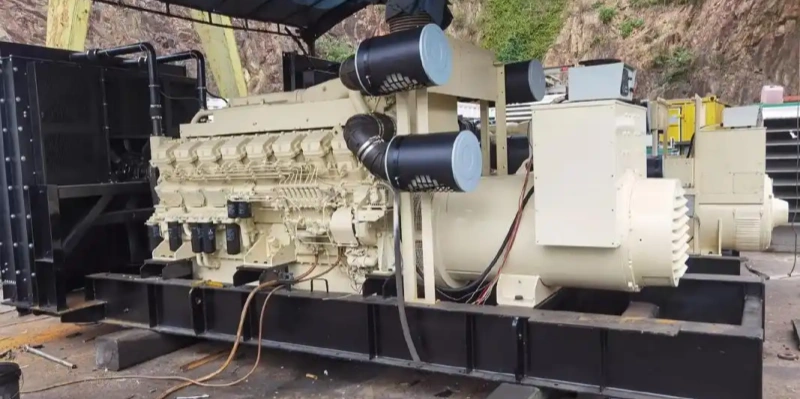
    ACB secures diesel generators and emergency power circuits. It allows safe switching between power sources and ensures backup systems operate reliably during outages.

    Large industrial diesel generator mounted on a black metal base frame in an outdoor workshop or construction site. The unit features a beige engine block with six visible cylinders, black air intake pipes with blue covers, an attached alternator at the end, various hoses and cables, exhaust components, control boxes, and surrounded by rocky cliff background under a shaded canopy.
  • Public Infrastructure and Transport

    ACB is installed in metros, railways, airports, tunnels, and ports. Its durable design and high reliability ensure continuous power in demanding public and transport environments.

    Drone aerial view of a massive container terminal on a clear day, filled with thousands of multicolored shipping containers stacked in organized rows, several large red gantry cranes actively working along the docks, a green cargo ship being loaded at the pier, industrial tanks and chimneys in the distance, and a city skyline visible under bright blue skies.
  • EPC Projects and Switchgear Systems

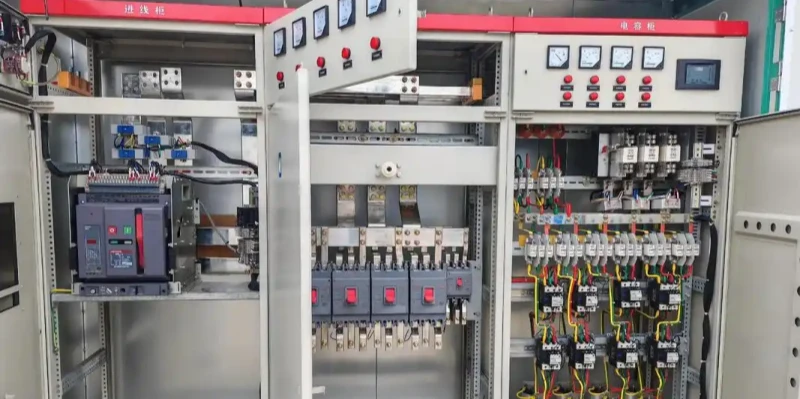
    In EPC projects and complete switchgear systems, ACB serves as main, busbar, or feeder protection. Flexible configurations and stable performance make it ideal for large-scale engineering and integration projects.

    Open industrial electrical switchgear panel with red top section labeled for incoming and outgoing lines, featuring analog voltmeters and ammeters, red push buttons, multiple circuit breakers with red handles, contactors, relays, neatly bundled colorful wires (yellow, green, blue, black), busbars, a digital display, and various labeled electrical components mounted inside a metal enclosure in a workshop.

How to Choose the Right ACB?

Lorem ipsum dolor sit amet, consectetur adipiscing elit. Integer nec odio. Praesent libero uctus non, massa. Sed cursus ante dapibus diam. Sed nisi. Nulla quis sem at nibh elementum imperdiet. Duis sagittis ipsum. Praesent mauris himenaeos.

  1. Step 1: Check the Rated Current

    Define the circuit's full-load current. Select the appropriate Frame Size (Inm) and Rated Current (In) to ensure the ACB handles steady-state loads without nuisance tripping.

  2. Step 2: Confirm the Breaking Capacity

    Verify that the ACB's ultimate short-circuit breaking capacity meets or exceeds the calculated maximum fault current at the installation point to protect your equipment during severe faults.

  3. Step 3: Choose the Right Number of Poles

    Select a 3-pole ACB for standard three-phase systems. Choose a 4-pole ACB when neutral protection, full isolation, or specific earthing system requirements must be met.

  4. Step 4: Select the Installation Type

    Fixed type ACBs are cost-effective for stable systems with minimal maintenance. Draw-out (Withdrawable) types allow for fast isolation and easy replacement, making them ideal for critical systems.

  5. Step 5: Select Trip Unit Functionality

    Modern ACBs use Electronic Trip Units (ETU). Choose a basic ETU for precise LSI protection, or an advanced version with an LCD screen for real-time power metering and fine-tuned settings.

  6. Step 6: Choose the Operation Method

    Manual operation is suitable for local control. Motorized or remote operation is highly recommended for automated systems, centralized control, or Automatic Transfer Switching (ATS).

  7. Step 7: Consider Communication Options

    For "Smart Grid" or Industry 4.0 applications, select ACBs with communication protocols (such as Modbus or Ethernet) to enable remote monitoring and energy management.

  8. Step 8: Check Standards and Environment

    Ensure the ACB meets international standards and is rated for your specific site conditions, such as high temperatures, humidity, high altitude, or corrosive environments.

Why Choose Our ACB?

We understand the challenges of B2B procurement. Here is how we make your job easier.

  • Manufacturer Direct

    No middlemen. You get the factory-direct price, ensuring higher profit margins for your distribution business.

  • Rigorous Testing

    Every ACB undergoes 100% mechanical and electrical endurance testing before leaving our warehouse.

  • Fast Shipment

    We keep stock of key components. Standard orders are typically ready to ship within 7-14 days.

  • Project Support

    Send us your project requirements. Our engineers will help you select the exact model to prevent overspending.

  • Global Compliance

    Certified confidence. Our ACBs strictly follow IEC 60947-2 and CE standards, ensuring smooth project acceptance worldwide.

  • Premium Materials

    Built to last. We use high-content silver alloy contacts and flame-retardant materials to ensure maximum electrical life.

  • Intelligent Control

    Future-ready. Built-in Modbus (RS485) interfaces allow seamless integration with BMS and remote monitoring systems.

  • Tailored Solutions

    We adapt to your market. From custom branding (OEM) to specific technical modifications, we offer flexible solutions with low MOQs.

Case Studies: ACB Solutions

Poland Factory Reduces Power Faults by 38% After Replacing Main ACBs

A medium-sized manufacturing plant upgraded its main air circuit breakers to improve protection reliability, reduce unplanned shutdowns, and support growing production loads.

  • Location Katowice, Poland

  • Industry Metal Processing & Fabrication

  • Company Type Medium Manufacturing Plant

  • Annual Output ~45,000 finished metal parts

The Challenge

The factory’s main switchboard had been in operation for over 10 years. As new CNC machines and welding lines were added, the old ACBs began to trip frequently and could no longer provide stable protection.

Identified Pain Points
  • ⚠️ Frequent Nuisance Trips: Load peaks during machine start-up caused unexpected shutdowns.
  • 🔧 Limited Breaking Capacity: Existing breakers were close to their short-circuit limit.
  • 🛠️ Slow Maintenance: Fixed ACBs required long shutdowns for inspection.
  • 📉 Production Loss: Each power fault stopped multiple production lines at once.

Our Solution

We supplied draw-out type ACBs with electronic trip units, rated at 3200A and designed for high short-circuit environments. The new breakers were installed into the existing switchboard with only minor adjustments, and protection settings were optimized for motor-heavy loads to reduce nuisance trips while maintaining safety.

Power Faults -38%Unplanned Shutdowns -45%Maintenance Time -50%Production Stability +30%
Metric (Yearly) Before After
Unplanned Shutdowns 11 events 6 events
Maintenance Hours 420 hrs 210 hrs
Power Fault Incidents 26 cases 16 cases
Lost Production Time 14 days 9 days
"After upgrading the main ACBs, our power system became much more stable. We no longer worry about sudden trips during peak production. Maintenance is easier, and downtime has been reduced significantly."

Piotr Kowalski, Plant Maintenance Manager

Spain Commercial Complex Improves Power Safety and Cuts Maintenance Time by 45% with ACB Upgrade

Facing rising prices of international circuit breakers, this medium-sized company successfully replaced MCCBs, achieving lower costs, faster delivery, and stable, reliable production.

  • Location Madrid, Spain

  • Building Type Commercial & Office Complex

  • Total Floor Area 68,000 m²

  • Installed Capacity:2.4 MW

The Challenge

The building’s original main breakers were fixed-type units installed during initial construction. Over time, routine inspections and upgrades became difficult, often requiring partial shutdowns that affected tenants and business operations.

Identified Pain Points
  • ⚠️ Maintenance Required Shutdowns: Every inspection required scheduled power cuts.
  • 🧯 Limited Operational Safety: Live maintenance carried higher risks for service teams.
  • 🕒 Long Service Windows: Each maintenance cycle took 6–8 hours to complete.
  • 📋 No Clear Status Indication: Facility staff lacked real-time breaker status visibility.

Our Solution

We supplied draw-out type ACBs with mechanical interlocks, allowing safe isolation during maintenance without shutting down the entire system. The new breakers were installed in existing switchboards, and indicator modules were added to give clear ON/OFF and trip status to facility staff.

Maintenance Time -45%Planned Shutdowns -60%Service Safety Incidents: 0Tenant Complaints -70%
Metric (Yearly) Before After
Maintenance Hours 260 hrs 145 hrs
Planned Power Shutdowns 10 events 4 events
Emergency Service Calls 18 calls 11 calls
Tenant Power Complaints 23 cases 7 cases
“The draw-out ACBs made maintenance much easier and safer. We can now isolate breakers without affecting tenants, which is critical for a commercial building like ours.”

Luis Moreno, Facility Manager

Italian Food Processing Plant Cuts Unplanned Shutdowns by 48% with ACB Upgrade

The client is a medium-sized food processing plant supplying packaged frozen products to major supermarket chains. The facility runs multiple production lines with large mixers, conveyors, and refrigeration systems operating simultaneously, placing heavy and uneven loads on the main distribution system.

  • LocationVicenza, Italy

  • Industry Food Processing

  • Company Type Industrial Manufacturer

  • Annual Production ~32,000 tons of finished products

The Challenge

The plant suffered from unexpected shutdowns caused by unstable main breaker operation during peak production hours. Load fluctuations between refrigeration and processing lines caused frequent protection conflicts, forcing operators to reset breakers manually and restart lines.

Identified Pain Points
  • ⚠️ Nuisance Trips: Sudden load changes between production and refrigeration lines caused frequent unwanted breaker trips.
  • ⏱️ Restart Delays: Each trip required manual reset and full line restart, wasting valuable production time.
  • 🔀 Poor Selectivity: Faults on one feeder often affected multiple circuits due to insufficient coordination.
  • 📉 Production Losses: Unexpected shutdowns during peak seasons directly impacted order fulfillment and delivery schedules.

Our Solution

We supplied draw-out ACBs with electronic trip units for precise long-, short-, and instantaneous protection. Coordination between the main incomer and feeders was optimized so only the affected circuit trips, and the draw-out design enabled maintenance without stopping the whole production line.

Unplanned Shutdowns - 48%Production Restart Time - 35%Maintenance intervention - 30%Production Loss - 48%
Metric (Yearly) Before After
Unplanned Shutdowns 25 times 13 times
Production Loss 420 tons 220 tons
Maintenance Interventions 62 times 43 times
Line Restart Time 45 min 29 min
"Since switching to the new ACBs, our production lines run much more smoothly. We can handle peak loads without worrying about sudden shutdowns."

Luca Romano, Production Manager

FAQs About ACBs

ACB Related Resources

Secure Your Power Needs Now!

No more delays. We’re here to power your project with reliable circuit breakers and fast service.

Photo gallery from our international guests' visit to Sincede Electric Factory: warm welcome with traditional Chinese tea in the office, friendly group photos with the team, guided tour through the production workshop, close-up inspections of electric components and samples, machinery in operation, casual team lunches, and final portraits in front of display cabinets and the modern factory floor.

Get our latest catalog & price list

Your privacy is totally safe, no disturbing, promotion and subscription at all!

Contact Us