
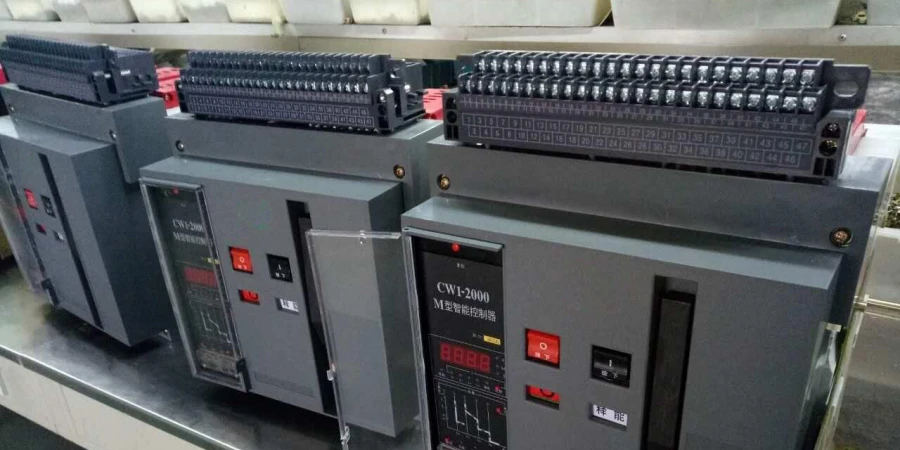
I still remember the first time a European distributor walked into our factory and asked, “Can your ACBs really match Schneider’s performance?” It was 2019, and I had been with the company for three years. The question wasn’t hostile—just curious, with a hint of doubt.
Five years later, that same distributor now orders container loads from us every quarter. This change didn’t happen by accident—it shows how the industry’s view of circuit breaker sourcing is shifting and reflects the progress Chinese manufacturing has made.
Today, whether Chinese air circuit breakers can replace international brands isn’t just about numbers on a datasheet. It’s about understanding what has changed in manufacturing, where gaps still exist, and how to make smart decisions based on real project needs instead of brand loyalty or outdated assumptions.
The Evolution of Chinese ACB Manufacturing
When I joined this company in 2016, we were still fighting an uphill battle against the reputation Chinese manufacturers had built in the 1990s and early 2000s. Back then, the perception was often accurate: inconsistent quality, minimal testing, and products designed mainly to hit the lowest possible price point.
What’s has changed since then isn’t just one thing—it’s been a complete shift in how Chinese manufacturers approach the ACB market. And I’ve watched it happen from the inside.
From Price-Focused to Quality-Certified
The shift started around 2012-2014, driven by two forces.
First, large domestic infrastructure projects in China started demanding higher quality and proper certifications. After several high-profile electrical failures, the government tightened regulations on substandard equipment. Suddenly, even local buyers wanted official test reports and ISO certificates.
Second, export markets matured. Early exports went mostly to developing countries with limited technical requirements, but as manufacturers gained experience, they began targeting Middle Eastern and European projects where IEC compliance wasn’t optional—it was mandatory.
In our factory, this meant serious investment in testing equipment. We installed a short-circuit testing station capable of validating breaking capacity up to 100 kA—equipment that cost much but was essential for proper type testing.
The production line changed too. We moved from manual assembly with spot-checking to automated assembly with 100% routine testing. Every single ACB that leaves our factory now goes through a series of tests: dielectric withstand, contact resistance, trip characteristic verification, and mechanical endurance. This isn’t marketing talk—I’ve walked auditors from European panel builders through the testing bay dozens of times, and they can watch any unit from their order being tested in real-time.
The Role of International Standards
Compliance with IEC standards became the line separating serious manufacturers from short-term operators. IEC 60947-2 defines exactly what an ACB must do: how much current it must carry continuously, how it must perform during short-circuit conditions, how many mechanical operations it must survive, and what temperature rise is acceptable.
I’ve sat in product development meetings where engineers debated design changes purely to meet IEC test requirements—even when those changes increased production cost.
Today, many established Chinese manufacturers operate multiple production facilities and export to 50-60 countries or more. Many work under OEM aggrements with European or Middle Eastern distributors who rebrand the products. This isn’t always public knowledge, but it’s common industry practice—some brands you might consider "European" are actually designed in Europe but manufactured in Chinese facilities under strict quality agreements.
Investment in Quality Systems
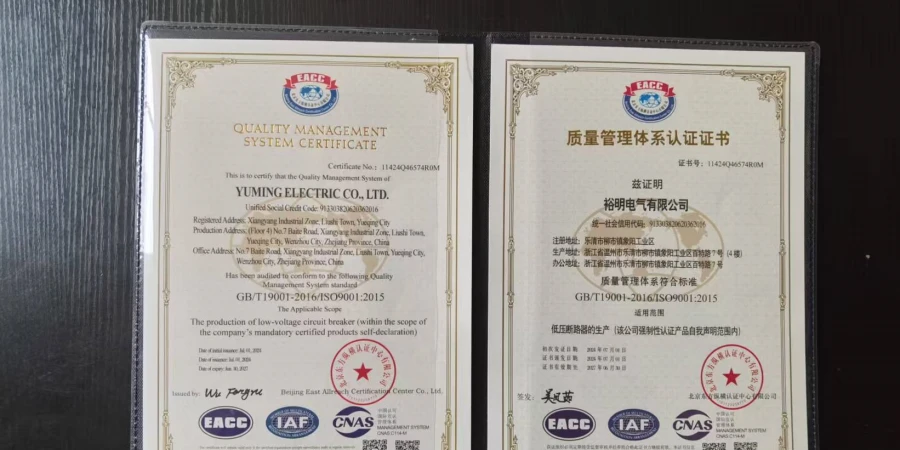
ISO 9001 certification used to be something Chinese companies got just to check a box on tender requirements. Now, at least among the serious manufacturers, it’s actually implemented. Our quality management system includes everything from incoming material inspection (we reject substandard materials even from long-term suppliers) to process controls and final verification.
We also track field failure data systematically. When a breaker fails in service, we want to know why—was it a design weakness, a manufacturing defect, an installation error, or misapplication? This feedback loop has driven continuous improvement in our products.
The gap between top-tier Chinese manufacturers and global brands hasn’t disappeared, but it’s narrowed a lot. Where we still lag is usually in areas like extreme-environment certifications (offshore marine, nuclear, etc.) and in the breadth of available accessories and variations. But for standard commercial and industrial applications using IEC-based coordination, the technical performance difference has become minimal when you compare apples to apples.
Performance and Feature Comparison
One of the questions I get most often from buyers is: "How does your ACB actually compare to Schneider’s Masterpact or ABB’s Emax?" It’s a fair question, but the answer isn’t simple—because "performance" covers a lot of ground, and what matters most depends on your specific application.
I’m going to break this down honestly, including where Chinese ACBs hold their own and where global brands still have advantages. Because pretending there’s no difference does nobody any favors, and ignoring the improvements Chinese manufacturers have made is equally misleading.
Core Protection Functions
At the basic level—overcurrent protection, short-circuit breaking, adjustable trip settings—the gap has essentially closed for standard applications. Our ACBs offer the same LSIG protection curves as major international brands. You can set long-time pickup current, time delay multipliers, short-time pickup, instantaneous threshold, and ground fault sensitivity. The electronic trip units use microprocessor control with digital displays showing actual current values and trip cause indication.
In blind testing—where the breaker model is concealed and only performance is evaluated—properly certified Chinese ACBs perform equivalently to international brands for standard coordination and protection requirements. I’ve seen this firsthand when electrical consultants conduct comparative testing for major projects. The breakers interrupt fault currents cleanly, the trip curves match published data, and coordination with downstream devices works as calculated.
The differences appear mostly in advanced features and ecosystem integration. Take communications, for example. We offer Modbus RTU/TCP as standard, which is sufficient for most building management systems. But Schneider’s EcoStruxure platform or ABB’s Ability suite provides deeper integration — predictive analytics, cloud connectivity, smartphone apps for remote monitoring, and correlation with power quality data from other devices.
Our product development team is working on these capabilities, but we’re realistically three to five years behind the leaders in this area. If your project is a standard commercial building where you just need current monitoring and trip indication via Modbus, Chinese ACBs work fine. If you’re designing a smart factory with integrated energy management and predictive maintenance across all electrical and mechanical systems, the global brands offer more mature solutions.
Product Range and Accessories
Here’s another area where international brands have an edge: sheer breadth of options. Schneider, ABB, Siemens—these companies offer dozens of accessory modules, mounting variations, special ratings for specific applications, and certified combinations with other equipment.
We manufacture a solid range of frame sizes from 630A to 6,300A, with multiple breaking capacities for each size. We stock common accessories like shunt trips, undervoltage releases, auxiliary contact blocks, and motor operators. But if you need something unusual—say, a specific mechanical interlock configuration, or a breaker rated for high-altitude operation, or certification for railway applications—you’re more likely to find an off-the-shelf solution from a global brand.
This mostly matters for complex projects with unusual requirements. For routine applications, Chinese products cover standard frame sizes and accessories. For specialized variants, always check availability before assuming any supplier can deliver.
| Feature Area | Chinese ACBs (Tier-1 manufacturers) | Global Brands (Schneider, ABB, Siemens) |
|---|---|---|
| Basic protection (LSIG) | Equivalent performance | Equivalent performance |
| Breaking capacity ratings | Up to 100-120 kA | Up to 150 kA (select models) |
| Communication protocols | Modbus RTU/TCP, Profibus | Modbus, Profibus, IEC 61850, proprietary platforms |
| Predictive maintenance | Limited; basic alarm functions | Advanced analytics, cloud integration, AI-driven insights |
| Accessory ecosystem | Standard options well-covered | Extensive range including specialized variants |
| Global service network | Regional coverage, growing | Worldwide presence, local support in most countries |
Reliability and Field Performance
Reliability is harder to quantify objectively because reliable field data is scarce and companies rarely publish failure statistics. What I can share comes from our internal data and feedback from distributors handling both Chinese and international brands.
Our warranty return rate is roughly 0.3–0.5% annually. That means out of every thousand ACBs we ship, three to five return within the first year. Some are genuine defects; others are due to installation errors or misapplication. Global brands claim similar rates, and panel builders who use multiple brands confirm that properly selected and installed ACBs from reputable Chinese manufacturers perform comparably to international brands in long-term reliability.
The key phrase there is "properly selected and installed." ACBs fail for reasons beyond manufacturing defects: incorrect coordination, environmental conditions exceeding ratings, loose connections causing overheating, mechanical damage during installation or operation. A Chinese ACB isn’t more fragile than a European one if both are rated for the same conditions, but if you cut corners on selection or installation, you’ll have problems regardless of brand.
One area where I’ll admit Chinese manufacturers still have room for improvement is consistency between production batches. Global brands with mature manufacturing processes have incredibly tight tolerances and minimal unit-to-unit variation. We’re good, but not quite at that level yet—you might see slightly more variation in mechanical operation feel or contact resistance measurements between supposedly identical units. It’s within specification, but it’s there.
Safety, Reliability, and Quality Verification
I was often asked: "Are Chinese ACBs safe?" Other times it’s implied through questions about testing, certificates, or field experience. I understand the concern—electrical equipment failures can cause fires, injuries, or major operational disruptions. Nobody wants to be the engineer who specified a breaker that failed catastrophically.
The truth is, "Chinese ACBs" is too broad a category to give a yes-or-no answer about safety. The Chinese market includes everything from world-class manufacturers with testing capabilities that rival any global brand, to basement operations assembling breakers from questionable components with zero testing. Lumping them all together makes no more sense than saying "European cars" are all reliable or all unreliable.
What Actually Makes an ACB Safe?
Safety in circuit breakers comes down to three things: correct design, proper manufacturing, and appropriate application.
A well-designed ACB safely interrupts fault currents up to its rated capacity, contains the arc energy without external flaming or explosion, and maintain insulation integrity under continuous service conditions.
Design validation happens through type testing—the comprehensive test program I mentioned earlier. When we submit an ACB design for type testing, it goes through destructive testing at maximum rated conditions. Testers try to make it fail under controlled conditions to verify safety margins. The breaker must interrupt fault currents at maximum rated capacity multiple times, survive temperature rise tests, and pass dielectric withstand testing at voltages well above normal operating levels.
Manufacturing quality ensure production units match the type-tested design. This is where factory quality systems are critical. In our facility, we maintain what’s called "configuration control"—any change to materials, dimensions, or assembly procedures requires engineering review and sometimes re-testing to verify it doesn’t affect performance.
Application is where many problems occur, regardless of manufacturer. I’ve seen expensive European breakers fail because someone applied them at fault current levels exceeding their rating, or installed them in ambient temperatures above their specified range, or failed to provide adequate short-circuit protection upstream. The breaker itself was perfectly safe—it just wasn’t safe for that particular application.
Testing Procedures and Factory Quality Control
Walk through our testing bay on any production day, and you’ll see racks of ACBs connected to automated test equipment. Every unit goes through a set routine before shipping: contact resistance verification (to ensure good electrical connections), dielectric withstand (to verify insulation), trip characteristic testing (to confirm protection settings work correctly), and mechanical endurance sampling (a percentage of units run through thousands of operations).
The testing isn’t optional or random—it’s integrated into the production control system. A breaker can’t be marked as ready-to-ship until all tests are recorded as passing. For large orders where buyers want extra assurance, we provide test reports for individual serial numbers showing the actual measured values.
Our short-circuit testing station is crucial for type testing new designs and validating production samples, but it’s also expensive to operate. We conduct these tests on pre-production samples and periodically on production units to verify consistency, but we can’t test every single breaker to destruction because there wouldn’t be any left to ship.
This is where choosing a manufacturer with proper facilities matters. Some Chinese companies claim high breaking capacities but lack equipment to validate them. They may test at reduced current and extrapolate, or worse, simply copy ratings from competitors without any testing. When you’re qualifying a supplier, ask where type testing was conducted and request copies of reports from recognized labs.
Distinguishing Between Quality Tiers
The Chinese ACB market has clearly segmented over the past decade:
-
Top-tier: Manufacturers like us with significant R&D, modern facilities, international certifications, and export experience. We sell to panel builders in Europe, contractors in the Middle East, and project developers across Asia and Africa.
-
Middle-tier: Regional manufacturers serving primarily domestic or nearby Asian markets. Products often meet basic IEC standards and carry certifications but may lack field experience in demanding applications or international support infrastructure.
-
Low-tier: Price-focused producers for minimal technical markets. Products might look similar externally but use cheaper components and processes. Suitable for non-critical applications but not recommended for important industrial or commercial projects.
How do you tell the difference? Here are several indicators help:
-
Export track record: Ask how many countries they exports to and request reference projects. A company shipping containers to 50+ countries monthly has been vetted by many buyers and contractors.
-
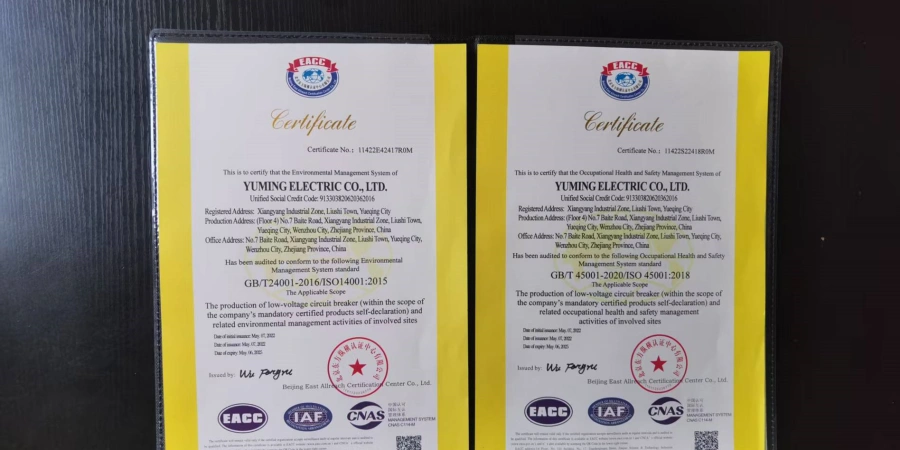
Factory certifications: ISO 9001 is the baseline; serious manufacturers also hold ISO 14001(environment) and ISO 45001 (occupational health and safety). Make sure the certificates are current—expired certificates are worse than no certificates because they suggest quality systems broke down.
ISO 14001 and ISO 45001 -
Technical support: Can they provide coordination studies, short-circuit calculations, and application engineering support? Top-tier manufacturers invest in this; low-tier do not.
-
Transparency about testing: Reputable companies provide type-test reports from accredited labs and welcome factory audits. If a supplier is evasive about testing documentation or won’t allow factory visits, that’s a serious warning sign.
The Real Question: Trusting the Specific Manufacturer
Here’s my view: you shouldn’t trust or distrust Chinese ACBs as a category. You should evaluate specific manufacturers based on evidence—certifications, test reports, factory capabilities, reference projects, and business track record.
Some Chinese manufacturers produce ACBs I’d confidently recommend for any standard commercial or industrial project. Others produce equipment I wouldn’t install in my own office building. The same is true of manufacturers anywhere; there are unreliable producers in Europe and North America too, though they tend to get weeded out faster in more mature markets.
The key is doing your homework. Visit the factory if possible or hire someone to do it for you. Review actual test reports, not just certificates. Talk to other buyers who’ve used the products in similar applications. Check whether the manufacturer has local support in your region for warranty service and spare parts.
And remember that even the most reliable ACB can fail if misapplied, improperly installed, or operated beyond its ratings. Good engineering practice—proper coordination studies, correct sizing, environmental protection, and regular maintenance—matters at least as much as the brand name on the breaker.
Conclusion
Choosing the right ACB isn’t about country of origin—it’s about knowing the manufacturer, checking certifications, and understanding your project’s needs. With careful selection and proper installation, you can rely on Chinese ACBs just as confidently as global brands, while staying practical and cost-effective.