
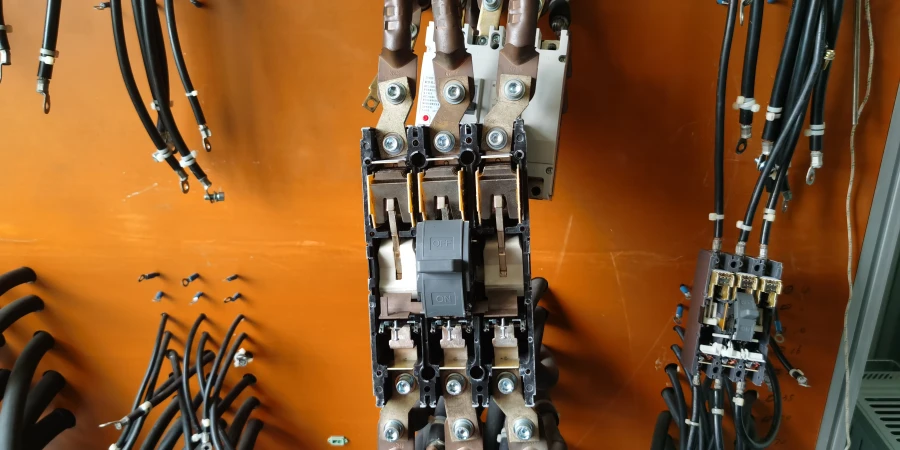
Before circuit breakers leave the factory, they often go through a temperature rise test, either because customers request it or to meet safety standards. This test isn’t just paperwork—it provides an early look at how heat distributes across the breaker and whether any component shows signs of abnormal thermal behavior.
During the test, small temperature sensors are attached to important parts like terminals, contacts, and handles. The breaker is run at its full rated current while the sensors record temperatures until they level off. Even a small hot spot can reveal hidden problems that could cause the breaker to fail or wear out faster than expected.
For both manufacturers and users, this test is more than a quality check. It helps catch potential issues before the breaker is installed, protecting the equipment, the system, and the people who rely on it.
What is Temperature Rise Testing?
When I first joined a circuit breaker factory and was still learning the ropes, the technical manager showed me a panel that was unusually warm—so warm you could feel the heat from several feet away. That’s exactly the kind of issue temperature rise testing is designed to detect—ensuring the breaker can operate safely under full load without overheating.
Temperature rise testing measures how much heat a circuit breaker produces when it carries its rated current under controlled conditions. Think of it as a stress test. You’re not just checking whether the breaker works—you’re confirming it can operate continuously without slowly cooking itself.
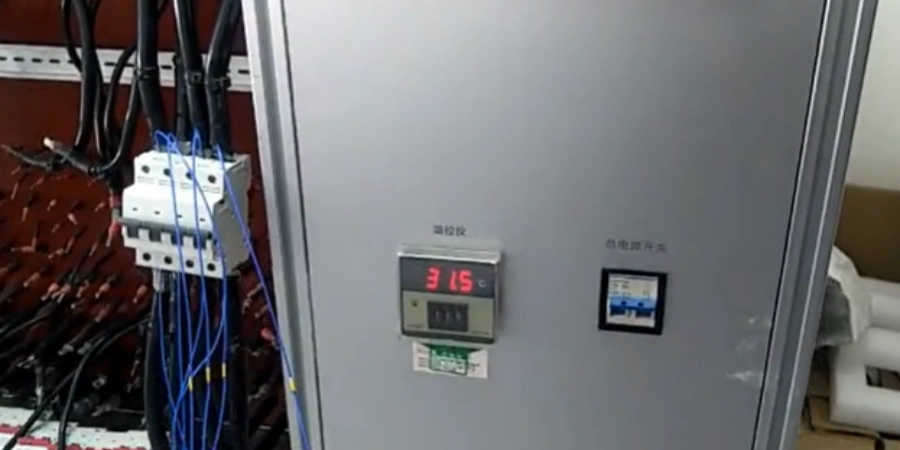
How the Test Actually Works?
The process is simpler than most people think, though it requires accuracy. First, the breaker is installed in a controlled environment where airflow won’t influence the readings. Then you attach thermocouples—tiny temperature sensors—to specific points: the busbar joints, the wire terminal connections, the breaker body, the handle, and a couple of spots around it to capture ambient temperature.
Once everything’s in place, you run the breaker at its rated current and wait. This isn’t a quick five-minute test. Large equipment might need two to three hours before temperatures stabilize. You’re looking for thermal balance—the point where temperature readings stop climbing and hold steady. Only then can you record the meaningful data.
At that point, the test shows whether each component stays within its designed temperature limits. Different parts have different thresholds because they serve different roles and face different risks. For example, wire terminals have stricter limits than handles, because excess heat there can damage insulation and create fire hazards. At the same time, handles can run slightly warmer because people only touch them briefly and can immediately tell if something feels unsafe.
Why We Bother With All This?
Here’s the part many people don’t realize: a circuit breaker that passes basic functional tests can still be a ticking time bomb if it runs too hot. I’ve seen breakers that trip perfectly well during a quick check, but once placed in continuous service at rated current and they start degrading within months instead of lasting the expected 15 to 30 years.
Temperature rise testing catches design flaws, manufacturing defects, and material incompatibilities before equipment ships to customers. It answers the key question: can this breaker handle its nameplate rating day after day without damaging itself or putting people at risk?
The test is also a valuable quality-control tool. If a batch of breakers suddenly shows higher temperature rises than previous batches, something in the manufacturing process likely changed—Maybe contact surfaces aren’t getting plated correctly, or the connection geometry shifted slightly. Finding these issues early can help prevent failures in the line.
| Test Parameter | What It Measures | Why It Matters |
|---|---|---|
| Terminal Temperature | Heat at wire connection points | Prevents damage to wire insulation |
| Contact Temperature | Heat at internal switching contacts | Reveals contact resistance and potential wear |
| Handle Temperature | Heat at the operator interface | Ensures user safety |
| Ambient Temperature | Surrounding environmental baseline | Used to calculate true temperature rise |
Why Temperature Rise Testing Matters?
The real value of temperature rise testing isn’t just in what it catches—it’s in what it prevents. Every electrical fire that doesn’t happen, every unplanned shutdown that gets avoided, every piece of equipment that reaches its expected lifespan—those are the wins that justify the testing.
The Fire Risk Nobody Talks About
Electrical fires account for roughly 46,700 incidents annually in U.S. homes alone, causing around 390 deaths, 1,330 injuries, and $1.5 billion in property damage. Electrical distribution equipment—including circuit breakers—causes 52 percent of those fires. These aren’t just statistics. Each represents a home, a business, sometimes a life.
Overheating doesn’t announce itself with warning bells. It starts small. A connection runs a bit warm. Insulation begins breaking down microscopically. Resistance increases slightly, which generates more heat, which accelerates the degradation. This feedback loop can run for months before you see visible signs of trouble. By then, you’re not dealing with a maintenance issue—you’re dealing with a safety hazard.
When internal components get too hot, insulation materials lose their protective properties. Modern circuit breakers use polymer-based insulation that performs well within its temperature range but degrades quickly beyond it. Once that insulation fails, internal arcing occurs. And internal arcing in an enclosed space with energized components? That’s how you get arc flash incidents reaching temperatures around 35,000°F—hotter than the sun’s surface.

Equipment Damage Beyond the Breaker
The breaker is just the starting point. When it runs hot continuously, it affects everything connected to it. Downstream equipment sees voltage drops and current irregularities. Wire insulation at connection points deteriorates faster than it should. Even the panel housing can warp if heat builds up enough.
In some panels, the metal around certain breakers may become discolored. This discoloration is not cosmetic—it’s a visible record of excessive heat exposure. The paint or coating changes color because it’s been cooked. If the outside looks like that, imagine what’s happening inside where temperatures run even higher.
Industrial facilities face particularly severe consequences. A single switchgear failure can shut down entire production lines. In manufacturing environments, 80 percent of switchgear failures trace back to overheating. That’s not a coincidence—it’s a pattern that temperature rise testing is specifically designed to break.
The Lifespan Question
Every circuit breaker has an expected service life. Residential breakers typically last 15 to 20 years. Industrial mccbs can go 20 to 30 years. Medium voltage breakers might reach 30 to 40 years under good conditions. But these numbers assume proper thermal conditions.
Research shows that for every 10°C increase above rated temperature, breaker life expectancy drops by approximately 50 percent. Let that sink in. If your breaker runs just 10 degrees too hot, you’ve cut its useful life in half. Run it 20 degrees too hot, and you’re looking at only 25 percent of the expected lifespan. The math gets ugly fast.
This isn’t theoretical aging—it’s accelerated degradation you can measure. Springs lose tension. Contacts develop corrosion. Insulation becomes brittle. Mechanical parts that should move smoothly start binding up. All these failures stem from the same root cause: excessive heat breaking down materials faster than they were designed to handle.
Conclusion
We often focus on what we can see and measure easily, but life—and machines—fail quietly in the shadows. Temperature rise testing is a lesson in looking deeper, thinking ahead, and valuing the invisible work that keeps everything running.