
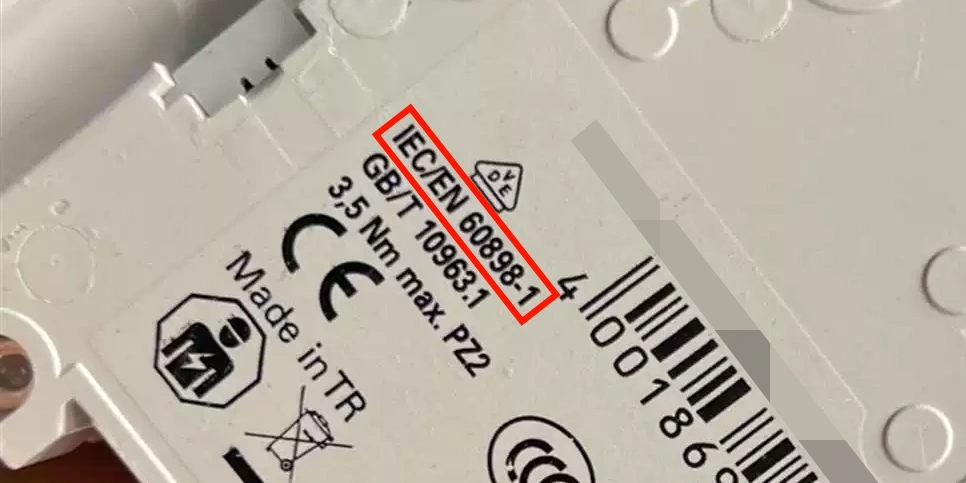
We’ve briefly talked about IEC 60898-1 before, but some people wonder why you often see EN 60898-1 in Europe and what the difference really is. For anyone not familiar with the chain of standards, all those letters and numbers can be confusing.
When we export our breakers to Europe, buyers and project managers often ask the same question: why does the same product sometimes show different standards? They want to know if it affects ordering, documentation, or compliance.
Behind this, it’s not just about technical requirements—it’s also about regulations and market rules. When we test each breaker before shipment, we always consider these differences to make sure our products are safe and compliant, no matter where they’re used.
How EN 60898 Relates to IEC 60898?
Here’s where things get a bit layered — and where I’ve seen the most confusion, even among experienced people.
The short answer is: EN 60898 is IEC 60898, just adapted for Europe. But that adaptation matters more than it might seem.
CENELEC and the Harmonisation Process
CENELEC is the European Committee for Electrotechnical Standardization. One of its main roles is to take IEC standards and adopt them as European Norms (EN). When IEC 60898-1 is adopted this way, it becomes EN 60898-1. The technical content stays largely the same — CENELEC doesn’t rewrite the engineering. What it does is bring the standard into the European regulatory framework.
Once a standard becomes an EN, individual countries within Europe then adopt it nationally. For example:
-
In the UK, it becomes BS EN 60898-1 (published by BSI)
-
In Germany, it becomes DIN EN 60898-1
-
In France, it becomes NF EN 60898-1
The underlying technical requirements are the same across all of these versions. The national prefix simply tells you which standards body published the local version. As the BEAMA guide to low-voltage circuit breakers notes, BS EN 60898-1 is the UK’s national adoption of EN 60898-1, which itself is based on IEC 60898-1. It’s a direct chain.
The "EN IEC" Prefix
You might also come across the combined "EN IEC" prefix on newer documents — for example, EN IEC 60898-3:2025, which covers DC circuit breakers for household and similar installations up to 440 V DC. This newer prefix style appears when the European text is directly aligned with a specific IEC edition. It’s essentially CENELEC signalling that the EN and IEC versions are closely harmonised.
This is why the same device might show what looks like different "versions" of 60898 on the label. It’s not inconsistency — it’s the same standard viewed through international, European, and national.
Are There Real Technical Differences?
This is the question that actually matters when you’re specifying products. And the answer is: mostly no — but there’s one important exception.
Day to day, EN 60898-1 and IEC 60898-1 cover the same class of MCBs and require the same test requirements. Manufacturers often mark devices to both standards at once, confirming compliance with both the international technical standard and the harmonised European version. If you’ve ever looked closely at the front panel of a modern MCB and seen multiple standard references stacked together, this is why.
Where the EN Version Differs: Annex ZZ
The meaningful difference between EN 60898 and IEC 60898 is regulatory, not technical.
EN 60898-1 includes what’s known as Annex ZZ — a section added by CENELEC under a standardisation request from the European Commission. Annex ZZ explicitly links the standard to EU legislation, including the Low Voltage Directive and the EMC Directive. In practical terms, this means that compliance with EN 60898-1 gives you a route to demonstrating conformity with EU law — something IEC 60898-1 alone cannot do, since IEC is a purely technical, globally-scoped document with no direct legal linkage to any national or regional regulations.
The most recent update on the European side — EN 60898-1:2019/A11:2024 — is an amendment specifically prepared under a European Commission request, backed by EFTA. It strengthens and updates the Annex ZZ content and also requires that any conflicting national standards be withdrawn. So if you’re selling MCBs in Europe, this is the version that matters for market access.
Which Standard Should You Specify?
After all the technical detail, this is usually what people really want to know: which standard should I write on my drawing, my specification, or purchase order?
The good news is that once you understand the relationship between IEC and EN 60898, the answer is fairly straightforward for most situations.
For EU and UK Projects: Use EN 60898-1
If your project is in Europe — whether that’s a new residential development, an office fit-out, or a light commercial board — you should be referencing EN 60898-1, or your national adoption of it (BS EN 60898-1 in the UK, DIN EN 60898-1 in Germany, and so on).
The key reason is the Annex ZZ. Referencing EN 60898-1 gives you a clear, documented route to demonstrate compliance with EU directives, including the Low Voltage Directive. IEC 60898-1 is technically sound, but it doesn’t carry that legal linkage. When a building control officer, an insurer, or a client’s technical team asks for proof of regulatory compliance, the EN reference is what you need in your documentation.
With the publication of EN 60898-1:2019/A11:2024, any conflicting national standards are being withdrawn, making EN 60898-1 the mandatory reference for relevant products across participating European countries.
For Global Specifications: Use IEC 60898-1
If you’re writing a specification that needs to work across multiple countries — say, a corporate fit-out standard applying to offices in Europe, the Middle East, and Asia — then IEC 60898-1 is the right reference. It’s recognised internationally and doesn’t include EU-specific regulatory requirements that might not apply outside Europe.
International suppliers working outside the EU framework will be more comfortable demonstrating conformity to IEC 60898-1 than to EN 60898-1, since they may not be set up to handle the EU legislative linkages included in the EN version.
When to Consider IEC 60947-2 Instead?
If your application goes beyond household and small commercial installations — for example, industrial environments, high fault levels, or currents above 125 A — then IEC 60947-2 is the relevant standard.
IEC 60947-2 covers industrial and commercial low-voltage breakers designed for skilled operators and higher ratings. For projects in Europe, this standard is also available as EN 60947-2, which aligns the technical requirements with European legislation and may include Annex ZZ.
For most residential and light commercial projects, however, IEC/EN 60898-1 remains the appropriate reference.
Quick Reference: Standard Selection
| Project Type | Recommended Standard |
|---|---|
| Residential or light commercial, EU/UK | EN 60898-1 (or BS/DIN/NF EN variant) |
| Global or multi-region specification | IEC 60898-1 |
| Industrial environment, >125 A or >440 V | IEC 60947-2 |
| DC circuits in household installations | EN IEC 60898-3:2025 |
| Demonstrating EU regulatory compliance | EN 60898-1 (with Annex ZZ) |
As we mentioned before, many manufacturers mark their MCBs to both IEC 60898-1 and EN 60898-1, and sometimes to BS EN 60898-1 as well — because they’re selling into multiple markets. Multiple standard references on the same device aren’t a sign of confusion — they show that the product has been tested and documented for each standard. The technical requirements are closely aligned, so a single device can carry all of them.
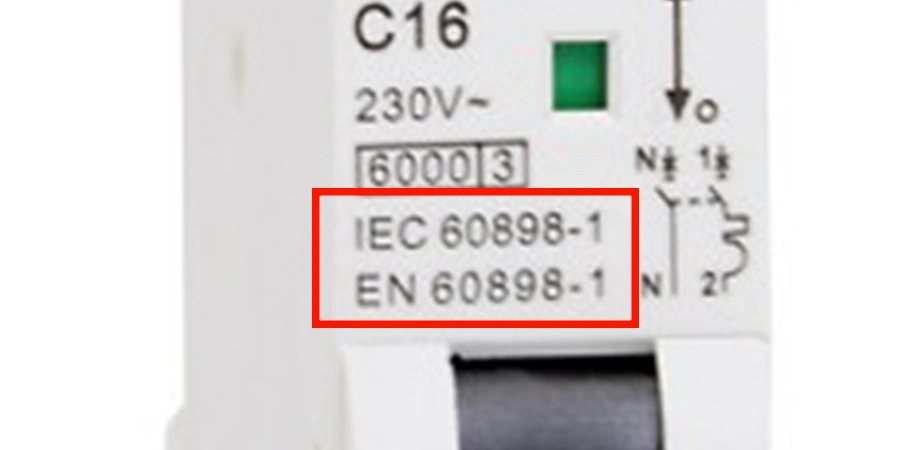
The key takeaway: choosing which reference to put in your documentation is different from choosing which product to buy. Often, it’s the paperwork that changes, not the hardware.
Conclusion
Choosing the right standard isn’t just paperwork — it’s about ensuring safety, compliance, and clarity in every project. When everyone knows which reference matters, decisions are faster, suppliers are aligned, and regulatory hurdles are smoother. A clear approach to standards keeps your projects organized, consistent, and trouble-free across different regions.