
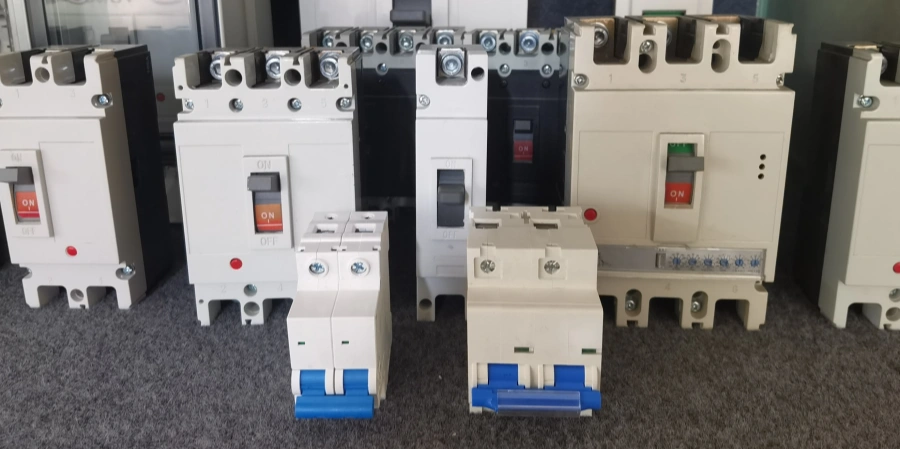
MCBs and MCCBs are the two most common types of low-voltage circuit breakers, but the roles they play in electrical systems are very different. Many people know that both devices protect circuits, yet few truly understand how far they differ in structure, capacity, and real-world use.
From appearance to performance, they belong to almost two different worlds. In terms of design and intended use, MCBs are compact and lightweight, suited for residential and light commercial circuits. MCCBs, on the other hand, are larger, heavier, and engineered to manage the high loads and fault currents typical of industrial installations. They’re grouped under the same category only because their purpose is similar—not because they can replace each other.
Understanding these differences isn’t just about technical detail. It directly affects how safe and reliable a system will be. Choosing the wrong type of breaker can lead to much more than an inconvenient trip—it can create serious risks and costly downtime.
Understanding the Basics
Let me start with something basic: what these acronyms actually mean and why it matters.
MCB stands for Miniature Circuit Breaker. The word "miniature" isn’t just marketing—it describes both the physical size and the scale of protection these devices offer. An MCB is a compact electrical protection device designed to automatically cut power when things go wrong in a circuit. Think of it as the first line of defense in residential and light commercial settings. When you flip open an electrical panel in a home or small office, those neat rows of switches you see are usually MCBs.
MCCB stands for Molded Case Circuit Breaker. The "molded case" refers to the insulated housing that encases the entire mechanism—a design feature that becomes important when you’re dealing with higher voltages and currents. An MCCB is a more robust electrical protection device engineered specifically for industrial and heavy commercial applications. You’ll find these in factory control rooms, large building distribution panels, and anywhere serious electrical muscle is needed.
Both devices serve the same core purpose: they automatically disconnect power during electrical faults like overloads or short circuits. But here’s what took me years to truly appreciate—the difference isn’t just about size or capacity. It’s about the entire philosophy of protection.
Why the Distinction Matters in Real Applications?
When I talk with electricians or technical managers, I’ve noticed a common misconception: many people treat MCBs and MCCBs as interchangeable options that are different only in current rating. But that’s like saying a pickup truck and a semi-trailer are the same because they both move cargo.
MCBs are designed for residential and light commercial loads. They protect individual circuits rather than entire systems, which means you might have one MCB for your kitchen outlets, another for lighting, and another for your air conditioner. This modular approach works beautifully in homes and small businesses where loads are predictable and relatively modest.
MCCBs operate in an entirely different environment. They’re built to handle the unpredictable, heavy-duty demands of industrial equipment. I’ve seen MCCBs protecting massive motor control centers in manufacturing plants, backup generator systems in hospitals, and main distribution feeders in shopping malls. The loads these devices manage can fluctuate wildly throughout the day, and the consequences of failure are far more severe than a tripped breaker in your living room.
The Protection Philosophy Behind Each Design
Here’s something that changed how I think about these devices: MCBs are essentially fixed-function protectors. You buy an MCB rated for 20 amperes with a Type C tripping curve, and that’s exactly what you get. There’s no adjustment, no custom settings—just reliable, straightforward protection. This simplicity is actually a strength in residential applications where consistency and easy replacement matter most.
MCBs are simple, fixed-function devices: you select a breaker with the appropriate current rating and tripping type, and it performs consistently without any adjustment. This straightforward design makes them ideal for homes and small commercial spaces, where predictable loads and easy replacement are important.
In contrast, MCCBs are built for flexibility. Many feature adjustable thermal and magnetic trip settings, allowing engineers to fine-tune protection for complex industrial loads. This adaptability is crucial in systems where load characteristics vary widely and coordination with upstream devices is required.
| Feature | MCB | MCCB |
|---|---|---|
| Full Name | Miniature Circuit Breaker | Molded Case Circuit Breaker |
| Primary Application | Residential and light commercial | Industrial and heavy commercial |
| Protection Scope | Individual circuits | Larger systems and feeders |
| Adjustability | Fixed settings | Often adjustable |
| Typical Setting | Homes, offices, retail | Factories, hospitals, data centers |
Key Differences Between MCB and MCCB
This is where things get interesting, and where I’ve seen the most confusion—even among experienced people in electrical industry. The differences between MCBs and MCCBs run deeper than you might expect, affecting everything from installation to long-term operating costs.
Current Rating and Capacity
The most obvious difference, and usually the first one people mention, is current-handling capability. MCBs are typically rated for currents from 6A to 125A. When you’re protecting lighting circuits, outlet circuits, or small appliance loads, an MCB in the 16A to 63A range usually does the job perfectly.
MCCBs operate in a completely different range—from 15A up to 2,500A. That upper limit isn’t a typo. I’ve worked on projects where customers use MCCBs rated for over 1,000 amperes to protect main distribution feeders. These aren’t devices you can hold comfortably in one hand—they’re substantial pieces of equipment that need our careful handling and proper mounting.
But here’s what many people miss: the current rating is only part of the story. What matters just as much is breaking capacity—the maximum fault current a breaker can safely interrupt without being destroyed. This is where the differences become clear and safety-critical.
Temperature Influence on Performance
Another important difference between MCBs and MCCBs is how they react to changes in the surrounding temperature.
MCBs are much more affected by ambient temperature. Their bimetallic strip responds directly to heat. When the panel temperature rises — for example, to 40°C or higher — an MCB may trip earlier than expected. In hot environments you often need to apply derating, meaning the breaker’s effective current rating becomes lower. In cooler environments, the opposite happens: the breaker may trip later than intended. (Related Reading: How Does Ambient Temperature Affect Circuit Breakers?)
MCCBs behave differently depending on the type of trip unit they use. Thermal-magnetic MCCBs still respond to ambient temperature, but they typically include better thermal compensation and are built with larger components that offer more thermal stability. This means their performance varies less with temperature compared to small MCBs, but they are still not completely immune to temperature shifts.
However, electronic-trip MCCBs operate on an entirely different principle. Instead of relying on a bimetal strip, they use electronic sensing to measure current, so their trip behavior remains much more stable across a wide temperature range. As a result, electronic MCCBs maintain consistent protection even in locations with significant temperature fluctuations—mechanical rooms, generator rooms, outdoor enclosures, and industrial environments.
Breaking Capacity
MCBs typically have breaking capacities normally between 6kA and 25kA In most residential installations, this is more than enough. A typical outlet’s prospective fault current might be 3kA to 6kA, well within an MCB’s safe range. Some industrial MCBs, like the Schneider Acti9 NG125H series, can handle up to 36kA, but these are rare and mainly used in bigger commercial or light industrial setups.
MCCBs offer breaking capacities ranging from 25kA to 200kA. This huge range reflects the demands of industrial systems they serve. Near large transformers or in facilities with on-site generation, fault currents can be enormous—tens of thousands of amperes flowing in milliseconds. An MCB in that situation wouldn’t just fail to protect the circuit; it could explode, creating an arc flash hazard.
💡 Manufacturer Insight
High breaking capacity requires rigorous testing. At Sincede, our circuit breakers undergo strict laboratory testing to ensure they meet the stated kA ratings, backed by ISO, CB, and CE certifications. This ensures that when a fault occurs, the breaker protects your assets exactly as intended.
Internal Construction
Open up an MCB and an MCCB side by side, and you’ll immediately see why they’re priced so differently. MCBs use a relatively straightforward mechanism built around a bimetallic strip. When current exceeds the rated value, heat causes the strip to bend, mechanically releasing a latch that opens the contacts. For short circuits, a magnetic coil provides instantaneous tripping. It’s elegant in its simplicity, which is exactly what residential applications need—reliable protection without unnecessary complexity.

MCCBs use a more sophisticated dual-mechanism approach. The thermal component works similarly to an MCB, detecting gradual overloads through bimetallic contact expansion. But the electromagnetic component is more robust, designed to handle the violent forces of high-magnitude short circuits. Many modern MCCBs go even further, incorporating electronic trip units with microprocessors that monitor current in real-time and can be programmed for precise protection characteristics.
These design choices are based on the environments in which the devices operate. In a factory, loads aren’t constant and predictable like in a home. Motor starting currents, welding equipment, variable frequency drives—these all create electrical conditions that demand smarter, more adaptable protection. The complexity inside an MCCB isn’t over-engineering; it’s necessary.
Trip Characteristics
Here’s where MCBs and MCCBs diverge in their approach to protection. MCBs come in several standardized types, each designed for specific load characteristics:
-
Type A Trips at 2–3 times the rated current. Used for very sensitive equipment and electronic devices that cannot tolerate high inrush currents.
-
Type B trips at 3-5 times rated current—ideal for resistive loads like lighting and heating
-
Type C trips at 5-10 times rated current—the most common type for general commercial loads and small motors
-
Type D trips at 10-20 times rated current—designed for highly inductive loads like transformers and large motors
-
Type Z – Trips at 2–3 times the rated current, similar to Type A, but even more sensitive to small overcurrents. Often used for protecting delicate electronics or devices with extremely low inrush current.
-
Type G – Also a high-sensitivity curve, typically tripping at around 2–3 times the rated current. Depending on the manufacturer, it may include a short delay to avoid nuisance tripping. Common in applications requiring very accurate protection of electronic equipment.
These trip characteristics are factory-set and completely non-adjustable. You select the type that matches your load, install it, and it performs exactly as designed. For most residential and light commercial work, this fixed-function approach is perfect. An electrician doesn’t need to worry about someone tampering with settings or misconfiguring protection.
MCCBs usually have adjustable trip settings. This lets you customize both thermal and magnetic protection. This adjustability serves two critical purposes. First, it lets you match protection more precisely to your actual load characteristics. Second, it enables selective coordination in complex electrical systems.
For example, Imagine a manufacturing plant with a main MCCB feeding several sub-panels, each with its own MCCB, and branch circuits protected by MCBs. When a fault occurs on one branch circuit, you want only that specific MCB to trip—not the MCCB protecting the sub-panel, and definitely not the main MCCB. Achieving this requires careful coordination of trip settings, which is only possible with adjustable devices.
Physical Dimensions and Installation Requirements
Size is another major difference with practical consequences for panel design and installation. MCBs are compact devices designed to fit densely in standard residential distribution boards. A typical single-pole MCB occupies just 17.5mm to 18mm of DIN rail width, allowing many breakers to fit in a small panel.
MCCBs are larger and heavier, with their size increasing dramatically at higher current ratings. A 100A MCCB might be 70-80mm wide, while a 1,000A MCCB can exceed 200mm. This size difference affects everything from panel selection to installation labor costs. You can’t simply swap an MCB for an MCCB without considering physical space and support requirements.
| Specification | MCB | MCCB |
|---|---|---|
| Current Rating Range | 6A – 125A | 15A – 2,500A |
| Breaking Capacity | 6kA – 25kA | 25kA – 200kA |
| Trip Settings | Fixed (Type B, C, D) | Adjustable (thermal & magnetic) |
| Typical Width | 17.5mm – 36mm | 70mm – 200mm+ |
| Internal Mechanism | Bimetallic strip + magnetic coil | Thermal-magnetic + electronic trip units |
| Primary Standard | IEC 60898-1 | IEC 60947-2 |
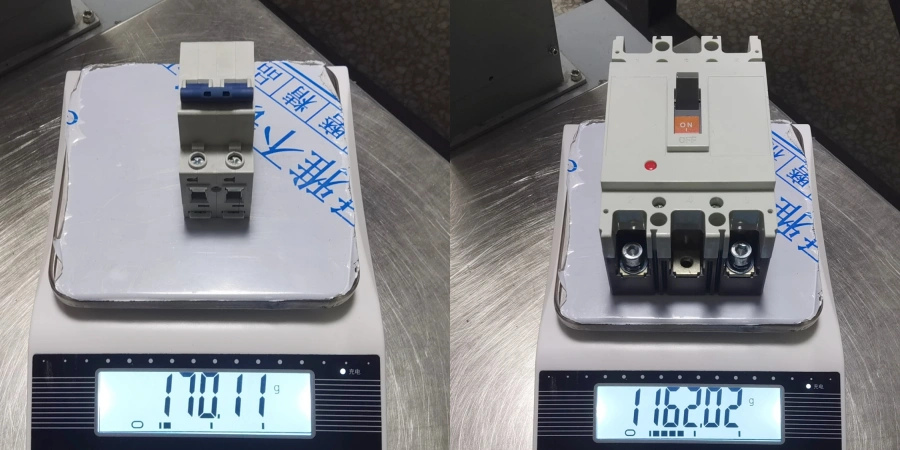
The weight difference is also huge too. A 1p standard MCB weighs perhaps 80-120 grams, while a large MCCB can weigh 5-10kg. This affects handling during installation and places different requirements on panel construction and mounting.
Cost & Maintenance Differences
When deciding between MCBs and MCCBs, cost and maintenance are often important to think about.
MCBs are usually not repairable. They have a simple design—mainly a metal strip and a small magnetic coil—so when they break or reach the end of their life, the easiest and safest solution is to replace them. Because MCBs are cheap, replacing them is usually easier and more practical than trying to fix them.
MCCBs, on the other hand, are designed to be maintained. Many industrial-grade MCCBs let you clean the contacts, check the mechanical parts, and even replace or adjust the trip unit. This makes them better for huge or critical systems, where simply swapping out a breaker would be expensive or cause downtime.
Even though MCCBs cost more upfront, their ability to be maintained and handle heavy-duty use can make them cheaper in the long run for industrial or high-current setups. In short: MCBs are perfect for homes and small businesses, while MCCBs are better for factories and large buildings.
Conclusion
MCBs and MCCBs may seem like small devices, but they reflect a broader principle: the right tools, applied thoughtfully, prevent small problems from becoming disasters. Considering their differences encourages a mindset of planning, precision, and respect for the systems we rely on every day.