
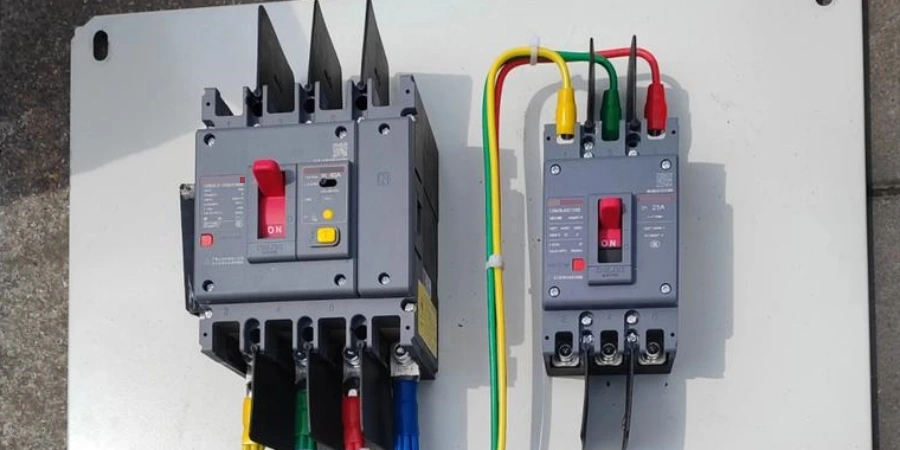
An mccb that’s the wrong size might seem fine at first, but it can cause unexpected trips, damage equipment, or even create safety hazards. Usually, the problem isn’t a broken part—it’s just a mismatch between the breaker and the load it’s protecting.
People often focus on obvious numbers like voltage or amperage, but the details in the specs matter just as much. Frame size and trip rating might look similar, but they control how a breaker actually behaves. Get them wrong, and problems can spread through a facility for months.
Paying attention to these details isn’t about being extra cautious—it’s about keeping systems running safely and reliably. A careful check or a small adjustment now can save a lot of time, money, and trouble later.
MCCB Frame Size vs. Trip Rating
The frame size—sometimes called the rated frame current or Inm—is the maximum capacity built into the breaker’s physical design. Think of it like a truck chassis: a light-duty pickup and a heavy-duty commercial truck might look similar at first glance, but they’re built for very different loads. Common industrial frame sizes include 63A, 125A, 250A, 400A, 630A, 800A, 1250A, and 1600A.
The trip rating (In), on the other hand, is the current level where the breaker is set to actually trip and cut power. This value is adjustable within the limits of your frame size. So you might have a 250A frame that’s configured to trip at 150A, 180A, 200A, or anywhere within that frame’s range. The frame determines what’s possible; the trip rating defines what actually happens.
Why This Matters in Real Projects?
I often see specifications that say “250A MCCB” without clarifying whether that means a 250A frame with a lower trip setting or a 250A trip rating in a larger frame. This kind of ambiguity consistently leads to on-site issues and delays, simply because different people interpret the number in different ways.
The physical implications are just as important. A 250A frame breaker has specific dimensions, mounting requirements, and busbar connection points. It takes up a certain amount of space in a panel and generates a predictable amount of heat during operation. None of these changes even if you set the trip lower. You can’t take a 100A frame and magically make it handle the heat of a 250A circuit just by adjusting settings—the physics won’t allow it.
Here’s a practical comparison that might help:
| Parameter | Frame Size (Inm) | Trip Rating (In) |
|---|---|---|
| What it represents | Maximum physical capacity of the breaker housing | Actual current threshold where protection activates |
| Can you change it? | No—fixed by manufacturer | Yes—adjustable within frame limits |
| Determines what? | Physical size, mounting compatibility, heat dissipation capacity, maximum breaking capacity | When the breaker trips during overload conditions |
| Example notation | 250AF (250A Frame) | 150AT (150A Trip) |
The Cascading Effects of Getting This Wrong
A simple specification error can snowball into serious problems. Let’s say you need to protect a circuit that carries 180A continuously. You calculate that you need at least a 225A trip rating (180A × 1.25 safety factor for continuous loads). Some beginners on your team sees "225A" and orders a breaker with a 225A frame and 225A trip rating. Problem is, that leaves zero room for adjustment, and the breaker will be operating right at its thermal limit constantly.
The opposite can be just as bad: Maybe you need a 100A trip but someone orders a 630A frame "just to be safe." Now you’ve got this massive breaker protecting a relatively small circuit. The trip characteristics are all wrong for selective coordination with downstream devices, and you’ve paid significantly more than necessary for equipment that’s actually making your system less safe, not more.
Undersized Frame Consequences
MCCBs with undersized frames can cause serious problems. Even if the breaker isn’t defective, a frame that’s too small for the load will run hotter than it should, wear out faster, and trip unexpectedly. This happens because the internal components aren’t designed to handle the thermal stress of currents near the top of the frame’s rating.
The Thermal Stress Problem
Inside every MCCB is a bimetallic strip that bends when it heats up. This is your thermal protection mechanism—it’s supposed to trip the breaker when current exceeds safe levels for an extended period. But here’s what happens when you put an undersized frame on a circuit: even during perfectly normal operation, that bimetallic strip is constantly hovering near its trip threshold. It’s like asking someone to hold a heavy weight at arm’s length all day, every day. Eventually, something gives.
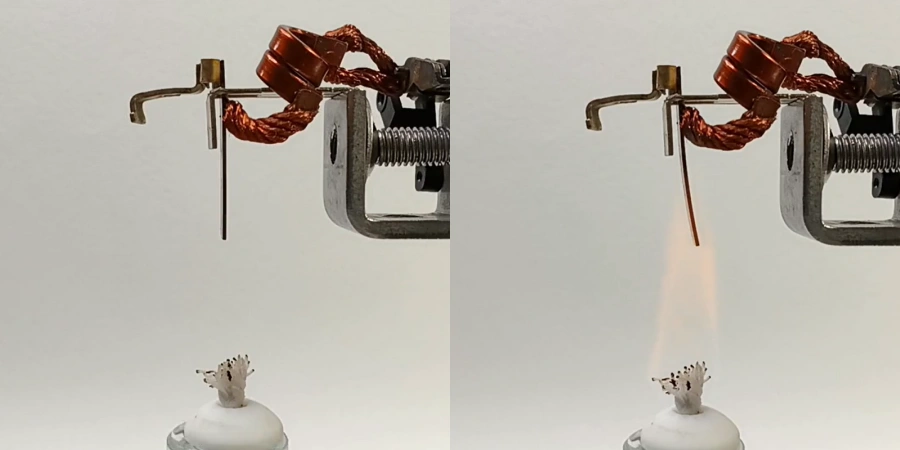
A smaller frame means thinner contact bars, a tighter arc chamber, and less material to absorb and dissipate heat. A 250A frame physically cannot handle the same thermal load of a 400A frame—it’s just basic physics. When you force a small frame to run near its limits continuously, the internal components face sustained thermal stress that accelerates wear.
Nuisance Tripping
The most immediate consequence we can notice is nuisance tripping. The breaker starts opening randomly during normal operation, with no real fault on the circuit. That’s because the thermal element has been stressed to the point where its calibration drifts. What was supposed to trip at 100A now trips at 95A, then 90A, then unpredictably anywhere in that range depending on ambient temperature, how long the load has been running, and probably the phase of the moon. (Related Reading: What Is Nuisance Tripping?)
Breaking Capacity
Here’s what keeps me up at night about undersized frames: the breaking capacity issue. When a short circuit happens, the breaker needs to interrupt potentially enormous fault currents—we’re talking tens of thousands of amperes in industrial settings. An undersized frame may have an Icu rating that passes on paper, but in practice it’s operating at the edge of what its construction can handle.
The breaking capacity of a breaker depends heavily on its physical construction: the arc chamber size, the strength of the contacts, the speed of the operating mechanism. This is why at Sincede, we don’t just assemble parts; we control the entire manufacturing process—from internal mold making to the final assembly of the arc chutes.
A 250A frame clearing a 25kA fault is working much harder than a 400A frame clearing the same fault. The smaller frame might successfully interrupt the circuit once, twice, or ten times. But each interruption erodes the contacts, stresses the arc chamber, fatigues the mechanism. Eventually—maybe during the next fault, maybe during the eleventh fault—the breaker can fail.
When the breaker fails to stop an electrical arc. The arc can keep burning inside the breaker, creating extreme heat and pressure. This can damage or rupture the enclosure, and in a closed panel, it can cause an arc flash that is very dangerous for anyone nearby.
Long-Term Reliability Effects
Even if an undersized breaker never fails violently, it won’t deliver the service life you’d expect from properly sized equipment. Here’s what the degradation pattern typically looks like:
| Timeframe | Observable Effects | Underlying Cause |
|---|---|---|
| 0–6 months | Occasional unexpected trips, slightly elevated temperature | Early loss of calibration from constant thermal stress |
| 6–18 months | More frequent nuisance trips, visible terminal discoloration | Contact erosion and oxidation from repeated heating cycles |
| 18–36 months | Unpredictable tripping, increased contact resistance | Significant degradation of thermal elements and weakened mechanisms |
| 36+ months | Failure to trip when needed or total mechanical failure | Loss of calibration, damaged contacts, possible welding |
The economic impact goes well beyond buying new breakers. Every failure means downtime for investigation and repair. It means keeping spare breakers in inventory. It means maintenance technicians spending time on reactive troubleshooting instead of preventive maintenance. It means reduced confidence in your electrical system’s reliability, which can lead to overly conservative operating practices that limit production capacity.
Oversized Frame Consequences
If undersized frames can cause nuisance trips and equipment stress, oversized frames bring a different set of problems. Using an MCCB with a frame that’s too large for the circuit doesn’t make the system safer. Instead, it delays protection, allowing cables and connected equipment to overheat before the breaker reacts.
The Cable Protection Failure
Here’s the principle that often gets overlooked: the MCCB isn’t there primarily to protect itself—It’s there to protect everything downstream—cables, equipment and people. Installing an oversized breaker puts the weakest link in the circuit at risk.
Let’s say a cable is rated for 27A but protected by a 50A breaker. At 25A, everything seems fine. But if the current rises to 40A, the cable overheats and its insulation begins to degrade inside the wall or conduit. At 40A, the breaker is only at 80% of its rating, so it may not trip for a long time—possibly hours—while the cable is already being damaged.
The real danger is that this damage is cumulative and hidden. Each overload event that the oversized breaker allows to continue weakens the cable’s insulation a little more. You might run the circuit like this dozens of times before anything obvious happens. Then one day, the degraded insulation fails completely, you get a line-to-ground fault.
The Fire Risk Reality
I don’t want to be alarmist, but fire risk is the most serious consequence of oversized breakers, and it’s more common than most people realize. The National Electrical Code is designed to stop this from happening: the breaker rating must not exceed the cable ampacity.
Typically, the progression looks like this: the cable overheats during sustained overload, the insulation becomes brittle, cracks form, you get arcing between conductors or from conductor to ground, and the arc generates extreme localized heat. Inside a wall cavity or above a dropped ceiling, that heat ignites combustible materials. By the time someone notices smoke or hears a fire alarm, the fire might already be spreading.
What makes this particularly insidious is the time delay. The oversized breaker will eventually trip—breakers do have thermal elements that respond to sustained overcurrent. But "eventually" might be far too late when cable insulation is failing.
Selective Coordination Breakdown
Oversized frames also create problems with selective coordination in your distribution system. Proper coordination means when a fault happens on a branch circuit, only that branch breaker trips—not the feeder breaker, not the main breaker, just the one closest to the problem, keeping the rest of the facility operational.
Coordination relies on time-current curves of upstream and downstream protective devices. These curves show how quickly a breaker trips at different current levels. For coordination to work, the downstream breaker’s curve must be below and to the left of the upstream breaker’s curve across the entire fault current range. When you oversized a breaker, you shift its time-current curve in ways that can overlap with downstream devices. Suddenly, both breakers might trip for a fault that should only affect one circuit.
The Equipment Damage Pattern
Oversized breakers don’t just threaten cables—they also put connected equipment at risk. Motors, transformers, and power supplies—these devices have thermal limits just like cables do. An oversized breaker allows sustained overcurrent that can damage motor windings, overheat transformer cores, or damage electronic components.
Here’s a comparison:
| Scenario | Correctly Sized Breaker | Oversized Breaker |
|---|---|---|
| Normal operation at 80% load | Breaker and cable within design limits | Appears normal, but cable near thermal limit |
| 125% overload | Trips within minutes, preventing damage | Cable overheats for extended period before tripping |
| Ground fault (low current) | Rapid trip, protecting cable | Delayed trip, possible insulation failure |
| Fire risk | Minimal | Elevated, cable can overheat before protection activates |
| Coordination | Maintains selective coordination | Often disrupts coordination, causing cascading trips |
Oversizing seems protective—more capacity, more safety margin—but it’s actually the opposite. You’re removing protection from the places that need it most. if you want more capacity, upgrade the cable and the breaker together. Don’t just slap a bigger breaker on existing wiring and call it a day.
Conclusion
Electrical protection depends on more than equipment—it depends on attention to detail. Taking the time to match breakers to real-world needs ensures systems run safely and reliably, avoiding problems that can quietly grow into serious failures.