
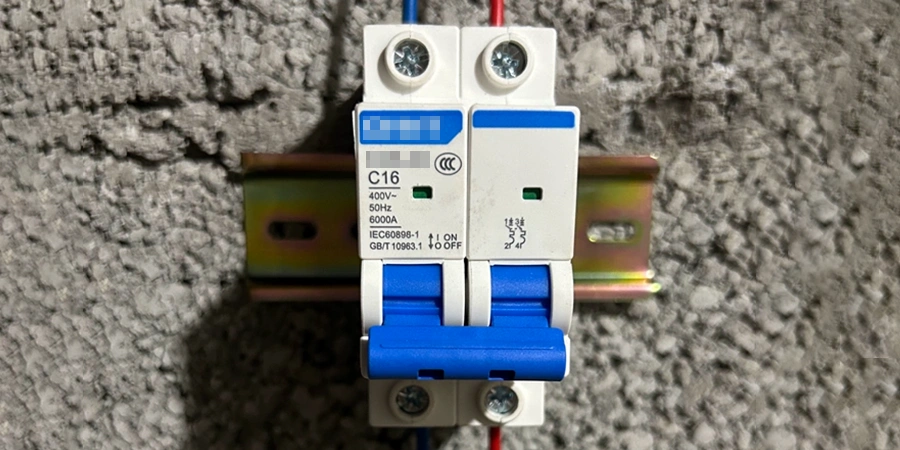
Every small circuit breaker has a number on it that might look unimportant at first. That number actually tells you how much short-circuit current the breaker can handle safely. When we test our products for customers, we always make sure they can survive their rated limits—because if they can’t, things can go wrong very fast.
One engineer on our team likes to say, "It’s not about the normal flow of electricity—it’s about what happens in the worst-case surge." That number on the breaker isn’t random; it comes from careful design, materials, and testing. Understanding it helps you pick the right breaker for your home, office, or factory.
In our warehouse, 4.5kA, 6kA, and 10kA breakers sit side by side. They may look similar, but each is built for a specific level of fault current. Knowing the difference isn’t just technical—it’s about keeping people and equipment safe.
What Breaking Capacity Means in MCBs?
Breaking capacity is the maximum short-circuit current an MCB can safely interrupt without failing. Here’s a simple way to think about it: when a major fault happens in your electrical system—like a dead short—thousands of amperes can suddenly surge through the circuit. The MCB must detect the fault, open its contacts, and stop that current before anything catches fire or explodes.
The breaking capacity, measured in kiloamperes (kA), tells you the highest fault current that specific MCB can handle safely.
The Numbers Behind the Rating
When you see "6kA" printed on an MCB, it means the device has been tested to safely interrupt up to 6,000 amperes of fault current under specific conditions. A 10kA-rated device can handle 10,000 amperes. Pretty simple, right?
But that number isn’t random. It comes from strict testing under international standards—mainly IEC 60898-1 for residential MCBs. During testing, breakers are exposed to carefully controlled fault currents at standard voltages like 230/400V.
To pass, the breaker must interrupt the fault successfully multiple times without failing, welding its contacts shut, or cracking its casing.
Why This Number Matters More Than You Think?
Over the years, I’ve seen engineers discuss MCB specifications in our product planning meetings. Breaking capacity always comes up because it’s non-negotiable. You can’t cut corners on it.
If your installation can produce 8kA of fault current during a short circuit and you install a 6kA MCB, you’re taking a serious risk—literally. When a real fault happens, that breaker could fail at the exact moment you depend on it most.
How Breaking Capacity Ratings Work (4.5kA vs 6kA vs 10kA)
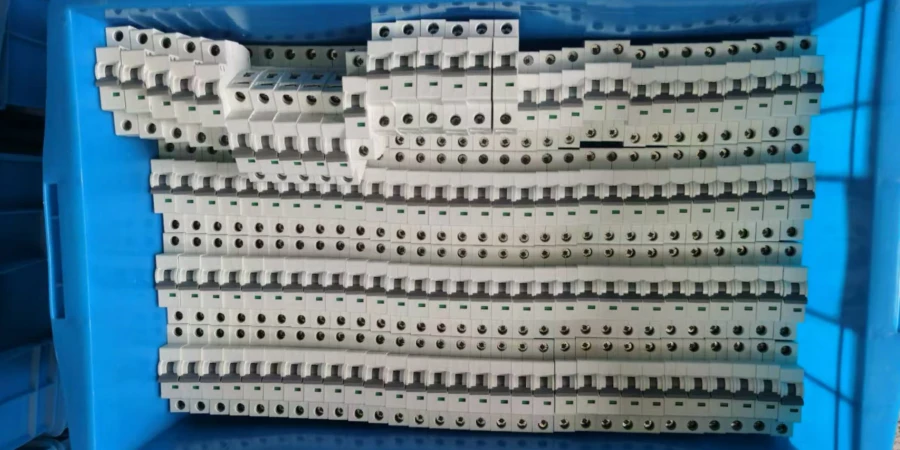
When you walk through our warehouse, you’ll see MCBs with different breaking capacities arranged on separate shelves. That’s not just for neatness. These ratings are not interchangeable, and mixing them up can cause real problems.
The difference between a 4.5kA, 6kA, and 10kA MCB isn’t just the number printed on the front. It reflects the internal design—contact materials, arc chutes, and the overall structure that allows the device to survive extreme fault conditions.
A 10kA MCB costs more to produce because it needs stronger components and a more advanced arc extinction system. It’s built to handle much higher stress.
What Makes Each Rating Different?
Here’s how I usually explain it, based on what I’ve seen in production:
4.5kA MCBs were once common in residential installations, especially in rural areas with long feeder cables. Those long cables add impedance, which naturally limits the fault current. Today, we manufacture fewer 4.5kA units than before because many markets have raised their minimum requirements. They’re still perfectly safe when used in the right application—when your prospective short-circuit current is genuinely below 4,500 amperes.
6kA MCBs have become the modern baseline in many countries. In fact, standards like IEC 60898-1 have influenced this shift toward higher minimum breaking capacities. In most residential distribution boards, fault currents rarely exceed 6kA. That makes 6kA MCBs a safe and cost-effective choice. Our sales data shows this clearly—6kA models outsell 4.5kA units by a wide margin.
10kA MCBs are what we recommend for commercial buildings, installations close to transformers, or anywhere the supply impedance is low. In urban areas with robust electrical infrastructure, or in buildings with their own transformers, fault currents can easily surpass 6kA. That’s where 10kA devices become necessary, not optional.
💡 Manufacturer Tip: Label vs. Real Performance
The breaking capacity (6kA or 10kA) printed on a breaker depends entirely on internal component quality—specifically the silver-point thickness and the arc-chute design. In our experience, we’ve found that many budget breakers fail to clear their rated currents under real-world stress.
For B2B procurement, don’t just trust the stamp. Always verify CB/CE test reports and ensure your supplier runs an in-house destructive testing lab to guarantee that mass-produced units match the certified samples.
Performance Under Fault Conditions
So what actually happens inside the breaker during a fault?
When thousands of amperes surge through the MCB, the contacts begin to separate. As they do, an intense electrical arc forms between them. That arc is essentially plasma—hot enough to melt metal.
The breaker has to extinguish that arc quickly while also resisting the powerful electromagnetic forces trying to slam or weld the contacts together. A 10kA MCB has larger arc chutes, stronger contact materials, and more robust internal mechanisms compared to a 6kA device. It’s specifically engineered to survive a more violent arc without failing.
During our quality tests, we sometimes let visitors watch from behind protective glass as we test MCBs under fault conditions. The flash and bang from a 10kA test is noticeably more intense than a 6kA test. You can feel the difference—even from a safe distance.
| Breaking Capacity | Typical Applications | Fault Current Range | Relative Cost |
|---|---|---|---|
| 4.5kA | Remote rural installations, legacy systems | Up to 4,500A | Lowest |
| 6kA | Standard residential, small commercial | Up to 6,000A | Moderate |
| 10kA | Commercial buildings, near transformers, industrial | Up to 10,000A | Higher |
Choosing the Right Breaking Capacity for Different Applications
Choosing the right MCB for a project mainly comes down to breaking capacity. Different buildings and electrical systems need different ratings depending on their setup and how far the panel is from the transformer.
Even within the same type of building, factors like the size of the service, the number of feeders, and the type of equipment connected can change the prospective fault current. That’s why it’s important to understand the system and select a breaker that can safely handle the maximum possible fault current.
Residential Use
For homes, the calculation is usually straightforward. Most residential installations are supplied through meters and service cables with enough impedance to naturally limit fault current. A standard house connected to the utility grid through standard service equipment rarely generates more than 3-6kA of prospective fault current at the distribution board.
That’s why 6kA MCBs work perfectly for most homes. They provide enough protection without adding unnecessary expense. However, there are exceptions. If you live in a high-rise apartment building with a shared transformer in the basement, or if your home has its own pad-mounted transformer nearby, the available fault current could be higher. It’s always verify rather than assume.
My general advice is simple: if you’re building new or rewiring, use 6kA as your minimum. Don’t use 4.5kA devices unless you’ve actually calculated the prospective short-circuit current and confirmed it’s within limits. The price difference is small, but the added safety margin is worth it.
Commercial Buildings
Commercial installations are more complex. Office buildings, retail spaces, and small factories usually have larger electrical services, with transformers located closer to the loads. That means lower impedance and higher prospective fault currents.
During our sales training, we teach our regional reps that 10kA should be the default recommendation for customers’ commercial projects. Not because 6kA devices are bad, but because commercial installations often include factors that increase fault currents—larger transformers, parallel cable runs, multiple feeders, and proximity to substations.
I’ve reviewed fault calculations from dozens of commercial projects with our engineers, and it’s common to see 7-9kA prospective fault current at main distribution boards. A 6kA MCB doesn’t meet the basic rule that breaking capacity must exceed the calculated PSCC. Using 10kA-rated MCBs removes that risk and also leaves room for future upgrades.
Industrial Settings
Industrial environments take it even further. Manufacturing facilities often use large transformers—500kVA, 1000kVA, or more—installed inside the building. They run heavy machinery and complex systems that can create higher and more unpredictable fault conditions.
At main switchboards, fault currents can easily exceed 10kA. In many cases, they reach 15kA, 25kA, or even higher.
At this level, although there are MCBs with higher breaking capacities available, most engineers prefer to use MCCBs (Molded Case Circuit Breakers) or ACBs (Air Circuit Breakers) instead.
It’s not that an MCB can’t handle it. The real issue is that once the system gets larger, you’re not just thinking about breaking capacity anymore. You also need to consider continuous current rating, coordination with other breakers, mechanical strength, and room for future expansion. In these areas, MCCBs and ACBs are usually a better fit for main distribution systems.
That said, for sub-distribution panels located farther from the main transformer, 10kA MCBs can still be a good choice. The longer feeder cables add impedance, which reduces the prospective fault current as you move further from the source, making high-capacity MCBs suitable for these downstream boards.
| Setting | Typical Breaking Capacity | Key Considerations |
|---|---|---|
| Residential (rural/remote) | 4.5kA or 6kA | Long supply cables limit fault current |
| Residential (urban/standard) | 6kA | Modern minimum, suitable for most homes |
| Residential (high-rise/transformer nearby) | 10kA | Higher fault levels require stronger protection |
| Commercial (offices, retail) | 10kA minimum | Larger services, lower impedance |
| Industrial (main distribution) | 15kA+ (MCCBs/ACBs) | Large transformers, heavy loads |
| Industrial (sub-distribution) | 10kA | Distance from transformer reduces PSCC |
Conclusion
Understanding the limits of an MCB isn’t just a technical detail—it’s about safety. Taking the time to pick the right device protects people, property, and equipment. Thoughtful choices today prevent accidents tomorrow, making every electrical system more reliable and secure.