
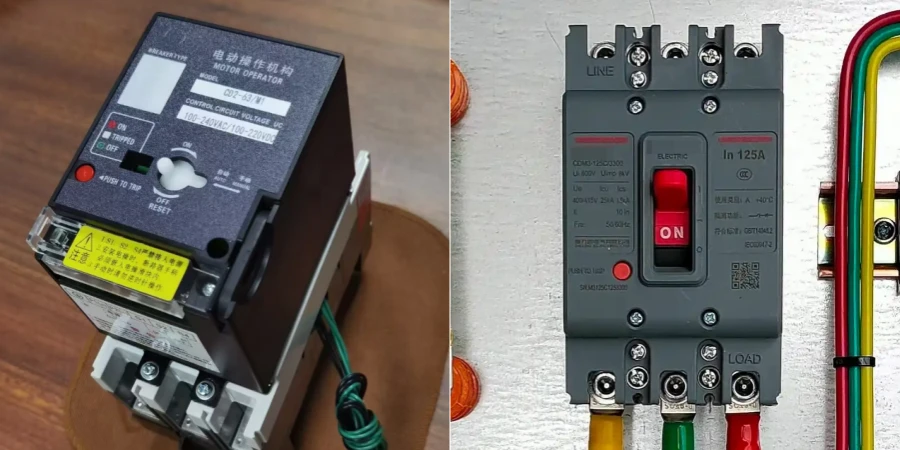
We introduced the motorized operating mechanism in the previous blog(A Simple Intro to Motorized Operating Mechanism), showing how it can make controlling electrical circuits easier from a distance. But that raises a common question: do you really need a motorized MCCB, or will a manual one do the job just as well? It’s a small decision on the surface, yet it can have a big impact on how smoothly a facility runs.
Some people are drawn to motorized breakers because they seem modern and convenient. Others stick with manual ones, appreciating their simplicity and reliability. Each approach has its place, and what works well for one setup might not make sense for another.
What matters isn’t how advanced the breaker is, but whether it solves the problem you actually have. In some setups remote control helps; in others a simple manual switch is all you need.
Manual vs. Motorized MCCBs
Controlling electrical circuits comes down to a simple choice: flip a switch yourself on site, or manage it from somewhere else. Each method has its own benefits and drawbacks.
The Manual Approach
Manual MCCBs are as straightforward as it gets. There’s a handle or lever on the front, and when you need to turn the circuit on or off, you walk up to the panel and flip it. That’s it. No electronics, no remote connections—just a simple, mechanism. In the real world, there are so many installations where this is exactly needed: a small workshop, a standalone pump station, or a backup panel that rarely gets touched.
The beauty lies in its reliability. There’s no control power to lose, no communication interface to diagnose, and no extra wiring to maintain. If something else in the control system fails, your manual breaker still works exactly as it should.
The Motorized Approach
A motorized MCCBs takes that same breaker and adds a motor operator, some auxiliary contacts for feedback, and terminals for remote control wiring. Suddenly, you can flip that breaker from anywhere—your control room, a building management system, or even your phone if the system’s set up that way.
Motorized MCCBs really shine when your equipment is spread out or needs to be switched on and off often. Instead of sending someone to walk or drive to each panel, you can control everything from one place. This makes the system faster to operate and keeps people safer because they don’t have to go into risky areas just to flip a breaker.
What Really Sets Them Apart
The difference between these two options goes beyond “manual versus automatic.” Here’s what matters in real-world use:
| Characteristic | Manual MCCB | Motorized MCCB |
|---|---|---|
| Operation Method | Physical handle at breaker location | Remote electrical signals from control panel |
| Response Speed | Depends on technician availability | Instant remote response |
| Emergency Access | Always manually accessible | Requires control power (manual backup available) |
| Status Monitoring | Visual inspection required | Real-time feedback via auxiliary contacts |
| Automation Capability | Limited to manual switching | Full integration with PLCs and control systems |
During a fault, a manual breaker needs someone to physically go to the panel, assess the situation, and reset the breaker—assuming they’re even on site. With a motorized system connected to smart monitoring, you get instant notification of the trip condition, can see voltage and current readings remotely, and in many cases, can safely reset the breaker from your control room after confirming the fault is cleared.
But here’s one point that often gets overlooked: "motorized" doesn’t mean you lose manual control. Most motorized MCCBs still include a manual operating mechanism as a backup. So if your control power fails or your PLC goes down, you can still walk up to the breaker and operate it by hand. You’re not trading reliability for convenience—you’re adding capability on top of what you already have.
Costs and Value
This is where the discussion often gets tricky. Many people focus mainly on the upfront price—and yes, motorized MCCBs are more expensive at the start—but the upfront cost rarely reflects the full picture.
At first glance, a motorized MCCB will always cost more than a comparable manual breaker. You’re paying for the motor operator, auxiliary contacts, and additional control hardware. Depending on the size and manufacturer, this price can range from a few hundred to over a thousand dollars per breaker. For small, simple installations, this difference can seem pretty high.
Looking Beyond the Sticker Price
The real cost advantage of motorized MCCBs shows up when you consider all the hidden expenses of a control system. Manual breakers require separate control wiring, junction boxes, conduit, and labor to pull and terminate cables. Troubleshooting and maintenance for these systems are also more time-consuming. In contrast, motorized breakers often use standardized communication wiring that reduces installation time, simplifies maintenance, and lowers long-term labor costs.
Even small reductions in installation and maintenance effort can add up over time. For facilities with multiple circuits, the extra investment in motorized breakers can pay for itself within a few years because it eliminates repetitive labor and streamlines system operation.
The Five-Year Picture
When you factor in lifecycle costs, the picture becomes clearer. Consider the following comparison between higher-quality motorized installations and simpler, budget-oriented manual setups:
| Cost Factor | High-Quality Motorized Setup | Basic Manual Setup |
|---|---|---|
| Initial Equipment & Installation | Moderate to High | Low |
| Annual Maintenance | Lower | Higher |
| Failure Rate | Low | Higher |
| Unexpected Downtime | Minimal | Potentially Significant |
| Total 5-Year Cost | Moderate | Potentially Much Higher |
Even without dramatic failures, manual systems often require more maintenance and troubleshooting over time. Motorized MCCBs with soft-start features place less mechanical stress on contacts, extend component life, and reduce the frequency of recalibration. That means lower ongoing maintenance costs and fewer unexpected interruptions.
When Manual Makes Financial Sense?
Now, I’m not here to tell you motorized is always the answer. If you’re installing a simple feeder circuit for a small commercial building—maybe a retail shop or a small office—and there’s zero need for automation, spending extra on a motorized breaker makes no sense. You’d be paying for features you’ll never use.
The same goes for temporary installations, seasonal operations, or anywhere the electrical system is genuinely simple. I worked with a customer on a project for a storage facility—just lighting circuits and some outlets. They asked about motorized breakers, and I told them honestly: "You’d be wasting your money." Sometimes the basic solution is the right solution.
The Crossover Point
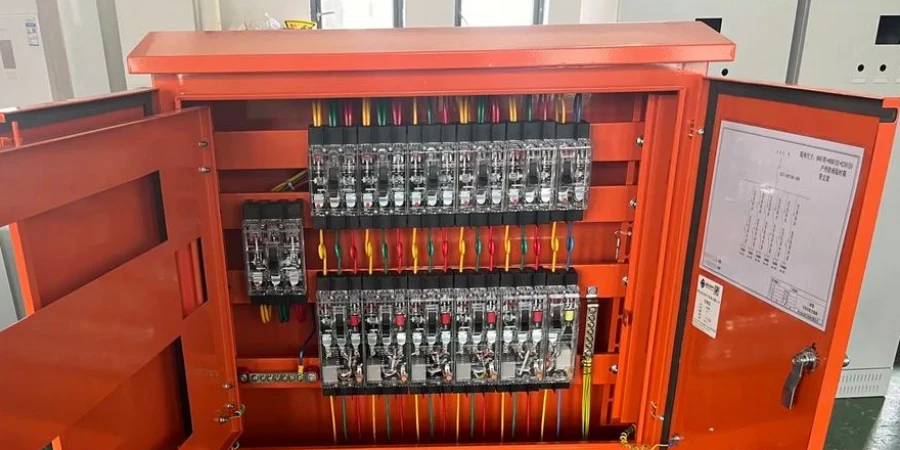
Motorized MCCBs start to make financial sense when you have multiple circuits to coordinate, automated operations, or systems that run beyond regular hours. Each manual intervention you avoid saves labor costs and reduces potential errors. Add to that the potential for energy optimization—through better load management and demand control—and the long-term savings can be substantial.
The bottom line: making decisions based solely on initial purchase price can be misleading. Consider the full lifecycle, operational efficiency, and labor savings. In many cases, a motorized MCCB can pay for itself faster than you might expect, even if it seems more expensive upfront.
Making the Right Decision for Your Project
Let’s get back to the practical question: which type of MCCB actually makes sense for your specific situation?
Many people picks a solution based on what they think they "should" do rather than what they actually need. Sometimes that means over-engineering with motorized breakers where manual would work fine. Other times it means going manual to save money upfront, only to spend more later retrofitting automation that should have been there from the start.
Start with Your Actual Requirements
Before you make any decisions, get clear on what your operations truly need.
-
Do you need remote control? Not “it would be nice” or “maybe someday”—is it actually necessary for efficient operation? If you’re running unattended sites, multiple buildings, or operations outside business hours, that’s a real need. If staff is always on-site and panels are accessible, remote control may be a luxury.
-
Is integration with other systems important? If you already use a building management system, SCADA, or industrial controls, integrating your breakers makes sense. If you don’t have or plan to implement these systems, motorized integration adds little value.
-
What’s your operational complexity? A facility with a single motor and simple loads doesn’t need the same setup as a facility with 30 motors requiring coordinated sequencing. Be honest about complexity—don’t oversimplify, but don’t overcomplicate either.
Consider Your Current and Future State
Here’s something you need to think: "What does my facility look like in five years?" Not in some aspirational sense, but realistically:
- Are expansions planned?
- Will operatons become more automated?
- Are renewable energy or backup power systems coming online?
If growth and automation are in your future, investing in motorized breakers now might make sense even if you don’t need all the features immediately. The infrastructure will be in place when you need it. But if your facility is essentially stable—same equipment, same operations, no major changes planned—designing for a future that probably won’t happen doesn’t make financial sense.
Evaluate Your Budget Realistically
Look at total cost of ownership, not just the initial purchase price.
If you’re working with a tight budget and genuinely don’t need remote control or automation, manual breakers let you maintain proper circuit protection without overspending. There’s no shame in choosing the economical solution when it meets your needs.
But if you’ll end up sending people to manually operate breakers regularly, if you’re missing energy savings opportunities, or if manual operation is creating safety concerns or operational inefficiencies, the "cheaper" option is actually costing you more. Run the actual numbers for your facility—labor time, energy costs, downtime risks—and see which solution makes better financial sense over the system’s life.
Consider Your Technical Capabilities
This one doesn’t get discussed enough. Motorized MCCBs integrated with control systems require someone who can maintain and troubleshoot those systems. If you have in-house people—an electrician comfortable with PLCs, controls technicians familiar with building automation, or engineers who understand the systems—great. If you don’t, and you’d be completely depending on outside contractors for even basic troubleshooting, that’s a consideration.
Manual breakers are simpler to maintain and troubleshoot. Most electricians can work on them confidently. Parts are readily available. There’s less that can go wrong, and what does go wrong is usually straightforward to fix.
I’m not saying lack of in-house expertise should automatically rule out motorized systems. But it should factor into your decision and your budget. If you’ll need to contract all the maintenance and troubleshooting, include those ongoing costs in your total cost of ownership calculation.
A Practical Decision Framework
Choose manual breakers when:
- Your facility operations are straightforward with readily accessible equipment
- You have staff on-site during all operating hours who can perform switching operations
- Budget constraints are significant and automation isn’t operationally necessary
- You lack the technical infrastructure (control systems, communication networks) to support motorized operation
- The electrical system is simple enough that manual operation doesn’t create efficiency or safety problems
Choose motorized breakers when:
- You need remote operation for safety, efficiency, or operational reasons
- Your facility includes unattended operations or equipment in difficult-to-access locations
- You’re integrating with building management or industrial control systems
- You have multiple motors requiring coordinated control or sequencing
- Energy management and load optimization are important operational goals
- The facility operates 24/7 or outside normal business hours
- Downtime costs are high enough that faster fault response and predictive maintenance provide clear value
Consider a hybrid approach when:
- Most of your system is straightforward, but specific circuits would benefit from remote control or automation
- Budget allows motorization of critical circuits but not the entire system
- You want to test motorized operation in key areas before committing to a full implementation
- Emergency or critical circuits need guaranteed manual accessibility while normal circuits can be automated
The Upgrade Question
Can you upgrade later if your needs change? Usually yes, most modern MCCBs can be retrofitted with motor operators if you decide you need automation down the road. But it’s more expensive and disruptive to retrofit than to install motorized breakers initially when the system is being built.
If you’re unsure, and can afford it, leaning toward motorized might be the safer choice—you can always operate them manually if you don’t need the automation, but you can’t easily add automation to manual breakers without a retrofit project.
But if you’re confident in your requirements and manual breakers meet those requirements, don’t let anyone convince you that you need features you don’t. Good engineering means matching the solution to the need, not the most sophisticated option by default.
Trust Your Operational Knowledge
Final thought: you know your facility better than anyone else. You know what works, what doesn’t, where the pain points are, and where money gets wasted. Trust that knowledge.
Google can tell you the technical information, industry data, and general guidelines, but you’re the one who understands whether remote breaker control would actually improve your operations or just be a fancy feature you never use. You’re the one who knows whether your team can maintain motorized systems or whether simpler is better. You’re the one who knows what your budget really allows and what your facility actually needs.
Make the decision based on your specific situation, not on what’s trendy or what someone else’s facility is doing. Both manual and motorized MCCBs are good solutions—they’re just good solutions for different situations. Pick the one that matches yours.
Conclusion
The best choices aren’t always the most advanced. Sometimes keeping things simple is safer and easier, while other times using new technology can make life easier in ways you didn’t expect. Knowing what really matters for your facility makes the difference.
Whether you decide to stick with the reliability of manual breakers or upgrade to the convenience of motorized operation, having a manufacturing partner who understands both is crucial.