
Do you know that the tiny shakes and bumps your circuit breakers face every day can quietly cause problems over time? Most of us only notice when something finally stops working, but the effects often start long before that.
Even small jolts or vibrations can loosen connections, wear down metal parts, or change how the breaker’s mechanism works. These changes happen slowly and are easy to miss, yet they can lead to unexpected failures if ignored.
Learning how these forces act gives us a new perspective on everyday equipment. It makes us wonder how many other devices around us face hidden stresses and how small, unseen forces shape the reliability of the tools we rely on.
Understanding Vibration and Mechanical Shock in Circuit Breakers
In the early years, I thought vibration was just "shaking." But then I realize I was totally wrong. Now let me break down what we’re actually dealing with when we talk about vibration and shock in circuit breakers.
Vibration is repetitive back-and-forth motion—You can think of it as the breaker moving continuously in small oscillations. We measure this in two main ways: displacement (how far something moves, usually in millimeters) at lower frequencies, and acceleration (how forcefully it moves, measured in g-forces) at higher frequencies.
You’ll see specifications like "0.38 mm from 10–57 Hz" or "5 g from 57–500 Hz" in breaker datasheets. These numbers aren’t random—they define the testing conditions that manufacturers use to qualify their products according to IEC 60068-2-6 standards.
On the other hand, mechanical shock is a completely different animal. It’s a sudden, high-acceleration pulse that happens over a very short duration—usually measured in milliseconds. Think of dropping a breaker or experiencing a sudden impact during transport. Testing standards like IEC 60068-2-27 define these shock pulses with specific peak accelerations and durations—for example, 25 g for 13 milliseconds. While that might sound extreme, these tests are designed to reveal mechanical weaknesses that could lead to failure in real-world conditions.
Why the Difference Matters?
Understanding this distinction has saved me from specification mistakes more than once. Vibration and shock stress circuit breakers in basically different ways.
Continuous vibration is like a marathon runner—it doesn’t hit hard all at once, but over time it wears down joints, loosens connections, and creates fatigue in mechanical components. I’ve seen bolted connections in vibrating panels that looked tight during installation become loose enough to cause heating problems within just a few months.
Shock, by contrast, is like a sprinter—short, intense, and capable of immediate damage. A single severe shock can fracture plastic housings, shift internal components, or knock calibration settings out of alignment.

The failure modes are completely different: vibration tends to cause gradual degradation( like fretting corrosion at connections, slow drift in trip calibration, and progressively loosening of terminals. Shock can cause sudden failures: cracked components, displaced latches, or immediate malfunction of the trip mechanism.
Real-World Implications
This distinction is especially important when specifying or installing equipment. A breaker might pass shock testing with flying colors but still fail prematurely under continuous vibration—or vice versa.
The standards bodies understand this distinction, which is why products need to pass both types of tests to be considered suitable for demanding environments. For example, when you see a rail-grade breaker certified to EN 61373, that certification means it’s been tested for both the continuous vibration of rail travel and the shock loads from track irregularities and braking events. This dual qualification matters because real-world applications rarely give you just one type of stress—they give you both.
Physical Effects on Circuit Breaker Components
Damage from shocks is easy to understand—a sudden hit can break parts of a circuit breaker right away. Continuous vibration, on the other hand, works more quietly and is less obvious, even though it can still have important effects over time.
Loosening of Connections and Terminals
One of the most common problem is loose connections. It sounds simple, almost trivial, but vibration-induced loosening is responsible for more breaker problems than any other single cause. Here’s what happens at a microscopic level that most training classes never cover.
When you torque down a terminal connection, you’re creating a clamping force that holds two metal surfaces together. That force depends on the bolt or screw maintaining its tension. But vibration causes a process called "relaxation"—tiny amounts of relative motion between the surfaces that gradually reduces the bolt preload. Research on bolted structures shows that just a few thousandths of an inch of fretting wear can cut bolt preload roughly in half.
Infrared scans on panels in high-vibration environments revealed shocking differences at terminal connections. Connection that started at proper torque had gradually loosened enough to create measurable resistance, which generated heat, which accelerated oxidation, which increased resistance further—a vicious cycle. For critical main distribution, we recommend Air Circuit Breakers (ACB) with reinforced, vibration-resistant terminals to prevent this cycle of failure.
Fretting Corrosion
Fretting corrosion is one of those problems that most people don’t know about until it bites them. It happens when two metal surfaces under pressure experience tiny oscillatory movements—we’re talking micrometers of motion here. The protective oxide layers on the metal surfaces break down, fresh metal is exposed to oxygen, and wear debris accumulates at the interface. In steel connections, this debris is typically magnetite and hematite, which actually accelerates wear and can initiate stress corrosion cracking.
Schneider explicitly identifies fretting corrosion at internal connectors as a major concern in low-voltage circuit breakers exposed to vibration. The tricky part is that the external terminals might look fine—properly torqued and visible undamaged—while internal connectors are deteriorating. This can generate false signals in electronic trip units or create intermittent high-resistance paths that lead to nuisance tripping.
Trip Mechanism Calibration Drift
Circuit breakers rely on mechanical trip mechanisms that are precision-calibrated at the factory. Magnetic breakers have armatures that must overcome spring tension at a specific current. Thermal-magnetic breakers use bimetallic strips that bend at predetermined temperatures. Hydraulic-magnetic designs use viscous fluid damping for time-delays. Every one of these mechanisms can be affected by vibration.
Magnetic and hydraulic-magnetic breakers are particularly sensitive to vibration and shock because they rely on moving parts whose neutral position and friction characteristics matter. If vibration alters these parameters—maybe by wearing away lubrication, creating burrs on sliding surfaces, or changing the position of return springs—the actual trip current and time can drift away from the published trip curves.
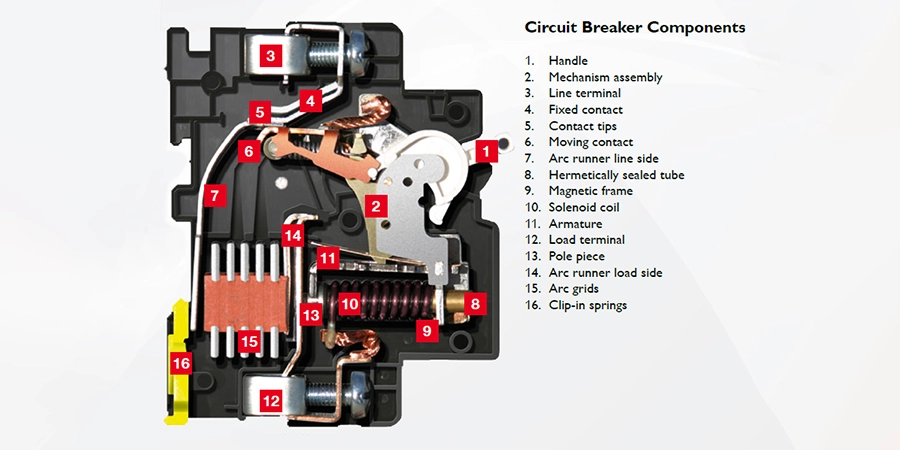
I’ve seen this show up in two ways. Sometimes you get nuisance tripping, where the breaker becomes more sensitive than usual. Other times—and this is more dangerous—you get delayed or missed trips where the breaker doesn’t respond properly to genuine fault conditions. Both trace back to the same root cause: mechanical degradation of the trip mechanism due to vibration.
Specific Vulnerabilities by Component
Different internal components react differently to vibration. Contact assemblies may lose pressure, which affects both resistance and arc suppression. The arc chutes (those ceramic or composite structures that help extinguish arcs) can develop cracks or shifting that reduces their effectiveness. Latch mechanisms holding contacts closed can wear that makes them more likely to release unexpectedly.
Hioki’s article points out that magnetic breakers with hinged metal parts are particularly prone to tripping under strong vibration or shocks even without an electrical fault. The energy from vibration can overcome the magnetic holding force, causing the armature to move enough to trigger the trip mechanism. This is especially problematic in instantaneous-trip designs where there’s no intentional time delay to filter out brief mechanical disturbances.
Common Symptoms You’ll See
Let me share you some practical warning signs based on field experience. Buzzing or humming from breakers is often the first clue—while some magnetic hum under load is normal, louder or irregular buzzing usually points to loose connections or vibration issues. Discoloration around terminals is another red flag—it shows the connection is heating up due to increased resistance.
If you notice breakers that feel warm under normal load, or if trips seem to follow the operation of nearby equipment, that’s another warning that vibration may be causing problems.
The trickiest issues are intermittent ones that appear randomly. These often come from connections that are just loose enough to cause trouble under certain vibrations, or from trip mechanisms that are operating right at their tolerance limits. In both cases, the combination of electrical load and mechanical stress can make the breaker behave unpredictably.
Conclusion
The quiet, persistent effects of vibration and sudden shocks remind us that durability isn’t just tested in labs—it’s earned in the real world. Observing and understanding these forces can change how we approach all kinds of engineering design.