
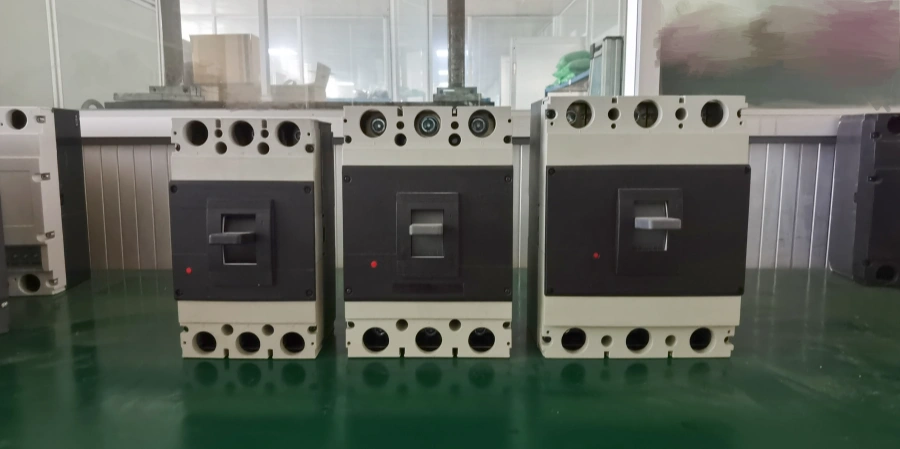
In our previous blog, we gave a simple overview of MCCB frame sizes. Knowing the frame size is a good start, but it’s only part of the story. The real question is: how do you pick the right breaker for your actual system and loads? (A Simple Guide to Understanding MCCB Frame Sizes)
Choosing the right MCCB is more than reading numbers. When I started in the field, the engineer guiding me said, “Don’t just look at labels—understand how the system really works.” Ignoring small details, like temperature or continuous loads, can make breakers trip and damage equipment. That lesson stuck.
The right choice isn’t always obvious. Systems have quirks—fluctuating loads, cramped or hot rooms. Even experienced engineers can miss details that later cause problems. Paying attention early saves headaches, protects equipment, and keeps everything running smoothly.
Essential Selection Factors
Selecting the right MCCB frame size comes down to four essential factors. If you miss any one of them, you risk problems—either immediately or later on.
Here’s a breakdown of each factor, based on what I’ve seen work (and not work) in the field.
Load Current Calculation
This is where everything starts. You need to know the actual current your circuit will carry—and it’s not just as simple as adding up nameplate ratings. For motor loads, you’ll need to use the three-phase motor current formula, which considers power, voltage, power factor, and efficiency:
I = \frac{P}{\sqrt{3} \times V \times \cos \phi \times \eta}where P is real power in watts, V is line voltage, cos φ is power factor, and η is motor efficiency.
A key detail often overlooked is the distinction between continuous and non-continuous loads. Continuous loads run for three hours or more. According to the NEC, your MCCB rating must cover at least 125% of that load. Non-continuous loads only require 100% coverage.
For example, a 200A continuous load requires a breaker rated at 250A (200 × 1.25). Ignoring this rule can lead to breakers running hot and tripping under normal conditions.
Breaking Capacity Requirements
Breaking capacity, also called interrupting rating, is the maximum fault current an MCCB can safely interrupt without failing. It’s measured in kiloamperes (kA) at a specific voltage.
There are two key ratings to know:
- Icu (Ultimate Breaking Capacity): The maximum short-circuit current the breaker can interrupt without immediate catastrophic failure. At this current, the breaker may be damaged and require replacement.
- Ics (Service Breaking Capacity): The maximum short-circuit current the breaker can safely interrupt and still remain usable afterward. This is the rating that matters for normal operation and safety. (Related Reading: Icu and Ics on Circuit Breakers: What You Need to Know)
Your breaker’s Icu must exceed the Prospective Short-Circuit Current (PSCC) at its installation point. If a fault occurs above that limit, the breaker can fail catastrophically—causing arc flashes, equipment damage, or injury.
Typical requirements vary by application:
- Industrial facilities: 35–100 kA due to nearby transformers and large motors.
- Commercial buildings: 25–65 kA, enough for most setups.
- Smaller commercial/residential: 10–25 kA usually suffices.
You should always calculate or measure your PSCC instead of guessing.
Environmental Conditions and Temperature
Here’s something I wish more people understood from the start: MCCBs aren’t used in labs. They’re installed in real-world conditions: electrical rooms that get hot, outdoor panels exposed to sun and weather, or crowded cabinets with poor ventilation. All of this matters because breakers are calibrated at 40°C (104°F) ambient temperature.
If your environment is hotter, you must apply derating factors. For example, a breaker in a 50°C room needs a derating factor of about 0.9. If your load is 200A:
200A÷0.9=222ASo you’d pick a frame that can handle at least 222A—usually a 250A frame.
I’ve seen many electrical rooms where poor ventilation caused internal temperatures to soar. Multiple breakers in tight cabinets, lack of airflow, and direct sunlight can all raise operating temperatures. Other environmental considerations include humidity (IP-rated breakers), dust (dust-tight enclosures), and vibration (secure mounting or shock-rated breakers).
| Ambient Temperature | Derating Factor | Example: 200A Load |
|---|---|---|
| 40°C (reference) | 1.0 | 200A breaker needed |
| 50°C | 0.9 | 222A breaker needed (250A frame) |
| 60°C | 0.8 | 250A breaker needed |
| 70°C | 0.7 | 286A breaker needed (400A frame) |
Voltage Rating Compatibility
Finally, your MCCB’s voltage rating must match the system voltage. Using a 240V breaker on a 480V system is dangerous: it can fail to interrupt a fault and damage insulation. Standard voltage ratings include 120V, 240V, 480V, and 600V. Always confirm that your chosen frame size is available in the voltage you need—most are, but don’t assume.
Step-by-Step Selection Process
Now that we’ve covered the basic factors, let’s walk through the actual selection process. Over the years, engineers have simplified it into a methodical approach that works reliably across different projects. The key is not to skip steps. Each one builds on the previous one, and cutting corners usually leads to problems later.
1. Calculate Your Adjusted Load Current
Start by totaling all connected loads in amperes. Remember the distinction between continuous and non-continuous loads:
\text{Total Current} = (100\% \times \text{Non-continuous Load}) + (125\% \times \text{Continuous Load})Remember what we discussed earlier, many mistakes happen here because people simply sum nameplate ratings without applying the 125% factor for continuous loads.
Example: A warehouse has lighting (80A continuous), HVAC (120A continuous), and overhead cranes (150A non-continuous):
(80 \times 1.25)+(120 \times 1.25)+(150 \times 1)=100+150+150=400AIf they had just added the nameplate ratings, they’d get 350A and undersize the breaker.
2. Apply Environmental Derating
Next is the step that gets forgotten. If your installation environment exceeds that 40°C reference temperature, you need to adjust your calculated load current upward. The formula is simple:
\text{Required Capacity} = \frac{\text{Load Current}}{\text{Derating Factor}}Let’s use the warehouse example again, the electrical room reaches 50°C. With a derating factor of 0.9:
400A \div 0.9A = 444AThis means a 400A frame wouldn’t suffice—they needed a 630A frame. Many breakers trip in hot rooms simply because ambient temperature wasn’t considered. Temperature derating is essential for reliable operation.
3. Select the Proper Frame Size
Now you’re ready to pick your frame size.
Select a frame whose maximum trip unit capacity meets or exceeds your adjusted load current. In our warehouse example, 444A requires the next standard frame size, 630A. This frame can accommodate trip units from 400A to 630A, so you might install a 500A or 630A trip unit depending on your specific needs and any future expansion plans.
Here is a tip I learnt from a 20-year electrical engineer: don’t automatically jump to the next frame size if you’re close to capacity. If your calculation shows 248A required and a 250A frame exists, use it. Oversizing can reduce protection sensitivity and disrupt coordination. Some people think they’re being conservative by going to 400A, but that’s oversizing, and it causes the problems—reduced protection sensitivity and potentially compromised coordination.
4. Calculate or Confirm PSCC
The Prospective Short-Circuit Current calculation(PSCC) is where things get technical, but it’s not as complicated as it seems. The basic estimation formula is:
\text{PSCC} = \frac{\text{Supply Voltage}}{\text{System Impedance}}Here, system impedance includes the utility transformer, cables, and all components between the power source and the breaker. Motor loads also contribute significantly to fault current, and for rough field estimates, engineers sometimes multiply total motor current by 4 to 6. For example, a 300A motor load may contribute 1,200–1,800A to the short-circuit current.
Important: In real-world projects, PSCC should always be calculated by a qualified electrical engineer or a professional design office. They use specialized software that accounts for transformer characteristics, all line and cable impedances, and motor contributions, producing precise short-circuit currents at each point in the system. While this needs some upfront cost, it ensures safety, prevents catastrophic breaker failures, and reduces liability.
5. Verify Breaking Capacity
Your selected breaker’s breaking capacity (in kA) must exceed the PSCC. This is non-negotiable.
Example: if your calculation shows the PSCC is 45 kA at a distribution panel. You need an MCCB with a breaking capacity of at least 50 kA(building in a small safety margin is smart). If you install a breaker rated for only 35kA, you’re creating a serious hazard.
Different manufacturers offer the same frame sizes with different breaking capacities, so you have options. A 400A frame might be available in 35 kA, 50 kA, 65 kA, or even 100 kA versions. The higher breaking capacity models cost more, but you only pay for what you actually need based on your PSCC calculations.
6. Choose Trip Unit Type and Pole Configuration
The final step involves two key decisions: the type of trip unit and the number of poles:
Trip Unit Type
Thermal-magnetic trip units are the traditional choice. They are reliable, proven, and cost-effective for standard applications, using a bimetallic strip for overload protection and a magnetic coil for short-circuit protection. Electronic trip units are more advanced: they use microprocessors to monitor current and allow adjustable settings for overload, short-circuit, and ground fault protection.
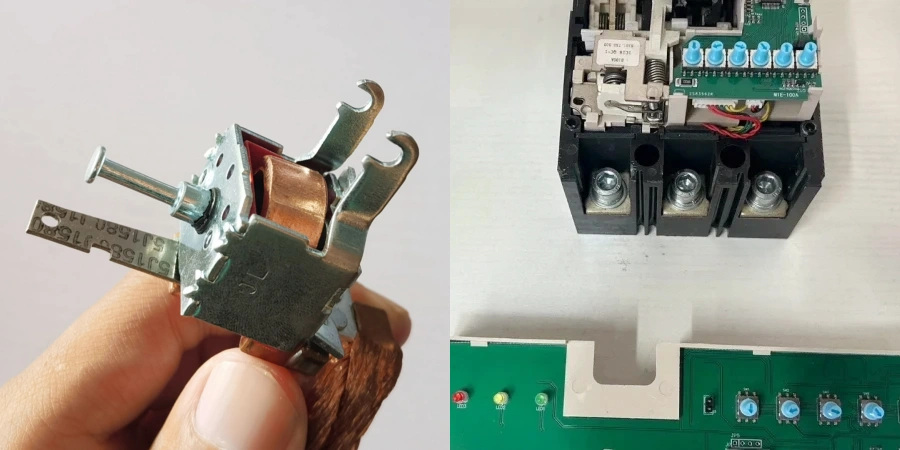
In my experience, thermal-magnetic units remain dominant in simple applications like branch circuits or basic feeders. Electronic units excel in complex systems where precise protection, diagnostic capabilities, or selective coordination is required. They are also preferable for variable loads or situations where protection curves need fine-tuning. (Related Reading: Thermal-Magnetic vs Electronic MCCB, Which One Do You Need?)
Pole Configuration
Then, how many poles? For three-phase systems, the choice is usually between 3-pole and 4-pole MCCBs.
A 3-pole MCCB protects the three phase conductors but not the neutral, which is suitable for balanced loads like motors with minimal neutral current.
A 4-pole MCCB adds neutral protection, essential in modern commercial buildings with significant single-phase loads, LED lighting, computers, or variable-speed drives. These systems create unbalanced and harmonic currents that can overload the neutral, making 4-pole protection critical.
Conclusion
The numbers guide you, but the environment and real-life usage define success. Choosing MCCBs thoughtfully encourages engineers to combine technical skill with practical insight, turning routine calculations into meaningful decisions that safeguard people, equipment, and long-term system performance.