
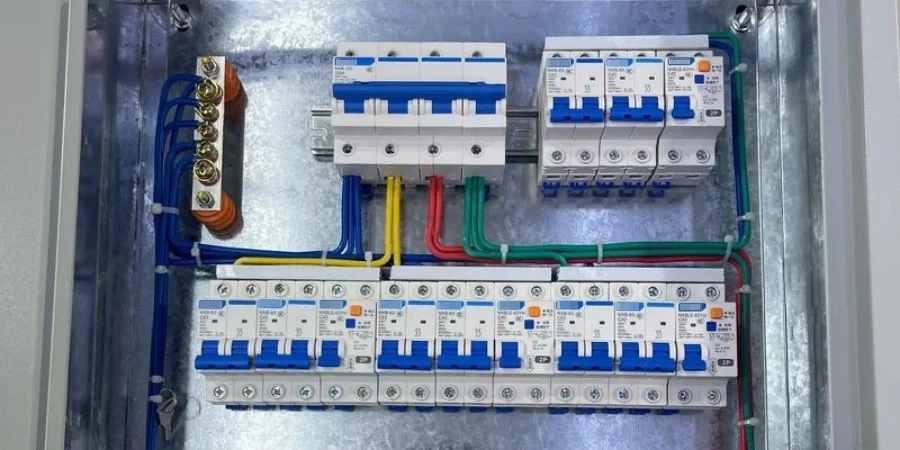
When you look at a distribution board, the first thing you usually notice is how neat it all looks—every breaker lined up, almost all from the same brand, giving it a clean, orderly appearance. It’s the kind of setup that makes you think everything inside is simple and straightforward.
But then a question often comes to mind: if the original breaker isn’t available, is it okay to mix in a breaker from a different brand? It sounds like an easy choice, yet it’s one that sparks curiosity and debate among electricians and anyone working with these boards.
The truth is, each distribution board is carefully designed with its own details that aren’t obvious at first glance. Even small differences can matter, and that’s what makes this question more interesting than it seems. It’s a small curiosity with bigger implications, and worth taking a closer look.
What "Mixing Breaker Brands" Actually Means?
I had spent a good part of my career working closely with the production and product planning teams at an electrical equipment manufacturer. One question that kept coming up — from customers, contractors, and even internally — about whether it’s okay to swap in a different brand’s breaker when the original isn’t available. It sounds like a simple question, but the answer is more nuanced than most people expect.
At its core, "mixing breaker brands" means installing miniature circuit breakers (MCBs), RCBOs, RCDs, or other protective devices from different manufacturers in the same distribution board or consumer unit. On the surface, this seems harmless. The breaker fits in, the DIN rail clips hold it, and the board closes up just fine. Job done, right?
Not quite.
Physical Fit Is Not the Same as System Compatibility
This is where many people — even experienced ones — get tripped up. A breaker from Brand B might slot perfectly into a board made by Brand A: same rail spacing, same pole width, same voltage rating on the label. But physically fitting in and being approved_to work in that board are two completely different things.
Here’s why that matters. When a manufacturer designs a distribution board, the busbar geometry, terminal clamping force, contact area, and thermal clearances are all engineered around their own breakers. For example, the contact pressure between the breaker and busbar, is calculated to handle specific current levels without overheating. A breaker from another manufacturer may have slightly different clip tension or contact dimensions — small enough that you’d never notice by eye, but enough to create resistance, heat buildup, or unreliable contact under load.
Think of it like buying a third-party battery for a power tool. It fits the slot, the voltage matches, but the discharge curve, communication protocol, or internal resistance may behave differently than what the tool was designed for. Over time, that mismatch causes problems.
What Counts as "Mixing"?
It’s worth being clear about what falls under this category, because it’s broader than most people assume:
| Scenario | Counts as Mixing? |
|---|---|
| Brand A board + Brand B MCB | Yes |
| Brand A board + Brand A MCB (different series) | Sometimes — check manufacturer docs |
| Brand A board + UL-classified Brand B breaker | Only if panel model is on the classification list |
| Brand A board + Brand A MCB (same series, listed) | No — this is the correct approach |
The mixing of breaker brands also includes situations where boards have been extended or modified over time by different installers, each using whatever was available. The result is a patchwork of devices that were never tested together as a system — which brings us to the next section.
How Distribution Boards Are Tested and Certified?
One thing I learnt working on the manufacturing side is how much goes into getting a distribution board certified before it ever reaches a job site. It’s not just about testing the board shell or the individual breakers separately. The whole system — board, busbars, and the specific breakers installed in it — gets tested together as a single unit. Understanding this made it much easier to see why mixing brands is such a contentious issue.
Most people outside the industry assume that if a breaker is certified and a board is certified, putting them together is automatically fine. That’s a reasonable assumption, but it’s not how the certification process works.
Boards Are Certified as Complete Assemblies
A distribution board or consumer unit isn’t just a housing. It’s a system. When a manufacturer submits it for certification, they test it with specific breakers installed — usually their own lineup, matched to the board’s busbar design and thermal characteristics. The certification covers that specific combination, not a free-for-all mix of any compliant devices.
This distinction is critical, and the standards make it explicit.
Key Standards That Govern This
| Standard | Region | What It Covers |
|---|---|---|
| UL 67 | North America | Panelboard construction and assembly testing |
| UL 489 | North America | Individual molded-case circuit breaker performance |
| IEC 61439 | International/Europe | Low-voltage switchgear and controlgear assemblies |
| IEC 60898 | International/Europe | MCB product standard (not assembly approval) |
| BS EN 61439 | UK/Europe | UK-adopted version of IEC 61439 |
In North America, UL 67 governs the panelboard as an assembly, while UL 489 covers the breaker as a standalone product. A breaker that passes UL 489 testing is certified for its own performance — interrupting capacity, trip accuracy, insulation — but that certification doesn’t automatically make it approved for use in every UL 67 panel. The panel manufacturer decides which breakers are listed for their board, and that information appears on the board’s label and in its installation documentation.
How IEC 61439 Approaches Assembly Testing?
In IEC and BS EN markets, IEC 61439 takes a similar but arguably stricter approach. Low-voltage assemblies, including consumer units and distribution boards must be type-tested with the actual devices that will be installed. The assembly manufacturer must declare which devices are suitable for their board. If a device isn’t listed in that declaration, it’s outside the scope of the type-tested assembly.
This is why mixing brands in a consumer unit doesn’t just raise a safety concern — it formally voids the board’s type-tested status under 61439. The installer then takes on the responsibility of demonstrating that the modified assembly still meets the standard’s requirements, which is a burden most people would rather avoid.
The takeaway is simple: a breaker being "certified" on its own doesn’t mean it’s certified for your specific board. Those are two separate approvals, and both matter.
The Risks of Mixing Breaker Brands
There’s a common assumption in the field that if a board is running fine today, whatever’s in it must be okay. I’ve heard that logic more times than I can count. But from where I sat, I learned that electrical problems often don’t announce themselves right away. They build quietly, over months or years, until something finally gives.
That’s exactly the kind of risk you take when mixing breaker brands without documented compatibility.
Overheating at the Busbar Interface
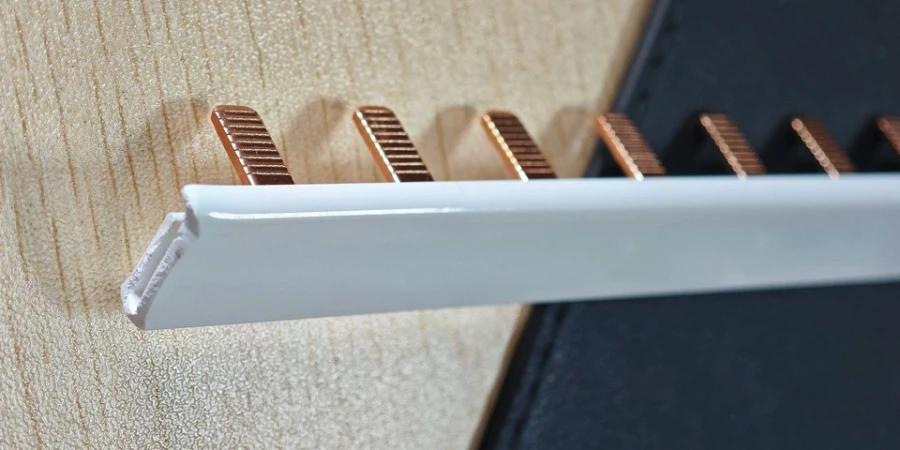
This is probably the most common and least visible risk. When a breaker from a different manufacturer connects to a busbar it wasn’t designed for, the contact interface may not be ideal. The clip tension might be slightly off, or the contact surface area might differ. Under normal conditions, this might not cause an immediate problem. But under sustained load — especially in boards running near capacity — that small difference in contact resistance generates heat.
Over time, that heat degrades the insulation around conductors, weakens terminal connections, and create the conditions that lead to arc faults or ignition. It’s a slow process, but it’s real. Several technical sources on breaker compatibility point to overheating at the busbar as one of the primary failure modes when brands are mixed without proper testing.
Loose or Stressed Terminals
Mounting dimensions and tolerances vary between manufacturers, even when products look nearly the same. A breaker that doesn’t seat perfectly against the busbar — even by a millimetre — can introduce mechanical stress at the terminal connection. That stress can cause the connection to loosen over time, particularly in environments with vibration or thermal cycling (which is basically every electrical installation that runs daily loads).
Loose terminals mean increased resistance, which means more heat. And that brings us right back to the overheating issue.
Nuisance Tripping and Failure to Trip
Protective coordination — the timing and threshold at which breakers trip — is carefully engineered within a distribution system. Breakers from different manufacturers may have slightly different trip curves, even if they carry the same nominal rating. This mismatch can cause two very different problems:
-
Nuisance tripping — the breaker trips when it shouldn’t, interrupting supply unnecessarily. (Related Reading: What Is Nuisance Tripping)
-
Failure to trip — more serious, the breaker doesn’t trip quickly enough under a fault condition, allowing dangerous currents to persist longer than the system was designed to tolerate.
As noted in industry guidance on mixed-brand boards, overheating, nuisance tripping, code violations, and safety risks are the common outcomes when brands are mixed without verified compatibility. None of these risks are theoretical — they’re the documented reasons why certification bodies require assembly-level testing in the first place.
What About Fire and Shock Hazards?
Yes, both are real possibilities in the worst-case scenario. Sustained overheating at a busbar or terminal can degrade surrounding insulation and create an ignition point — particularly in older boards or enclosed enclosures with limited airflow. If a breaker fails to trip reliably, fault currents can persist beyond safe limits, increasing the risk of electric shock for anyone working on or near the installation.
That is why many inspectors and insurers treat non-listed combinations as a safety defect rather than a minor technical violation. It’s not just about paperwork — it reflects the real risk that an untested combination introduces into a system that people rely on every day.
Is It Ever Legal or Safe to Mix Brands?
This is the question everyone eventually gets to, and the honest answer is: rarely, and only under very specific, documented conditions. It’s not a flat "never" — but the exceptions are narrower than most people assume, and they come with requirements that must be followed carefully.
Based on my experience, I know how much effort goes into getting a product classified or listed for use in a competitor’s board. It’s not a quick process. There are test submissions, documentation reviews, and very specific scope limitations. That context helped me understand why these exceptions exist, and why they’re so tightly controlled.
UL-Classified Breakers: The North American Exception
In North America, the main legitimate exception is the UL-classified breaker. Some manufacturers produce breakers that UL has specifically classified for use in certain competitor panels. This is different from a standard UL listing — A classification is granted for a defined scope, meaning it applies only to the exact panel models, breaker ratings, and pole configurations listed in the classification documentation.
If you’re using a UL-classified breaker, the classification sheet must be available on site. Inspectors in most NEC jurisdictions will want to see it before accepting a non-original breaker in another manufacturer’s panel. Without that document, the combination is treated as non-compliant regardless of how well the breaker appears to fit or function
It’s worth being clear: UL classification is not a blanket permission to mix any brands freely. It’s a controlled, documented exception for a specific product in a specific panel model. Outside those listed parameters, the approval doesn’t apply.
Manufacturer-Declared Alternatives Under IEC 61439
In IEC and BS EN markets, the equivalent exception comes from the board manufacturer’s own documentation. Some manufacturers carry out additional IEC 61439 type testing using devices from other brands and then formally declare those devices suitable for use in their assemblies. When that declaration appears in the manufacturer’s published literature, those combinations are considered part of the type-tested assembly.
Without that formal declaration, mixing brands in a consumer unit or distribution board places the assembly outside its type-tested scope. In practical terms, that means the installer takes responsibility for proving the modified assembly still meets the standard. As we mentioned before, that’s a level of liability most experienced contractors would rather avoid.
What the Codes Actually Say?
Both major regulatory frameworks ultimately arrice at the same conclusion, even if they take slightly different paths:
NEC (United States)
-
NEC 110.3(B) requires equipment to be installed according to its listing and labeling. For panelboards, this means using only the breaker types the panel manufacturer has specified.
-
NEC 408.36 reinforces this by requiring that overcurrent protection for panelboards match the listing requirements.
IEC / BS EN (Europe and International)
-
IEC 61439 treats a distribution board as a complete system, and the manufacturer must specify which devices are approved for use in it.
-
If a device is not on that approved list, the board is no longer considered compliant under the standard.
The NEC and IEC frameworks differ in structure, but they point to the same practical conclusion: once you move beyond the manufacturer’s documented combinations, you step outside tested and certified territory — and the responsibility shifts to you.
So to answer the question directly: mixing brands can be legal and safe, but only when a UL-classified breaker is used within its documented scope, or when a board manufacturer has explicitly declared a third-party device suitable in its assembly documentation. In every other case, it’s best avoided.
Conclusion
Mixing breaker brands might seem convenient, but the hidden risks are real. Proper testing and documented approvals exist for a reason. When in doubt, stick to approved combinations, and always check manufacturer guidance. Smart choices now prevent costly mistakes, safety hazards, and headaches down the line. Safety and reliability are worth the extra effort.