

We often hear a simple rule in electrical work: MCBs are for homes, while MCCBs are used in industrial systems. It’s an easy way to remember, and for many years it matched how most residential panels were designed. Small modular breakers usually handled household loads without question.
But electrical systems don’t stay the same for long. As homes evolve and power needs grow, old rules can start to feel less absolute. Changes in appliances, energy systems, and urban living are quietly shifting how people think about residential protection devices.
I noticed that some homes are starting to push the limits of traditional MCBs. New appliances, chargers, and energy systems are quietly changing the demands on residential panels. It raises an interesting question: are there situations where different types of breakers might be better suited for modern homes?
Where MCCBs Fit in a Residential Setting?
If you’d asked me five years ago whether MCCBs belonged in homes, I would have said "rarely." Today, my answer is different. Electrical demands in modern homes — especially in urban areas — have grown faster than most people realize, and what once felt like overkill is becoming practical.
Let me explain where MCCBs actually make sense in a residential context, because it’s not a one-size-fits-all answer.
Main Service Panels and High-Load Circuits
The most common residential application for MCCBs is at the main incoming supply — the point where power enters the building and before splitting into branch circuits. If total load demand is high enough, or if the local grid can supply fault currents beyond a typical MCB breaking capacity, an MCCB is the right choice.
Urban High-Rises and Mid-Rise Residential Buildings
This is where the numbers start getting interesting. Urban high-rise buildings — 20, 40, or 60 apartments stacked vertically — behave more like commercial buildings than traditional homes, even though people live in them. The main supply panels feeding these buildings often carry current loads and fault current levels that go well beyond what standard MCBs can handle safely.
Compact MCCBs now account for 29% of new urban residential installations, a figure that reflects a real shift in wiring practices for mid-rise and high-rise buildings. It’s not a niche trend — it’s becoming standard in many cities.
Homes with EVs, Solar, and Heavy Appliances
This category is growing fastest right now. As EV ownership climbs and solar installations become more common, the electrical system inside private homes is having to scale up to match. A single fast-charging EV charger can draw 32–50A continuously. Add a solar inverter, battery storage, and a modern heat pump, and you’ve got a load profile that would have been unthinkable a decade ago.

For these setups, using an MCCB as the main protection device — with the ability to set trip thresholds appropriate to the actual load — offers a level of control and safety that fixed MCBs can’t provide. The IEC 60947-2 standard governing MCCBs was written precisely for environments where loads are high and variable — and that description increasingly fits modern residential installations.
When Fault Currents Exceed MCB Limits
Home MCBs usually have a short-circuit breaking capacity of 6–18kA, depending on the model and rating. For most suburban and rural homes, this is enough to protect the circuits.
But in dense city areas, where multiple large buildings are fed by high-capacity transformer — fault currents at the meter can exceed 18kA. you need a device with a higher breaking capacity. In these cases, a higher-breaking-capacity device like an MCCB is required.
This isn’t just theoretical. Electricians in city centers often encounter situations where the available grid-side fault current pushes the limits of standard residential breakers. Knowing when to upgrade to an MCCB can mean the difference between a safe installation and a potential hazard.
When to Choose an MCCB Over an MCB in Your Home?
One thing I want to point out is that people often ask the wrong question. They ask "Can I use an MCCB here?" when the real question should be "Should I use an MCCB here?" These aren’t the same thing.
Technically, you can install an MCCB almost anywhere that has enough physical space and correct wiring, not a single soul on earth could prevent you from doing that. But whether it makes sense depends on a few key factors. Here’s how to think through it clearly.
Load Exceeds 100A on the Main Supply
This is the most straightforward trigger. MCBs are well-suited for branch circuits up to 125A, but once your main incoming supply consistently exceeds 100A — or you’re specifying protection for a supply that could reach that level — an MCCB is the right choice.
The selection criteria for circuit breakers are fairly clear: use MCBs for loads below 100A where fault current is within standard limits, and move to MCCBs when load demand or fault current levels go higher. It’s not about preference — it’s about matching the device to the environment.
Fault Current Exceeds 18kA
If you’re in an area where the grid supplies fault currents above what a standard MCB can safely interrupt, an MCB is not just inadequate — it’s a safety risk. A breaker that can’t fully interrupt a fault current may arc, overheat, or fail in a way that could cause a fire or equipment damage.
A qualified electrician can measure the prospective short circuit current (PSCC) at your panel. If it exceeds 18kA, your main protective device needs a higher breaking capacity — meaning an MCCB.
You Need Adjustable Protection Settings
Some residential situations benefit from having a main breaker with adjustable trip settings. Homes with:
-
Solar PV systems with battery storage
-
EV charging infrastructure
-
Multiple high-draw appliances on a single supply
-
Future load expansion planned
…can take advantage of MCCBs’ flexibility. Being able to fine-tune overload thresholds during commissioning — and adjust them again if the load profile changes — adds a layer of safety control that fixed MCBs simply don’t provide.
Use MCCBs for Mains, MCBs for Branches
This is the practical takeaway that I’d give any electrician or homeowner planning a new install. MCCBs and MCBs aren’t competing products — they’re complementary. The correct approach is:
-
MCCB at the main incoming supply position — for high breaking capacity, adjustable settings, and protection against the highest fault energies
-
MCBs on all branch circuits — for individual protection of lighting, outlets, kitchen appliances, and other standard loads
| Position | Recommended Device | Reason |
|---|---|---|
| Main incoming supply (>100A or PSCC >18kA) | MCCB | High breaking capacity, adjustable trips |
| Main incoming supply (\<100A, standard PSCC) | MCB | Adequate capacity, simpler and cheaper |
| Branch circuits (lighting, outlets) | MCB (6–32A) | Right-sized, cost-effective |
| High-load branch (EV charger, HVAC) | MCB (32–63A) | Fixed protection, typically sufficient |
| Sub-distribution panel in large home | MCCB or MCB | Depends on downstream load and fault current |
This combination approach gives robust main protection where it’s needed without over-engineering every individual circuit. It’s the same logic used in commercial and industrial installations — scaled for residential use.
Can MCCBs Directly Replace MCBs?
Short answer: no. Longer answer: it depends on what you mean by "replace." Understanding the distinction could save you a costly mistake.
This question comes up more than you’d expect — especially from homeowners who’ve read about MCCBs online and think upgrading their panel’s main breaker is as simple as swapping one device for another. It’s not. And the reasons go beyond just size.
Why Direct Replacement Doesn’t Work?
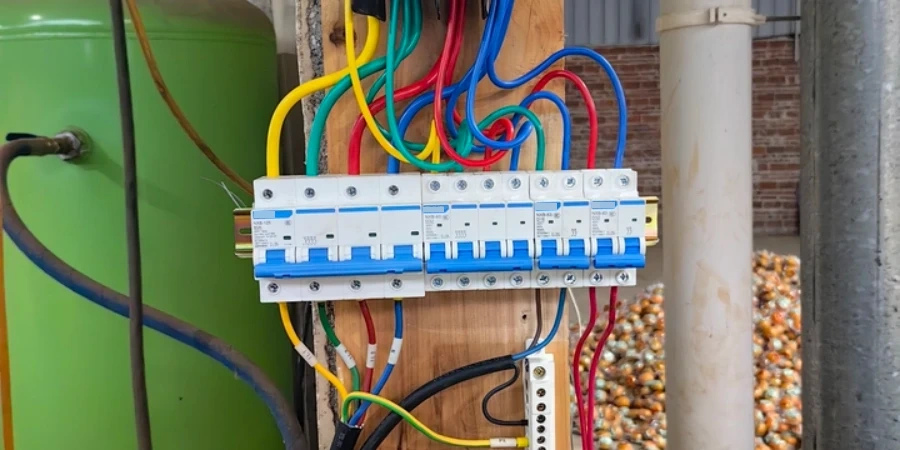
The first obstacle is physical. MCBs clip onto a DIN rail — the standard 35mm metal track inside a domestic consumer unit. MCCBs use bolt-on or panel-mount connections; they need a suitable enclosure, proper bus bar connections, and enough physical space for their larger sizing. You cannot simply remove an MCB from a DIN rail and bolt an MCCB into the same slot. The connection geometry is entirely different. (Related Reading: What Are Din Rails?)
Beyond the mechanical issue, there’s panel compatibility. Standard residential consumer units are designed around MCBs. The busbars, terminal blocks, and internal wiring are sized for MCB connections. Introducing an MCCB into that environment — especially without modifying the panel — can create poor contact, clearance violations, or other safety risks — replacing one device with another doesn’t automatically improve protection.
The installation requirements for MCCBs are specific: correct panel enclosure, proper conductor sizing, verified torque on all terminals, and adequate ventilation. None of these are guaranteed in a standard domestic board unless the whole panel has been fully assessed and upgraded for MCCB use.
When a Panel Upgrade Is Required?
If you decide to install an MCCB as the main protective device, the panel usually needs to be replaced or substantially modified. This means:
-
Selecting an enclosure designed for MCCB mounting
-
Ensuring busbars are rated for the MCCB’s current rating
-
Using correctly rated conductors from the incoming supply
-
Verifying compliance with the applicable standard — IEC 60947-2 for the MCCB, and IEC 60898 for the downstream MCBs on branch circuits
This is not a DIY project. A qualified electrician needs to assess the entire supply arrangement before specifying and installing an MCCB.
Don’t Over-Specify
Finally, there’s a practical point: MCCBs are overkill for most circuits under 100A. Installing a 250A MCCB on a main supply that never exceeds 60A doesn’t improve safety — it just adds cost, complexity, and a device that isn’t well-matched to the actual load.
The right device for home wiring is always the one that correctly matches the current rating and fault current level of the circuit it protects. MCCBs have a clear purpose, but that purpose only applies in the situations described in the sections earlier.
Conclusion
Residential electrical systems are no longer as simple as they once were. Higher loads, new technologies, and denser urban environments are changing how protection devices are selected. Taking the time to understand these changes helps ensure that electrical systems remain reliable, safe, and capable of supporting modern power needs.