
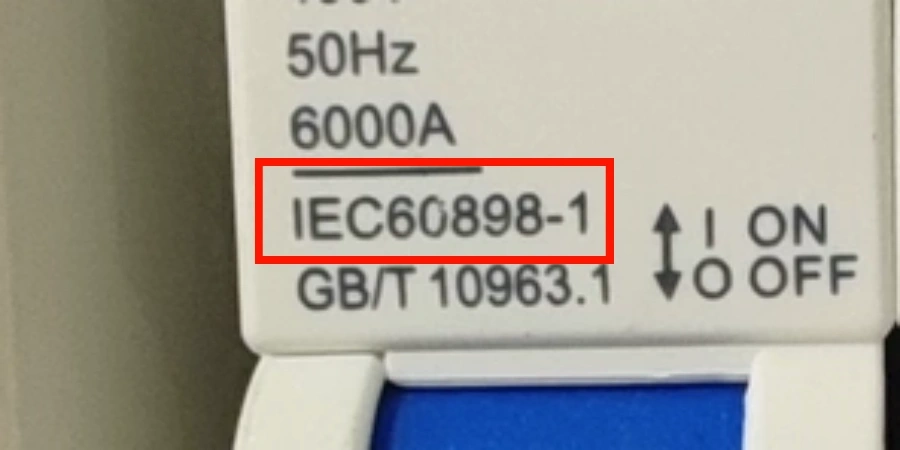
When you first look at an MCB, you’ll notice a small label that says IEC 60898-1. At first, it might just look like a random set of letters and numbers, and you probably won’t know what it means.
One of the engineers on our team explained that this label actually tells you how much current the breaker can handle, how much short-circuit it can stop, and where it’s safe to use. Every number and code is there for safety.
After a while, you start to see that these little labels really matter. They help you figure out if a breaker is right for a home, office, or small shop, and make sure it will work safely when you need it.
What IEC 60898-1 Actually Covers?
At its core, IEC 60898-1 is an international standard published by the International Electrotechnical Commission. Its full title is "Electrical accessories – Circuit-breakers for overcurrent protection for household and similar installations." In plain terms, it sets the rules that miniature circuit breakers (MCBs) must follow to be considered safe and reliable for use in homes, apartments, small offices, and similar buildings.
What the Standard Actually Governs?
The standard covers AC air-break MCBs — the type you typically find in a residential distribution board or a small commercial panel. To fall under IEC 60898-1, a device must stay within certain limits: rated voltage up to 440 V between phases, rated current up to 125 A, and a rated short-circuit capacity (Icn) of no more than 25 kA.
These numbers aren’t random. They reflect the realistic electrical conditions you normally find in household and light commercial environments.
Another key point is who will be using these devices. IEC 60898-1 assumes that MCBs in this category will be operated by ordinary people — not trained electricians or engineers making regular adjustments. This shapes a lot of the design and testing requirements built into the standard. The devices are expected to work correctly over their lifespan without routine maintenance or recalibration by a specialist.
Where IEC 60898-1 Applies — and Where It Doesn’t?
This is where a lot of new buyers get confused. IEC 60898-1 is specifically designed for household and similar installations — think residential wiring, small retail spaces, offices, and light commercial buildings operating under normal indoor conditions. The standard classifies these as Pollution Degree 2 environments, meaning typical levels of dust and humidity, not environments with chemical exposure, heavy machinery, or explosive gases.
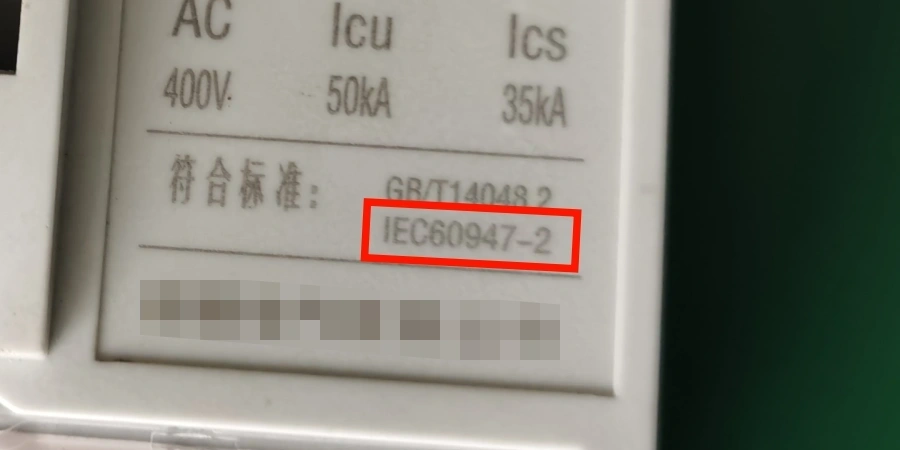
The standard does NOT apply to industrial settings. If you’re specifying breakers for a factory floor, a heavy commercial facility, or any environment with high mechanical stress or higher pollution levels, IEC 60898-1 MCBs are not the right choice. For those applications, IEC 60947-2 — which governs industrial circuit breakers including molded case circuit breakers (MCCBs) — is the relevant standard.
Understanding this boundary before you buy is important. Using the wrong type of breaker in the wrong environment doesn’t just affect performance — it can create real safety risks.
Key Technical Limits to Know
When I first started reviewing MCB spec sheets at work, the numbers felt like a blur — voltages, currents, breaking capacities, all packed into a small label.
Over time, I realized these figures tell you almost everything you need to know about whether a breaker is right for a given job. Learning the technical limits set by IEC 60898-1 is essentially learning how to read that label properly.
Voltage, Current, and Breaking Capacity at a Glance
IEC 60898-1 defines three main technical limits for compliant MCBs:
| Parameter | IEC 60898-1 Limit |
|---|---|
| Rated voltage | Up to 440 V AC between phases |
| Rated current | Up to 125 A |
| Rated short-circuit capacity (Icn) | Up to 25,000 A (25 kA) |
These limits aren’t just numbers on paper — they define the safe operating envelope for the device. An MCB rated under this standard should never be installed in a system where voltage, current, or fault levels exceed these boundaries. If the prospective short-circuit current at your installation point is higher than the breaker’s Icn, the device may fail to interrupt the fault safely, which can cause serious damage or fire.
In practice, most residential and light commercial MCBs you’ll come across have Icn values of 4.5 kA, 6 kA, or 10 kA at 230/400 V. The 25 kA limit represents the upper boundary of what the standard covers — it doesn’t mean every MCB under IEC 60898-1 is rated that high. Always match the Icn to the actual fault level at the installation point. (Related Reading: Understanding 4.5kA, 6kA and 10kA Breaking Capacity in MCBs)
Why the 30°C Reference Temperature Matters?
One detail that often gets overlooked is the reference ambient temperature used in IEC 60898-1: 30°C. This is the baseline temperature at which current ratings and thermal trip characteristics are tested and verified.
Why does this matter? Because an MCB’s thermal trip mechanism is sensitive to heat. If a breaker is installed in a panel where the surrounding temperature is consistently higher than 30°C — say, in a poorly ventilated enclosure or a hot climate — its effective current-carrying capacity will be lower than the nameplate rating suggests. Conversely, in cooler environments, it may carry slightly more. (Related Reading: How Does Ambient Temperature Affect Circuit Breakers?)
This is something to keep in mind if you’re sourcing MCBs for projects in regions with high ambient temperatures, or specifying equipment for enclosed panels where heat builds up. Many manufacturers provide derating curves for different temperatures — it’s worth asking for these when evaluating products.
What "Rated Short-Circuit Capacity" Really Means?
The Icn value — rated short-circuit capacity — is the maximum fault current the MCB can safely interrupt under IEC 60898-1 test conditions. Think of it as roughly the same idea as the Icu rating used for industrial breakers: it shows the extreme current the device can handle without catastrophic failure. After interrupting a fault at Icn, the breaker might no longer be in perfect condition, but it should have cleared the fault safely.
There’s also a related value called Ics (service short-circuit capacity), which is the fault current level after which the MCB is expected to still be fully functional and reusable. Ics is typically expressed as a percentage of Icn — commonly 50%, 75%, or 100% depending on the manufacturer and product range. For critical circuits where you need confidence that the breaker remains serviceable after a fault event, checking both Icn and Ics is a good habit.
Conclusion
IEC 60898-1 defines the limits and test conditions that determine whether an MCB is suitable for household and similar installations. By understanding its voltage, current, and short-circuit boundaries, engineers and buyers can better match protection devices to real installation conditions and ensure consistent, predictable performance over time.