
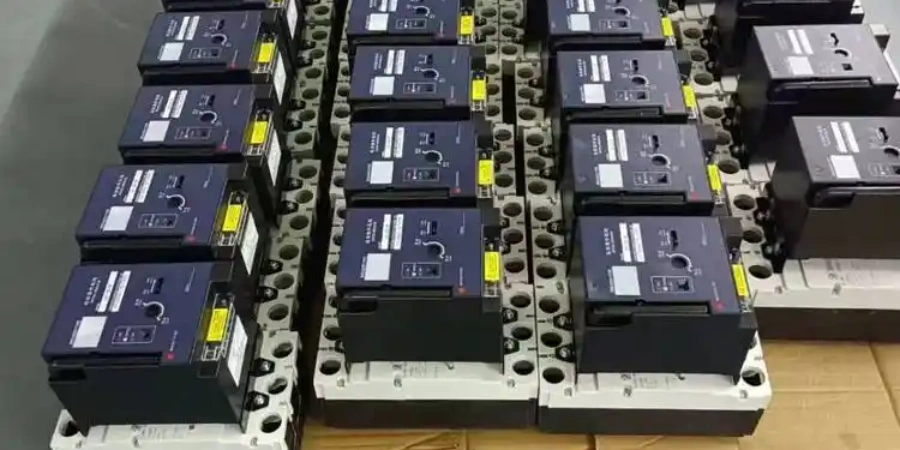
Flipping a circuit breaker might seem like a small task, but in some buildings it’s anything but simple. Walk down a long hallway, climb a ladder to reach a high panel, or enter a restricted electrical room, and that simple switch suddenly feels like a problem.
Motorized operating mechanisms make that everyday task easier. They let operators control breakers remotely without losing the ability to operate them by hand when needed. It’s a small piece of equipment that can make a big difference in convenience and safety.
For engineers and facility managers, these devices aren’t just about avoiding trips or ladders. They open new ways to manage power, respond to issues quickly, and integrate with modern automated systems—all while keeping control firmly in human hands.
What is a Motorized Operating Mechanism?
Motorized operating mechanisms have transformed the way we handle MCCBs. When I first came across these devices, I’ll admit I was skeptical—why add complexity to something as simple as a circuit breaker? But after seeing them in action, I’ve come to appreciate how they solve problems I didn’t even realize existed.
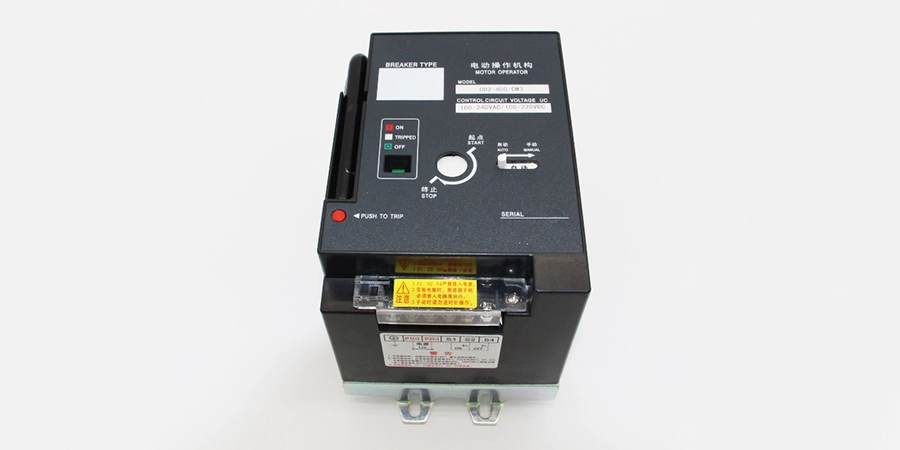
A motorized operating mechanism is basically an electrical device that lets you control an MCCB remotely. Instead of walking up to a breaker and flipping the handle by hand, you can send an electrical signal that triggers a motor to do it for you. Think of it as upgrading from a manual car window to a power window—the end result is the same, but the convenience and control options expand greatly.
The Core Principle
At its heart, the technology is a motor-driven system that mechanically connects to the MCCB’s toggle handle. When you send a control signal—whether from a wall-mounted switch, a PLC, or even a smartphone app in modern systems—the motor activates and physically moves that handle between the ON and OFF positions. What makes this particularly valuable is that you’re not replacing the breaker itself. You’re adding a layer of automation on top of existing, proven circuit protection technology.
The real breakthrough isn’t just avoiding a walk to the electrical room. It’s about enabling control in situations where physical access is difficult, dangerous, or simply impractical. I’ve seen these mechanisms installed in ceiling-mounted panels 20 feet off the ground, in electrical rooms with restricted access, and in hazardous locations where sending someone during an emergency would be risky. In one facility I visited, they had breakers controlling outdoor lighting across a campus—the maintenance team could manage the entire system from their office instead of driving around to multiple substations.
Manual Control Meets Automation
What I appreciate most is that these mechanisms don’t eliminate manual control—they complement it. Every motorized operator includes manual override capabilities. If the motor fails, if you lose power, or if you simply prefer hands-on operation, you can still charge the springs and operate the breaker the old-fashioned way. This dual-capability design means you’re not trading reliability for convenience. You get both.
The electrical operating mechanism combines electrical control signals with mechanical switching precision, which matters more than you might think. MCCBs need to open and close with specific force and timing to handle high currents safely. A motorized mechanism doesn’t just "push" the handle—it manages the entire energy storage and release cycle through springs and mechanical linkages, ensuring every operation meets the same exacting standards as manual operation.
Where Are Motorized MCCBs Used?
Knowing where motorized MCCBs excel has helped me guide customers toward better decisions and avoid recommending over-engineered solutions for applications that don’t need them. Certain environments and operational requirements make motorized mechanisms not just beneficial but often essential for reliable operation.
Industrial Manufacturing Facilities
Manufacturing environments are some of the strongest cases for motorized MCCBs. Production lines frequently power up and down—sometimes dozens of times per shift—as different processes run. I’ve seen automotive parts manufacturers where entire sections of the factory cycle on and off based on production schedules, with breakers switching automatically as equipment comes online or goes into standby mode.
The automation integration matters here. Modern manufacturing facilities use PLCs to coordinate equipment sequencing, and motorized breakers become part of that coordination. Instead of someone manually switching breakers when a new production run starts, the PLC handles the entire startup sequence—energizing circuits in the correct order, monitoring for faults, and shutting down gracefully if problems occur.
Data Centers and Critical IT Infrastructure
Data centers may be the ideal place for motorized MCCBs. These facilities require absolute reliability—even brief outages can cost thousands of dollars per minute in lost services, data integrity issues, or SLA(Service Level Agreement) violations. Motorized breakers enable automatic switchover between redundant power sources, rapid fault isolation, and remote management of electrical distribution without sending someone into electrical rooms during emergencies.
The response time is critical. Data center often use multiple layers of redundancy—dual utility feeds, backup generators, UPS systems, and parallel distribution paths. Motorized MCCBs integrate into this redundancy architecture, automatically switching loads between sources when problems occur. The millisecond response times mean connected equipment often doesn’t even experience an interruption—the switch happens faster than most IT equipment can detect.
In modern data centers, the position of each breaker can be monitored in real time through centralized control systems. This allows operators to check breaker status remotely during maintenance, ensuring circuits are properly isolated without needing to inspect each breaker physically.
Commercial Buildings and Campuses
Large commercial buildings and campuses with multiple structures benefit from centralized electrical system management. This includes office towers, universities, or corporate campuses where power is distributed across several buildings. Motorized MCCBs let facility managers monitor the entire electrical network from one location, adjusting power based on occupancy, time of day, or emergency conditions.
During low-occupancy periods—weekends, holidays, or summer breaks—the system can automatically powers down entire buildings or sections, cutting energy use without requiring staff to physically access every electrical room. In many cases, the energy savings alone can pay back the investment within a few years.
The values are even clearer in emergencies. During fire alarms, security incidents, or natural disasters, managers can remotely control power distribution to affected areas. This removes the need to send someone into potentially dangerous situations while still maintaining control over electrical systems.
Renewable Energy Installations
Solar and wind installations create unique challenges. Power output varies with weather conditions, requiring frequent adjustments to grid connections, battery storage, and backup system. Motorized MCCBs handle these dynamic conditions far better than manual breakers could.
In solar and wind installations, inverter outputs often need to be isolated regularly for maintenance or to meet grid requirements. Scheduled automation allows circuits to be disconnected and reconnected efficiently, which would be difficult and error-prone if done manually.
Battery storage integration adds another layer of complexity. As batteries charge and discharge, the electrical system needs to switch smoothly between grid power, solar generation, battery discharge, or combinations of these sources. Motorized breakers enable these transitions to haapen reliably, keeping connected loads stable while optimizing energy usage and storage according to real-time conditions and electricity pricing.
Hospitals and Healthcare Facilities
Hospitals combine several factors that favor motorized MCCBs: critical loads that absolutely cannot fail, complex systems with multiple redundant paths, and regulatory requirements for rapid fault isolation. Operating rooms, ICUs, emergency departments, and diagnostic equipment all rely on uninterrupted power with automatic backup switching.
The circuit breaker protection requirements in hospitals go beyond typical commercial applications. Life safety codes require automatic transfer between normal and emergency power sources within seconds of a failure. Motorized MCCBs integrate into these automatic transfer schemes, working alongside transfer switches and generators to maintain power to critical loads.
Remote monitoring is very useful. Facility managers can check the status of the entire electrical system in real time and spot potential problems before they cause outages. During maintenance on critical circuits, staff can use remote control and verification tools to manage power transfers without having to enter electrical rooms, saving time and improving safety.
Remote and Hazardous Locations
Some installations are simply difficult or dangerous to access physically. Offshore platforms, remote substations, rooftop equipment, and hazardous industrial processes all benefit from remote breaker control.
In petrochemical facilities, some electrical rooms can be dangerous due to the presence of flammable gases. Entering these areas often requires special permits, continuous gas monitoring, and fire watch personnel, even for simple tasks like operating a breaker. Motorized control allows these breakers to be operated remotely, reducing the need for routine entry while still providing safe access for inspections and maintenance.
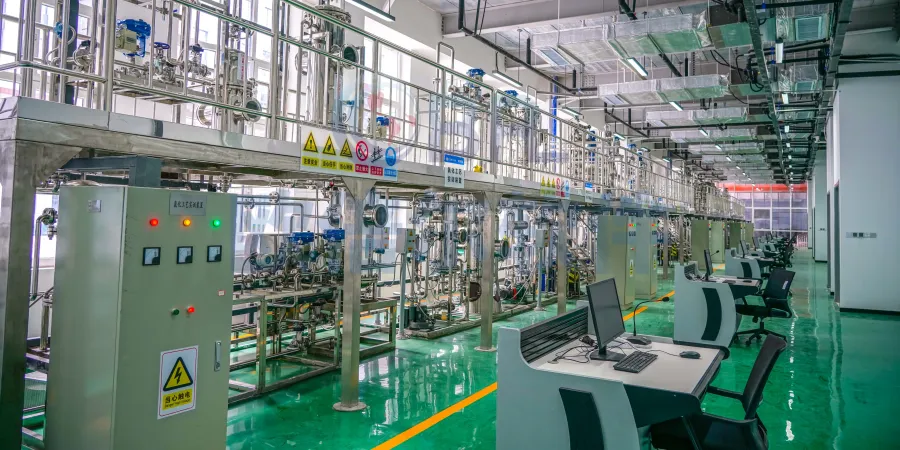
Remote substations face similar challenges. Utility often includes unmanned substations in locations that might be miles from the nearest town. Motorized breakers let utility operators manage these installations remotely, only dispatching field crews when actual maintenance or repairs are necessary. This reduces both operational costs and response times during system reconfiguration.
| Application | Key Benefits | Typical Use Cases |
|---|---|---|
| Industrial Manufacturing | Automated startup sequences, equipment protection, production line coordination | Factory main distribution, motor protection, conveyor systems |
| Data Centers | Automatic source switching, redundancy management, millisecond response | UPS distribution, dual-feed systems, critical load management |
| Commercial Buildings | Centralized control, energy management, emergency response | Campus distribution, multi-building facilities, scheduled load shedding |
| Renewable Energy | Dynamic grid integration, battery storage coordination, variable output management | Solar inverters, wind turbines, storage system switching |
| Healthcare Facilities | Life safety compliance, automatic emergency transfer, critical load protection | Operating rooms, ICU power, emergency systems |
| Remote Installations | Reduced site visits, hazardous area safety, unmanned operation | Substations, offshore platforms, rooftop equipment |
Research shows that facilities with motorized distribution systems often see roughly 30% reduction in electrical-related equipment damage and can save $20,000 to $30,000 annually through faster fault isolation and automated response. While these numbers vary by facility size and criticality, the pattern is clear—automation provides measurable reliability improvements that justify the investment.
Conclusion
Even simple upgrades, like motorized operating mechanisms, can ripple into profound changes in how we design, operate, and protect electrical systems. They challenge us to think about safety, convenience, and control in entirely new ways.
Reliable automation starts with reliable hardware. If you are planning to upgrade your facility or looking for a steady supplier for your distribution equipment, we are here to help.