
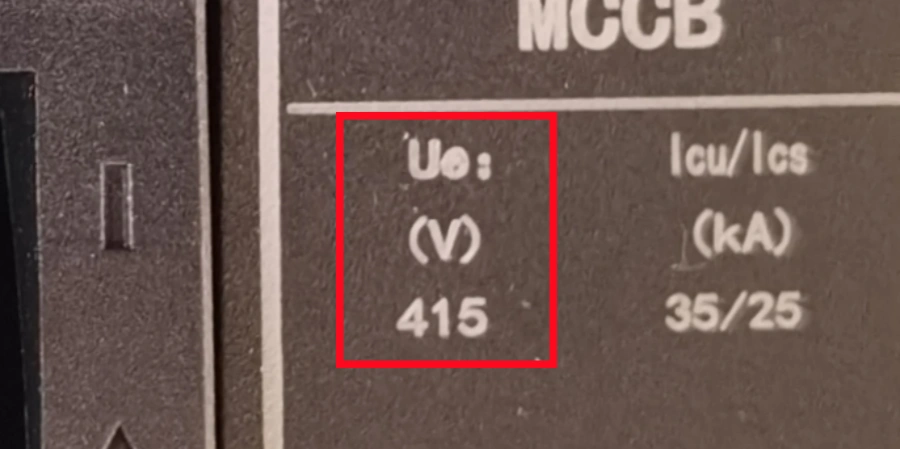
After covering rated current, it’s worth paying attention to another number that often gets overlooked: rated voltage. When customers pick breakers, their focus usually lands on current, and voltage can easily be forgotten. Over the years of making breakers, we’ve seen this happen countless times.
Rated voltage tells you the maximum voltage a breaker can safely handle, both in normal use and during faults. Getting it wrong can damage equipment, cause outages, or even create safety hazards.
Voltage isn’t always stable in real systems. It can spike or fluctuate, especially during faults. Knowing the rated voltage helps spot hidden risks and ensures the breaker can protect the system when it really counts.
What Is Rated Voltage?
Rated voltage is the highest RMS (root mean square) voltage that a circuit breaker is designed to safely handle — both during normal continuous operation and, more importantly, during fault interruption. It basically defines the insulation level of the breaker. On the breaker’s nameplate, you’ll usually see it labeled as Ue. Think of it as the ceiling the breaker was engineered not to exceed.
This is different from what most people call the "system voltage" or nominal voltage. Nominal voltage is the voltage a system is designed to operate at under normal conditions. Rated voltage, on the other hand, is always set a bit higher — typically 5 to 10% above the nominal value — to give the breaker a safe buffer against the natural fluctuations that happen in real electrical systems.
Why That Margin Exists?
You might wonder why we don’t just rate a breaker exactly at the system voltage. The short answer is that real systems are never perfectly stable.
Voltage on a live network constantly rises and falls due to load changes, switching operations, grid disturbances, and many other factors. A breaker installed in a 480V system, for example, may regularly experience brief voltage spikes above that nominal value. That’s why a circuit breaker rated at 600V is the standard choice for such systems — it gives you enough margin without requiring you to move to an entirely voltage class.
This margin becomes especially important during fault events. When a short circuit occurs, voltages can behave unpredictably before the breaker clears the fault. The rated voltage determines whether the breaker’s insulation can withstand that stress and whether its arc-extinguishing mechanism can do its job without failing or flashing over.
Rated vs. Nominal
| Parameter | Nominal Voltage | Rated Voltage |
|---|---|---|
| What it represents | Designed operating voltage of the system | Maximum voltage the breaker can safely handle |
| Typical relationship | Base reference value | 5–10% higher than nominal |
| Example (LV system) | 480V AC | 600V rated |
| Example (MV system) | 11 kV | 12 kV rated |
| Determined by | System design | Breaker design and testing |
From a factory view, rated voltage is one of the first things our engineering team defines when designing a new breaker. Everything that follows — insulation thickness, contact spacing, arc chamber design — is built around that number.
If that value is wrong at the design stage, no amount of later adjustment can truly fix it.
Why Rated Voltage Matters for System Safety?
Rated voltage is one of the most important specs for a circuit breaker, yet it’s often overlooked. It defines the maximum voltage the breaker can safely handle and directly affects how reliably it can interrupt faults.
What Happens During a Fault?
The job of a circuit breaker isn’t just to carry current under normal conditions. Its real test comes when something goes wrong — a short circuit, a ground fault or an overload. In those moments, the breaker must interrupt the fault current cleanly, which means it has to extinguish the arc that forms when the contacts separate. (Related Reading: What Is an Electrical Arc?)
Arc extinction depends heavily on voltage. When the contacts open, an arc sustains itself by ionizing the gas between them. The higher the voltage across the contacts, the harder it becomes to extinguish. If the breaker’s rated voltage is lower than the actual voltage it’s seeing, the breaker may struggle to interrupt the arc completely.

The result can be prolonged arcing, contact erosion, internal damage, or in extreme cases, an explosion.
The Numbers Behind the Risk
This risk isn’t just theoretical. According to CIGRE reliability survey data, voltage-related issues account for roughly 21% of major high-voltage circuit breaker failures. Operating mechanism failures — often linked to electrical stress and long-term voltage effects — account for about 50% of major failures.
These aren’t small numbers. And a meaningful share of those failures can be traced back to misapplication, where breakers are operated outside their rated voltage limits.
Overvoltage and Insulation Stress
Even when faults aren’t present, sustained overvoltage can gradually degrade a breaker. The insulation system — including solid insulation around conductors and the dielectric properties of the arc-quenching medium — is designed to withstand voltage only up to a certain level.
If the breaker regularly operates above that rated voltage, the insulation begins to break down slowly. You may not notice any immediate problems in day-to-day operation, but over months or years the insulation weakens, and the breaker becomes less reliable.
This is why circuit breaker ratings aren’t simply conservative guidelines — they represent engineering limits tested under controlled conditions.
Two Failure Modes to Know
| Failure Mode | Cause | Likely Outcome |
|---|---|---|
| Underrated breaker | Breaker voltage rating below system max | Arcing failure, contact damage, explosion risk |
| Overrated breaker | Breaker voltage rating far exceeds application | Nuisance tripping, poor arc quenching at low voltage, coordination issues |
| Correct rating | Rated voltage ≥ system maximum voltage | Reliable fault interruption, proper insulation margin |
Both extremes create problems. An underrated breaker is the more dangerous case of the two — it may simply not be able to do its job when the system needs it most. However, using an overrated breaker in the wrong place can also cause issues, particularly in protection coordination and arc-flash calculations.
Reliability Across All Applications
This principle applies everywhere — from a residential panelboard to a 220 kV transmission substation. The underlying physics remain the same; only the scale changes.
Proper voltage rating is the foundation on which all other breaker specifications are built. If that parameter is wrong, no other rating — not current capacity, not interrupting rating — can fully compensate for it.
Common Rated Voltage Ranges by Application
Rated voltage isn’t a single universal number. The industry uses a range of standard values, organized by voltage class and application type. Knowing which category your application falls into is the first practical step in choosing the right breaker.
Low Voltage
For most hoems and commercial buildings, you’re dealing with low-voltage system. In North America, common rated voltages are 254 V, 508 V, and 635 V, with 600 V being the most common. In China and many other countries, low-voltage systems usually run at single-phase 220 V or three-phase 380 V. These systems are used in buildings, panelboards, small motor control centers, and light industrial setups.
Low-voltage circuit breakers are designed to handle the typical fault currents you find in commercial distribution. They are the most widely produced type of breaker and are highly standardized in size and shape, and they make up the main part of what our factory manufactures.

Medium Voltage
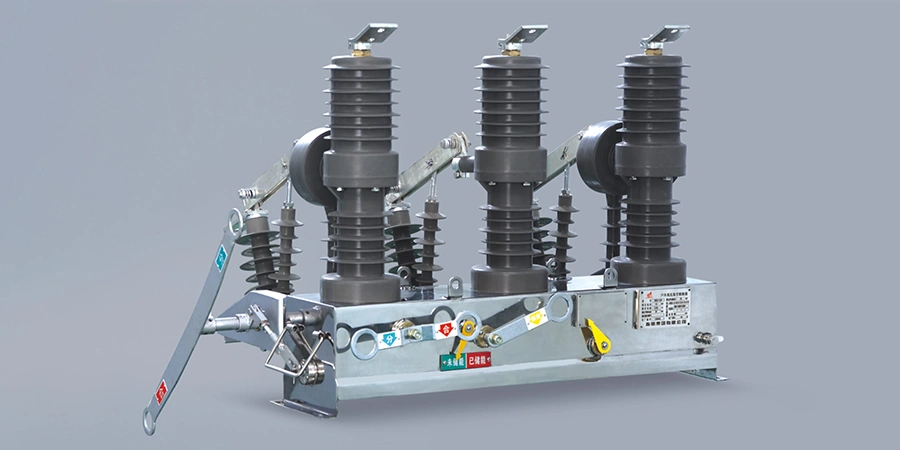
In industrial plants, utility distribution feeders, and large commercial campuses, and you move into medium voltage land. Standard rated voltages here run from 3.6 kV up to 36 kV, with the most common values being 3.6, 7.2, 12, 17.5, 24, and 36 kV. These follow the IEC 62271 series and cover the distribution voltage levels used in most industrialized countries.
Medium-voltage breakers are more application-specific. The arc-quenching technology — whether vacuum or SF₆ — becomes a key design factor, and the rated voltage directly influences which technology is suitable.
High Voltage
High-voltage breakers handle long-distance transmission, with rated voltages ranging from 72.5 kV up to 1,100 kV for ultra-high voltage systems.
These breakers protect the long-distance transmission infrastructure that forms the backbone of national grids. The main parameters of high-voltage circuit breakers at this level are much more demanding, and mistakes in voltage selection can have severe consequences.
Standard Voltage Classes at a Glance
| Category | Typical Rated Voltages | Primary Applications |
|---|---|---|
| Low Voltage | 254V, 508V, 635V (600V fused) | Residential panels, commercial buildings |
| Medium Voltage | 3.6, 7.2, 12, 17.5, 24, 36 kV | Industrial plants, utility distribution |
| High Voltage | 72.5, 126, 252 kV; up to 1,100 kV | Transmission infrastructure |
Regional Differences Are Real
Voltage standards aren’t uniform worldwide. The 600 V class is mostly a North American convention. European and international standards under IEC use slightly different voltage steps. Globally, circuit breaker ratings range from 0.415 kV at the low end to 220 kV and beyond.
If you’re sourcing equipment for a cross-border project, always verify which standard the breaker was tested and certified to. A breaker that meets IEEE C37 requirements may not automatically satisfy IEC 62271, and vice versa.
Knowing which voltage class your application falls into isn’t just a formality. It shapes every aspect of breaker selection — the technology choice, testing standards, protection coordination, and ultimately, how reliably the breaker will perform when it matters most.
Conclusion
Electrical systems have hidden stresses, and a breaker’s voltage rating helps protect against problems. Ignoring it might not cause issues right away, but over time it can lead to serious damage or accidents. Paying attention to voltage ratings isn’t just a technical detail—it’s part of being responsible with electrical systems.