
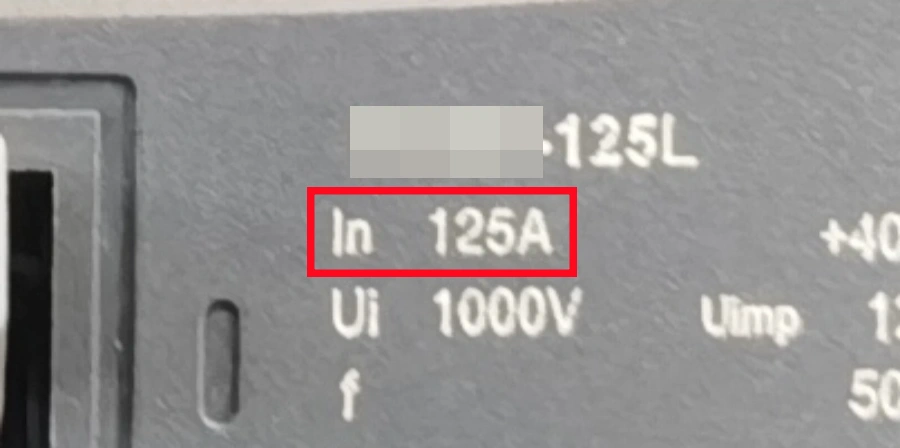
Many beginners in the electrical field see rated current on a breaker or datasheet and assume they fully understand it. It looks simple, but it’s worth paying attention to.
The concept itself isn’t complicated, but if you only look at it on the surface, you might miss small details that can make a difference in confidence and decisions.
Knowing rated current helps you feel more sure of your work. Whether you’re handling everyday tasks or encountering something new, it gives you a bit more peace of mind and confidence in what you’re doing.
Understanding Rated Current (In)
Rated current, often written as In on product datasheets and nameplates, is the maximum continuous current a circuit breaker is designed to carry without tripping under normal operating conditions.
The key word here is continuous — this isn’t a peak value or a fault value. It’s the steady, sustained current the breaker can handle hour after hour without the thermal protection mechanism kicking in.
By the way, the I stands for current, and the n comes from nominal, meaning “rated” or “named.” So In just means the breaker’s rated (nominal) current.
What "Normal Conditions" Actually Means?
This definitionalso includes a condition that a lot of people overlook: temperature. Manufacturers — including where I work — test and rate breakers at a reference ambient temperature, typically 30°C or 40°C, depending on the standard being applied.
That number on the nameplate only applies at that temperature. If the environment gets hotter, the breaker’s actual current-carrying capacity decreases. (Related Reading: How Does Ambient Temperature Affect Circuit Breakers?)
The rated current value is stamped directly on the breaker’s nameplate. It may appear as In or simply as a number followed by amps — for example, 32A. When you’re on a job site or reviewing a panel schedule, that’s the number you start with. It tells you the maximum continuous load that circuit is designed to handle, and it becomes the baseline for everything else: wire sizing, fuse coordination, panel capacity planning.
Why This Number Gets Misread?
One thing I noticed early on, when I was still learning the product side of things, is that some people sometimes confuse rated current with the tripping current. They’re not the same.
The rated current is the safe operating ceiling. A breaker won’t trip just because it’s running at that level. Tripping only begins when the current exceeds that value by a meaningful margin. For thermal overloads, that typically means 135–150% of In sustained over a period of time. For short circuits, the magnetic mechanism responds almost instantly at much higher multiples.
Understanding circuit breaker ratings and nameplate specifications is essential if you work with electrical systems in any capacity — whether you’re selecting equipment, commissioning panels, or troubleshooting unexpected trips in the field.
Standard Rated Current Values by Breaker Type
The values aren’t random. They follow a deliberate system, and once you understand that, selecting the right breaker size becomes much more intuitive.
The IEC Standard and the Renard Series
The IEC 60898-1 standard defines the preferred rated current values for low-voltage circuit breakers used in household and similar installations. The common values are: 1A, 2A, 4A, 6A, 10A, 13A, 16A, 20A, 25A, 32A, 40A, 50A, 63A, 80A, 100A, 125A.
These values follow the Renard series — a mathematical progression designed to space standard sizes at roughly equal ratios. In simple terms, each step up provides you a proportional increase in capacity. This makes it easier to scale up or down when selecting equipment, without choosing a size that is unnecessarily large.
In residential installations, most MCB selections fall within the 6A to 50A portion of this range.
| Rated Current | Typical Residential Application |
|---|---|
| 6A | Small appliances, lighting circuits |
| 10A | General lighting, low-load outlets |
| 16A | Standard socket circuits |
| 25A | Larger appliances, washing machines |
| 32A | Cookers, EV chargers (light duty) |
| 40A–50A | High-load circuits, sub-distribution |
How Breaker Type Affects the Range?
Rated current doesn’t stop at 125A — that’s just where the typical MCB range ends. As you move into larger categories of equipment, the rated current range increases significantly.
| Breaker Type | Full Name | Typical Rated Current Range |
|---|---|---|
| MCB | Miniature Circuit Breaker | 0.5A – 125A |
| MCCB | Molded Case Circuit Breaker | Up to 2,500A |
| ACB | Air Circuit Breaker | 800A and above (industrial) |
MCBs are commonly used in residential and light commercial applications — the breakers you usually see in distribution boards. MCCBs are designed for heavier commercial and industrial loads. ACBs, on the other hand, are used in large-scale power distribution where fault currents can be extremely high.
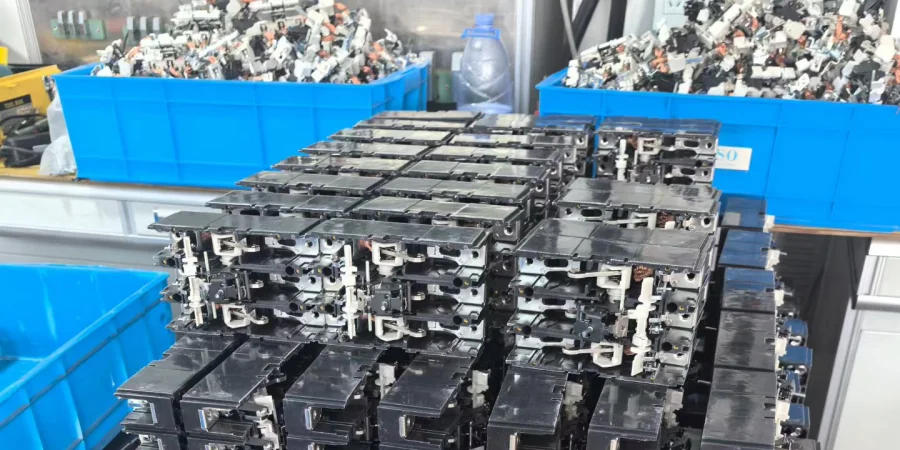
In our factory, when the production team works on different product lines, the manufacturing process, components, and testing procedures are quite different between these categories — which gives you a sense of just how wide the range really is. A 6A MCB and a 1600A MCCB both have a rated current, but they are built for completely different environments.
If you work across both residential and industrial systems, it’s useful to keep a reliable sizing guide handy for standard circuit breaker sizes across different applications.
Conclusion
Rated current isn’t just a technical specification — it’s a guide for making systems work safely and efficiently. Paying attention to how it fits your specific environment and equipment keeps installations reliable, reduces unexpected trips, and gives confidence in every decision from design to daily operation.