
When I first joined the factory, I assumed that every buyer already knew what IEC meant. After all, it shows up on datasheets and procurement lists constantly. I thought it was just common knowledge in our industry.
But after speaking with many clients, I quickly realized that wasn’t true. Many were simply following instructions to pick “compliant” products, without really understanding what IEC is or why it matters. They knew the letters, but not the meaning behind them.
That’s when I understood how easy it is to take standards for granted. Even experienced buyers can overlook what’s really behind the labels they trust every day. Learning a little about IEC can make procurement decisions feel a lot clearer and more confident.
What IEC Actually Stands For?
IEC stands for the International Electrotechnical Commission. It’s a global organization, founded in 1906, that develops and publishes international standards for electrical and electronic technologies. Think of it as a body that brings experts from around the world into the same room — or the same process — and asks them to agree on how electrical products should be designed, tested, and rated.

For circuit breakers, IEC sets the performance criteria a product must meet before it can be called safe and reliable. We’re talking about things like breaking capacity, thermal stability, and how well a breaker handles continuous electrical load over time.
More Than Just a Label
A lot of people see "IEC" printed on a breaker and treat it like a stamp of quality. And while that’s not entirely wrong, it’s more accurate to say that IEC standards are performance-based benchmarks — they define what a product must do, not necessarily how it must be built.
That distinction matters when you’re comparing breakers from different manufacturers. Two products may look different internally, but if both meet the same IEC performance requirements, they have passed the same defined tests.
IEC standards cover a wide range of voltages and applications:
-
Low-voltage breakers (up to 1000V AC or 1500V DC) for homes, commercial buildings, and light industrial installations. Standards like IEC 60898-1 and IEC 60947-2 ensure overload protection, short-circuit performance, temperature rise limits, and mechanical and electrical endurance.
-
Medium- and high-voltage breakers (above 1 kV AC), used in industrial plants, substations, and power transmission networks. Standards such as IEC 62271 series focus on insulation, breaking capacity, system compatibility, and operational safety under more demanding electrical and mechanical conditions.
In short, whether it’s for a residential panel or a high-voltage substation, an IEC-compliant breaker has been tested against rigorous, internationally recognized benchmarks — giving you confidence that it will perform safely and reliably in its intended environment.
Why This Matters for International Buyers?
Another important point is that IEC standards rarely stand alone. Many countries adopt them directly or base their national regulations on them. China’s GB standards, India’s IS standards, and many European national codes are closely aligned with IEC frameworks.
Because of this, an IEC-certified product is much easier to use in multi-country procurement. The baseline requirements are already internationally recognized.
This becomes especially important in cross-border infrastructure projects. You don’t want to arrive at a job site in Southeast Asia with breakers certified only to a U.S.-specific standard. Knowing whether a product follows IEC gives you a clear indication of where it can be used — and where additional certification may be required.
In short, IEC is the common language of electrical safety across most of the world. Understanding it doesn’t require an engineering degree — It simply means knowing what the standard represents and why it matters.
Key IEC Standards for Circuit Breakers
Not all IEC standards are the same, and this is one of the places where beginners can easily go wrong. It’s an easy mistake to make, but also an easy one to avoid once you know the basics.
The two most important IEC standards for low-voltage circuit breakers are IEC 60898-1 and IEC 60947-2. They cover completely different applications and have different performance requirements, so knowing which one applies to your project is step one.
IEC 60898-1
IEC 60898-1 covers low-voltage AC circuit breakers for household and light commercial use. These are the breakers you’d typically find in a residential distribution board or small commercial panel. Key points include:
-
Rated current ranges from a few amps up to 125A
-
Short-circuit capacity (Icn) goes up to 25kA
-
Products are marked with a trip curve letter + amperage (e.g., C20 means a C-curve breaker rated at 20A)
This standard is designed to be simple and user-friendly. The goal is to ensure breakers are safe, reliable, and easy to install, even for people who aren’t electrical engineers. The performance requirements focus on typical household fault scenarios.
Related Reading: A Simple Look at IEC 60898-1
IEC 60947-2
IEC 60947-2 takes things further. It covers industrial and commercial applications where higher currents, greater fault energy, and more frequent operating are common. Key features include:
-
Rated current can go well beyond 125A — industrial breakers in this category are often rated in the thousands of amps
-
Impulse withstand voltage ratings of 6–8kV (vs. lower requirements in 60898-1)
-
Two separate breaking capacity ratings: Icu (ultimate breaking capacity) and Ics (service breaking capacity)
-
The breaker’s maximum and normal breaking limits (Icu and Ics) are shown on its label or datasheet.
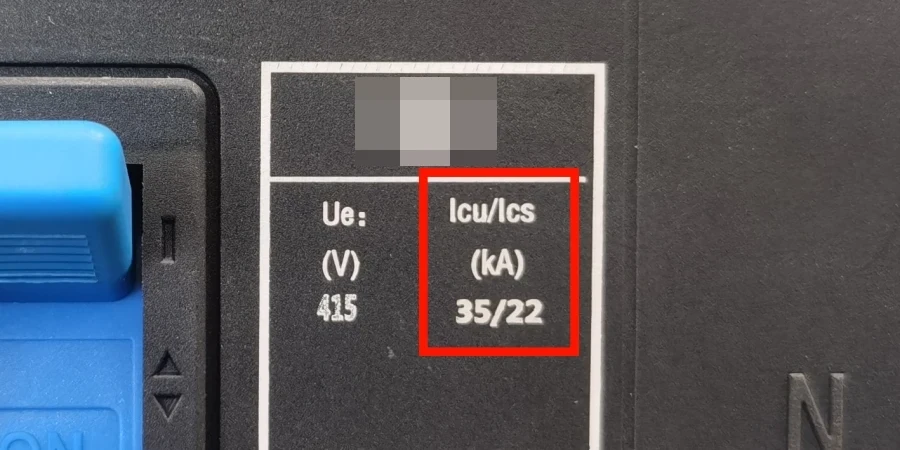
Icu and Ics on an MCCB panel
The Icu/Ics distinction is important. Icu represents the maximum fault current a breaker can interrupt once, after which it may not operate normally. Ics indicates the breaker’s ability to handle faults repeatedly while remaining ready to function again. For systems exposed to repeated faults, Ics is the more relevant figure.
Related Reading: A Simple Look at IEC 60947-2
Staying Current: New Updates to Watch
The IEC standards landscape doesn’t stand still. A recent example is IEC TS 63042-301:2026, which introduces additional testing requirements for high-voltage equipment and protection systems. While this may not directly affect standard residential or light commercial breakers today, it points to the direction the industry is moving — particularly as renewable energy systems and smart grids push equipment to operate under more demanding conditions.
For buyers planning long-term projects, keeping an eye on these updates is important. A breaker that’s compliant today may need to meet stricter requirements for future phases or re-certifications.
Why IEC-Certified Breakers Are Worth It?
After years of fulfilling orders for clients, I’ve seen firsthand how circuit breakers are rigorously tested before they leave the factory. That experience has given me real respect for IEC certification — it’s not just a piece of paper or a label. It’s a standard that shows the product is reliable, safe, and built to last.
When a breaker carries valid IEC certification, it means the product has been tested — by an independent lab, using standardized methods — against the conditions it wll face in real use. That includes overloads, short-circuit events, thermal stress, and mechanical endurance over thousands of operating cycles. That process takes time and costs money, and manufacturers who go through it aren’t cutting corners.
The Safety Case: Fewer Electrical Fires
The numbers speak for themselves. Homes and facilities using IEC-compliant circuit breakers see electrical fire rates nearly 50% lower than those using non-compliant alternatives. That’s a significant reduction, and it reflects something real: a certified breaker will trip when it should, at the current level it’s rated for, and it will do so reliably over time. An uncertified or poorly made breaker might trip inconsistently, fail to interrupt a fault, or degrade faster than expected — problems that only show up when it’s too late.
For anyone specifying equipment for residential buildings, hospitals, schools, or any occupancy where people are present, this is the most important reason to care about IEC certification. It’s the baseline assurance that the product will behave the way it needs to when the situation demands it.
Global Market Access Through the CB Scheme
For international buyers, IEC certification opens another practical door: the IECEE CB Scheme. This is a multilateral agreement between national testing bodies that allows a product tested and certified in one country to be accepted in others without full re-testing.
As of now, the CB Scheme is recognized in 54 countries, covering most of the major markets in Europe, Asia, the Middle East, and Latin America. For buyers sourcing equipment for international distribution or managing multi-country projects, this can save significant time and cost. Instead of completing separate national certifications in each country, a single CB test certificate often provides the coverage needed across multiple markets.
The scheme works through accredited labs called NCBs (National Certification Bodies). When a manufacturer’s product earns a CB certificate from one NCB, other participating countries’ bodies can accept it as the basis for their own national certification — often with little or no additional testing.
Cost Savings Through Mutual Recognition
The financial benefits of IEC certification go beyond safety and market access. Consider the difference in practice:
| Cost Area | Without IEC Certification | With IEC Certification |
|---|---|---|
| Re-testing per country | Required in each market | Often waived via CB Scheme |
| Inspection delays | Likely on non-compliant products | Reduced with recognized certificates |
| Insurance exposure | Higher risk, potential claim denial | Lower risk with documented compliance |
| Replacement costs | Higher due to early failures | Lower with tested, durable products |
| Project downtime | Risk of failed inspections mid-project | Reduced with pre-verified compliance |
These savings aren’t always obvious in procurement quotes, but they’re real. Buying cheaper, non-certified breakers might seem attractive initially, but the total lifecycle often tells a different story.
Overcurrent Protection and Long-Term Durability
Beyond fire safety and market access, IEC-certified breakers are tested for operational endurance — meaning they must perform correctly over a defined number of mechanical and electrical operations. Under IEC 60947-2, industrial breakers must demonstrate reliable performance through thousands of cycles. For residential breakers under IEC 60898-1, endurance testing covers both no-load mechanical operations and loaded electrical operations.
In practice, circuit breakers aren’t static — they are switched, they trip under fault conditions, and industrial breakers may operate hundreds of times per year. A breaker that hasn’t been tested for endurance might work fine initially but degrade over time, potentially failing when it’s needed most. IEC certification is not a guarantee of eternal performance, but it does give you a verified baseline. You know the product was built and tested to a standard — and that standard was designed by people who thought carefully about how these products are actually used in the field. For anyone making long-term procurement decisions, that baseline is worth paying attention to.
The global circuit breaker market is projected to grow from $26.49 billion in 2026 to $50.44 billion by 2034 — fueled by renewable energy, smart grid infrastructure, and construction growth across Asia-Pacific and beyond. In a market of that scale, with so much at stake, the baseline assurance of IEC certification is not just a nice-to-have — it’s a strategic advantage.
Conclusion
Buying circuit breakers isn’t just about price—it’s about trust. IEC compliance provides a clear signal that a product has been tested and built to handle real-world conditions. Understanding this helps buyers make choices that protect people, save money over time, and simplify international projects.