
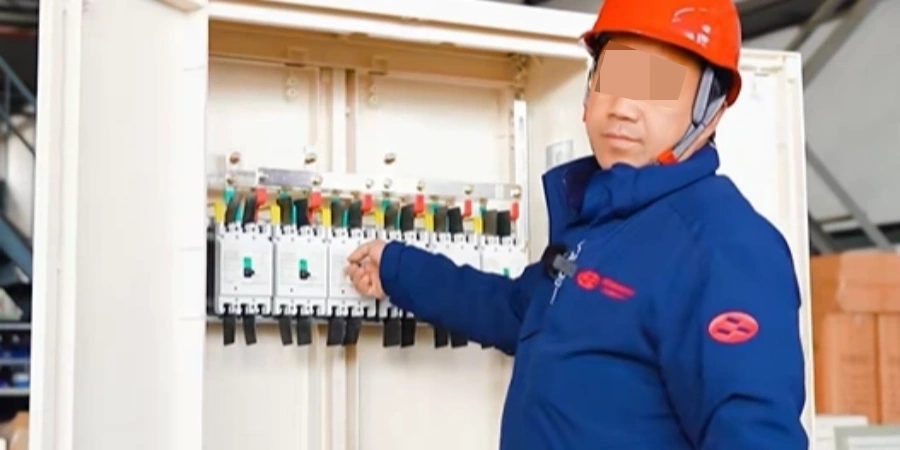
Closing a circuit breaker might look like a simple flick of a switch, but in that instant, a lot of unseen energy starts moving. Even a small action can carry hidden risks, making the task more serious than it appears.
Your safety doesn’t depend only on the breaker itself. How you position yourself while operating it matters just as much. Standing slightly to the side, rather than directly in front, is a small adjustment that can make a big difference in avoiding danger.
True safety comes from habits built into everyday work. Each careful movement, each mindful choice of stance, helps you stay protected and confident whenever you handle electrical equipment.
What Happens When You Close a Circuit Breaker?
Closing a circuit breaker might look simple: you push a handle, and the circuit is on. But even this small action involves a lot of electrical and mechanical changes inside the breaker. Understanding what happens can help you operate it safely and take better care of the equipment.
The Moment of Contact
When you close a circuit breaker, you’re bringing two conductive contacts together to complete a circuit. In that fraction of a second, current rushes from the supply side to the load — and it doesn’t always do so smoothly. There’s often an inrush of current as the circuit energizes, especially when motors, transformers, or other inductive loads are connected downstream. This surge is brief, but it creates real stress on the breaker’s internal components every single time it happens.
Many people don’t realize there can be a small arc at the moment the contacts meet. The breakers are designed to handle this — that’s part of what goes into its engineering. But "designed to handle it" assumes the breaker is in good condition. Worn contacts, internal contamination, or even a slightly mis-adjusted mechanism can change that equation fast.
When the System Is Under Stress?
Older breakers, heavily loaded panels, or medium-voltage systems carry higher risk during switching. Over time, the internal parts that suppress and interrupt arcing can degrade. The contacts can develop pitting from repeated arcing. Springs lose tension. Insulating materials break down. You might not see any of this from the outside — the enclosure looks fine, the handle moves normally — but inside, the safety margins are smaller.
The risk also depends on what’s downstream of the breaker. If there’s a fault — a short circuit, a ground fault, or damaged cable — closing the breaker feeds current directly into that fault. The breaker may trip almost instantly, but in those milliseconds, the energy release can be enormous.
This is why switching operations are treated as high-risk tasks in electrical safety programs. The act of closing a breaker is a moment of uncertainty. You’re committing the system to carry current, and you won’t know what happens next until it happens.
| Condition | What It Affects | Risk Level |
|---|---|---|
| New breaker, healthy load | Minimal inrush, clean contact closure | Low |
| Aged breaker, heavy load | Worn contacts, higher inrush stress | Moderate |
| Any breaker, suspected fault | Direct fault energization | High |
| Aged breaker, unknown load state | Combined degradation and uncertainty | Very High |
Understanding this doesn’t mean you need to be afraid of breakers. It means you need to respect what’s actually going on inside them — because that shapes every safety habit that follows.
The Real Danger — Arc Flash
The first time I heard a detailed description of an arc flash, I was sitting in an internal safety briefing. A senior engineer walked us through a case study — not from our facility, but from an industry report. The numbers were striking, but what really stuck with me was the speed. The whole event, from the initial fault to the explosion of energy, took less time than a blink. That’s the part that catches people off guard.
What Arc Flash Actually Is?
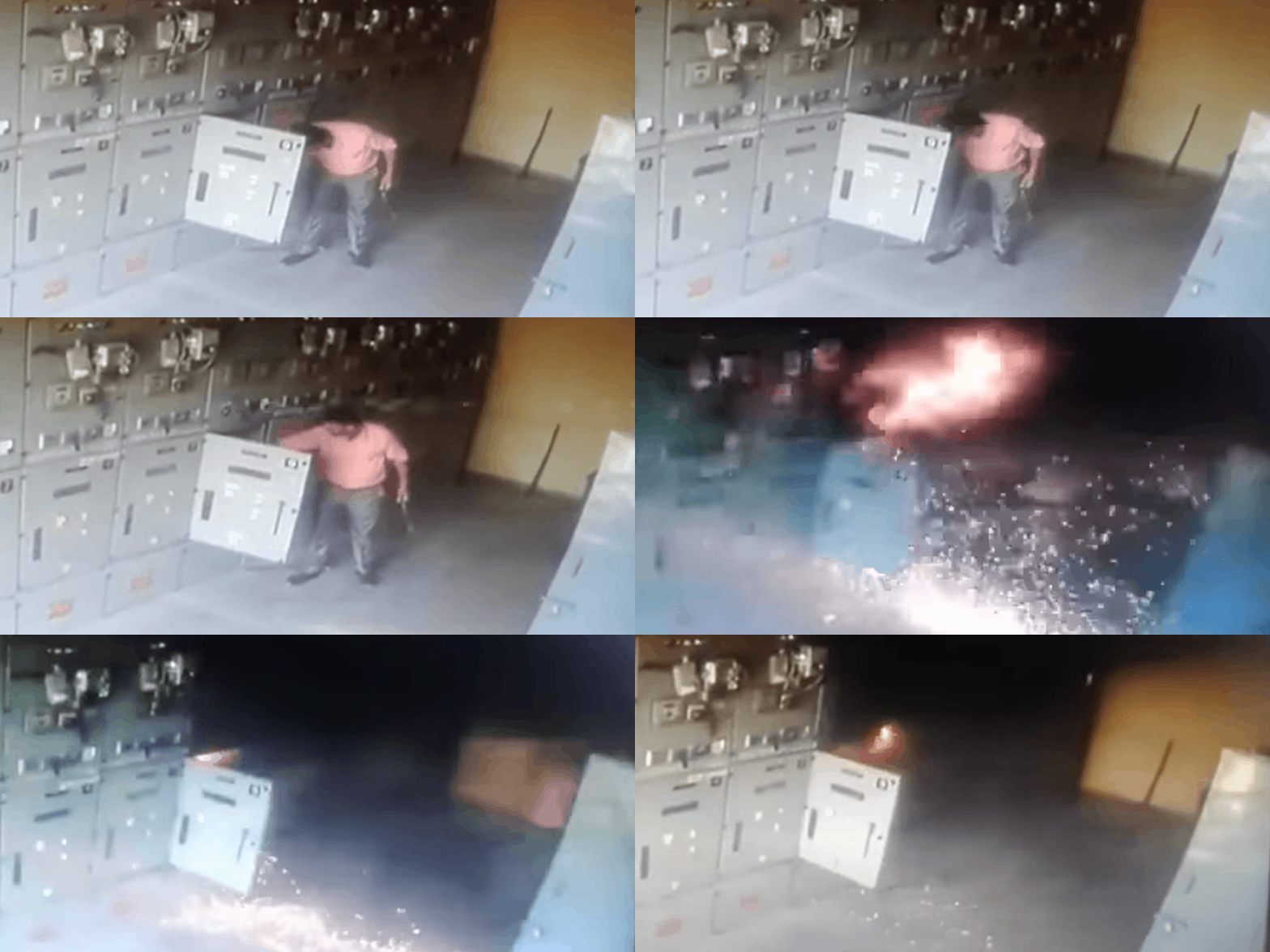
An arc flash is what happens when electrical current jumps through the air between conductors — or from a conductor to ground — outside its intended path. It’s triggered by things like equipment faults, accidental contact, switching errors, or equipment failure. Once it starts, it sustains and rapidly escalates. The mechanics of arc flash involve a superheated plasma channel that can exceed 19,000°C — roughly four times hotter than the surface of the sun.
At these temperature, metal doesn’t just melt — it vaporizes. Copper bus bars, breaker contacts, and enclosure components turn into expanding metallic plasma and superheated gas in milliseconds. This expansion creates a pressure wave that can shatter enclosures, throw a person across a room, rupture eardrums, and turn metal fragments into high-speed projectiles. The radiant heat alone can cause severe burns through clothing, even at what fell like "safe" distances.
Why It’s Easy to Underestimate?
The danger of arc flash is that it’s invisible until it isn’t. There’s no warning, no gradual buildup you can observe. One moment you’re standing in front of a panel, the next — if something goes wrong — you’re in the middle of a thermal explosion. Arc flash hazard analysis data consistently shows that most victims don’t see it coming.
People also tend to underestimate lower-voltage systems. Many assume that 480V gear is "small" compared to medium or high voltage. But some of the most damaging arc flash incidents on record have occurred on 480V equipment. What matters isn’t just voltage — it’s the available fault current and how long the protective device takes to clear the fault. A panel fed by a large transformer with high fault current can release enormous energy even at relatively low voltage.
| Factor | Why It Matters |
|---|---|
| Available fault current | Higher current = more energy in the arc |
| Clearing time | Longer trip time = more energy released |
| Voltage level | Higher voltage sustains arcs more easily |
| Working distance | Closer proximity = greater exposure to heat and blast |
| Enclosure type | Confined spaces concentrate blast energy |
The Injury Profile
Arc flash statistics paint a clear picture of how serious these events are. In the U.S., estimates put workplace arc flash incidents at around 30,000 per year, with roughly 400 deaths and 2,000 hospitalizations annually (ESFI workplace data). Up to 80% of serious electrical injuries involve burns from arc flash rather than electric shock — a fact that surprises many who assume shock is the main risk.
Burns from arc flash aren’t like ordinary burns. The combination of radiant heat, convective heat, and superheated metal vapor means injuries can cover large areas of the body and penetrate deeply into tissue in a fraction of a second. Survivors often face months or years of treatment, multiple surgeries, and permanent scarring. This is not a statistic on a page — it’s the real consequence of standing in the wrong place at the wrong time.
Why Standing to the Side Makes a Difference?
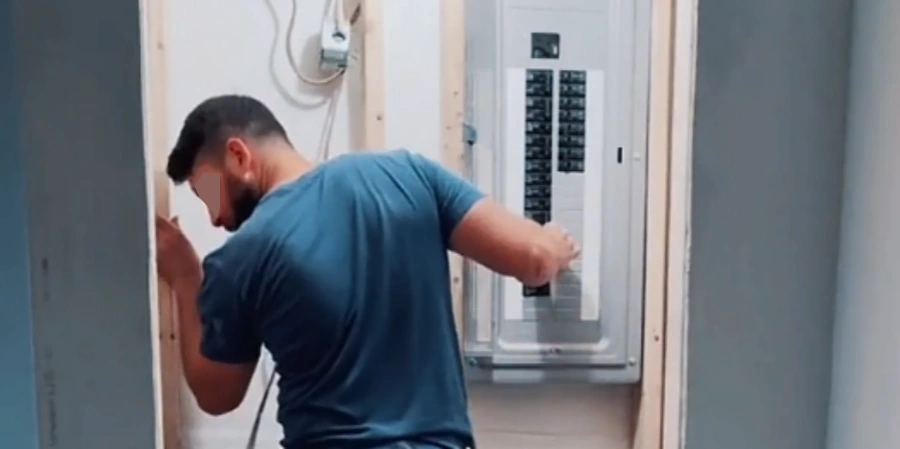
Later, an experienced electrician taught me an important industry rule: when testing or operating a breaker, never stand directly in front of it. He showed me to stand to the side, turn your face away, and reach across with one hand to operate the switch.
This is standard practice in the trade. Once you understand how arc flash energy moves, the reason for this simple positioning becomes very clear.
The Direction of a Blast
When an arc flash occurs inside a panel or enclosure, the energy has to go somewhere. The path of least resistance is almost always forward — through the front of the enclosure, gaps in the door, cable entries, or any weak point facing the operator. The blast, the heat, and any ejected material travel outward in a cone directed toward whoever is standing in front.
Safe switching technique guides all emphasize this: position your body to the side of the panel, not directly in front. When you stand laterally, you step out of the primary blast path. The energy still moves forward — but it doesn’t hit you directly. Simply by adjusting your position, you dramatically reduce your exposure to heat and flying debris.
The Correct Stance
The technique taught in most safety training is straightforward. Stand to one side of the enclosure, close enough to reach the handle comfortably but with your torso and head out of the panel’s front. Turn your face away from the panel. Use the hand that’s farther from the panel to operate the switch. This way, even your arm is somewhat shielded by your shoulder.
It sounds simple — and it is. That’s the point. This isn’t a complicated procedure requiring special tools or extensive training to execute. It’s a body position. You can do it every single time, in any setting, without adding more than a second to the task. And if something goes wrong, that one-second adjustment could be the difference between walking away and being airlifted to a burn center.
Why the Habit Matters More Than the Risk Level?
You might wonder whether this level of caution is really necessary for every single breaker operation. The honest answer is yes — and here’s why. You can’t always predict when a breaker is going to fail. A panel that has worked without issue for years can suddenly develop a fault. A downstream cable you didn’t know was damaged can create a fault current the moment you close the breaker. Situations that look routine from the outside can have hidden variables.
Safety training materials make it clear: standing to the side isn’t only for high-risk industrial gear. The same positional habit applies in residential settings, commercial panels, and industrial equipment alike. The scale of injury may differ, but the basic physics — blast energy exits from the front — stays the same regardless of voltage class.
Building the habit into every operation, not just the ones that feel risky, is what actually keeps people safe. It’s easy to be careful when something looks dangerous. The accidents tend to happen when everything seems normal.
Conclusion
Working with a circuit breaker isn’t just flipping a switch — you’re dealing with invisible energy. Respect the equipment, build safe habits, and stay aware of risks to keep yourself safe. Standing to the side isn’t just for breakers — it’s a good habit for any electrical gear where a sudden arc or energy release could happen. Safety isn’t about being scared; it’s about doing the small, simple things every time to protect yourself.