
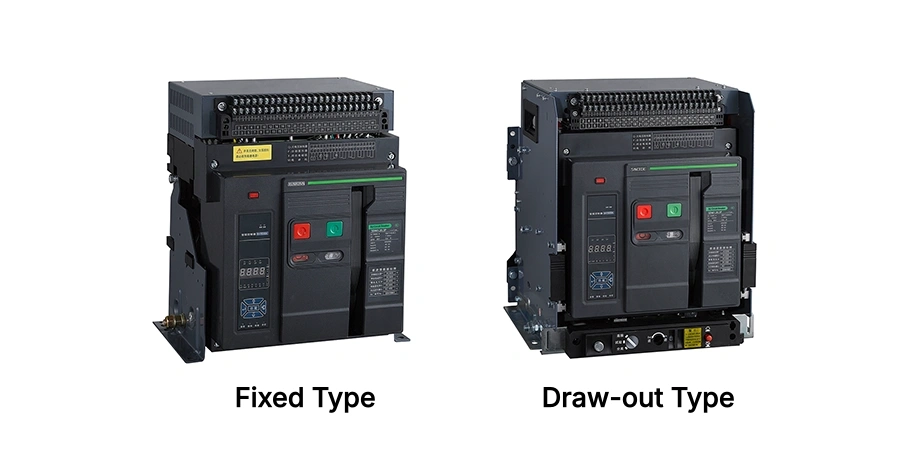
When it comes to the ACB, there are two different types that handle the same job in very different ways. One stays firmly in place, bolted into the panel, while the other can slide in and out like a drawer. From our experience exporting breakers to different countries, even small design choices like this can affect how smoothly a system runs day to day.
One engineer in our team once spent several days on-site adjusting and testing breakers for a large industrial facility. Watching the mechanisms up close, it’s easy to see how much thought goes into balancing reliability, safety, and ease of use. Small design details can make a noticeable difference for everyone who works with the equipment.
Over the years, we’ve seen how these differences show up in real installations. Even subtle variations can influence workflow, safety checks, and how technicians interact with the equipment—details that often matter far more than most people realize.
Fixed Type ACB: How It Works
The first time I saw a fixed ACB being installed, I was shadowing an installation crew at a mid-sized manufacturing facility back in 2017. The simplicity struck me—bolt it down, wire it up, close the panel, and you’re done. That’s the essence of a fixed type ACB.
A fixed ACB is permanently mounted to your switchboard chassis or directly to the busbars. There’s no cradle, no sliding mechanism, no fancy racking system—just solid, rigid mounting. The electrical connections go straight to the breaker terminals, and once it’s in place, it’s staying there unless you have a compelling reason and the tools to remove it.
Construction and Core Components
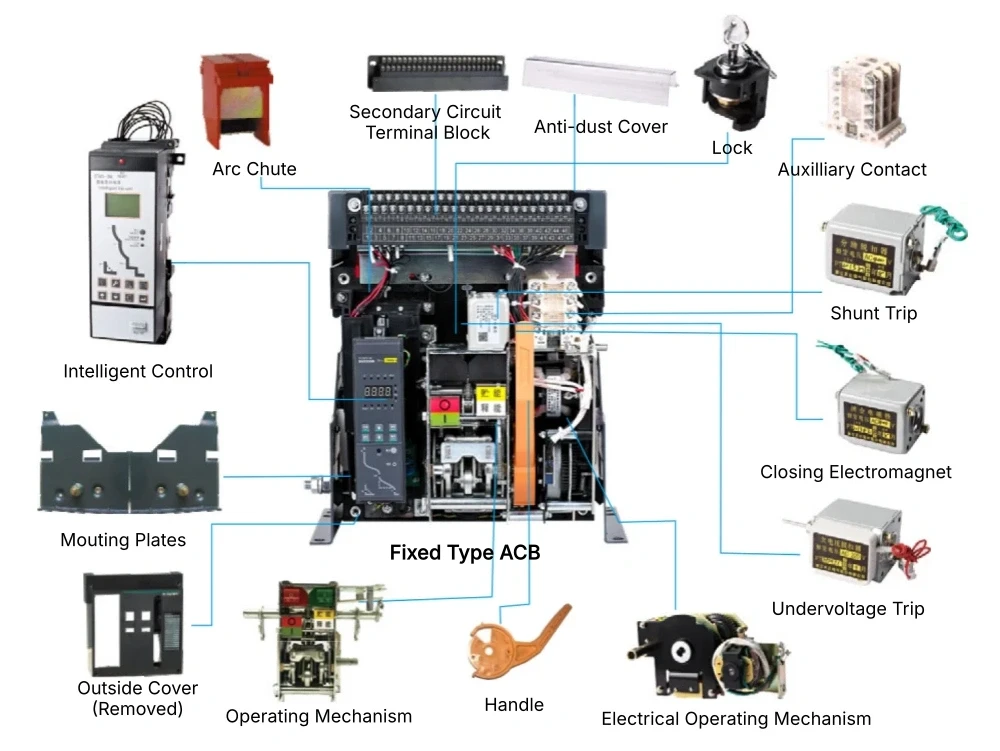
Let me walk you through what’s inside a fixed ACB, because understanding the construction helps explain both its advantages and limitations.
The operating mechanism is the heart of the system—this can be a spring-charged mechanism or a stored-energy motor operator, depending on the manufacturer and rating. When you close the breaker, energy stored in springs (or released by the motor) drives the moving contacts against the fixed contacts with enough force to maintain a low-resistance connection capable of carrying hundreds or thousands of amperes continuously.
The contact system itself is typically a dual-contact design. The main contacts carry the load current during normal operation, while the arcing contacts that are designed to handle the stress when the breaker opens under fault conditions. When a trip occurs, the main contacts separate first, then the arcing contacts take over the current flow. As they separate, the arc forms between them. This is where the arc chutes come into play—these are steel plates arranged to split, cool, and ultimately extinguish the arc using the surrounding air.
The trip unit monitors the current and decides when to initiate a trip. Older models, you’d find electromechanical relays or thermal-magnetic devices. Modern fixed ACBs typically use electronic trip units with microprocessor controls that give you precise, adjustable protection curves. You can set long-time delays, short-time settings, and instantaneous trip thresholds to match your coordination study requirements.
Because there’s no draw-out mechanism to accommodate, the entire assembly can be more compact. Everything’s integrated into one unit, and the terminal connections are straightforward—typically bolted lugs or compression terminals that connect directly to incoming and outgoing cables or busbars. This simplicity translates to lower manufacturing cost, which is one reason fixed ACBs typically run 20-30% cheaper than their draw-out counterparts in the same current rating.
Installation and Access Considerations
Here’s where the trade-offs start to show up. Installing a fixed ACB is relatively straightforward if you’re building a new panel or switchboard. The mounting holes line up with the chassis, you bolt it down, torque the terminal connections to spec, and verify continuity and insulation.
But what happens when you need to service or replace it?
With a fixed breaker, accessing the unit for maintenance typically means opening the panel door and working around energized components. In many cases, the safe approach requires de-energizing the entire feeder section. For non-critical loads or applications where you can schedule outages without major consequences, this isn’t a big deal. I’ve seen plenty of small commercial buildings where the manager can afford a couple hours of downtime for annual maintenance.
But I’ve also visited facilities where that downtime costs thousands of dollars per hour in lost production. That’s where fixed ACBs start to be limited. You can perform some basic visual checks and thermal imaging through the panel door, but any serious inspection—checking contact wear, measuring resistance, testing the trip unit, verifying the operating mechanism—requires hands-on access. And hands-on access to a fixed breaker often means hands near live conductors if adjacent sections remain energized.
The testing process for fixed ACBs is mostly in-situ. You can inject test currents through the trip unit while it’s installed, but you can’t easily remove it out to a test bench for a comprehensive evaluation. Some technicians use portable test sets that clamp onto the breaker’s current transformers, but it’s always a compromise compared to offline testing.
When Fixed Makes Perfect Sense?
Don’t get me wrong—fixed ACBs definitely have their place. Over the years, I’ve specified them for many clients where they made both economic and practical sense. Small distribution boards, basic generator transfer panels, light commercial buildings, residential complexes—these are all solid candidates for fixed mounting. If your maintenance intervals are long (maybe annual visual checks and testing every 3-5 years), your system is relatively simple without critical 24/7 loads, and if your budget is limited, fixed ACBs deliver reliable protection at a lower price point.
They’re also great for retrofit situations where panel space is tight. Because fixed breakers don’t need the extra depth for racking clearance (we’re talking about saving 12-18 inches of panel depth in many cases), you can sometimes fit a higher-rated breaker into an existing enclosure that wouldn’t accommodate a draw-out design. I’ve seen my customer’s retrofit projects where that space savings was the deciding factor.
The key is knowing your priorities. If cost and space are your main drivers, and if you can live with the maintenance and downtime implications, fixed ACBs are proven, reliable devices that’ll serve you well for decades with proper care.
Draw-Out Type ACB: How It Works
I’ll never forget the first time I watched an electrician rack out a draw-out ACB at a pharmaceutical manufacturing plant. It was maybe my second year in the industry, and I was tagging along on a site visit. The panel was energized, adjacent breakers were carrying load, and this technician calmly inserted the racking handle, turned it with steady rhythm, and pulled a 3200A breaker completely out of its cradle like pulling a drawer from a filing cabinet. The whole operation took maybe three minutes, and nobody lost power. That’s when I understood why critical facilities pay the premium for draw-out designs.
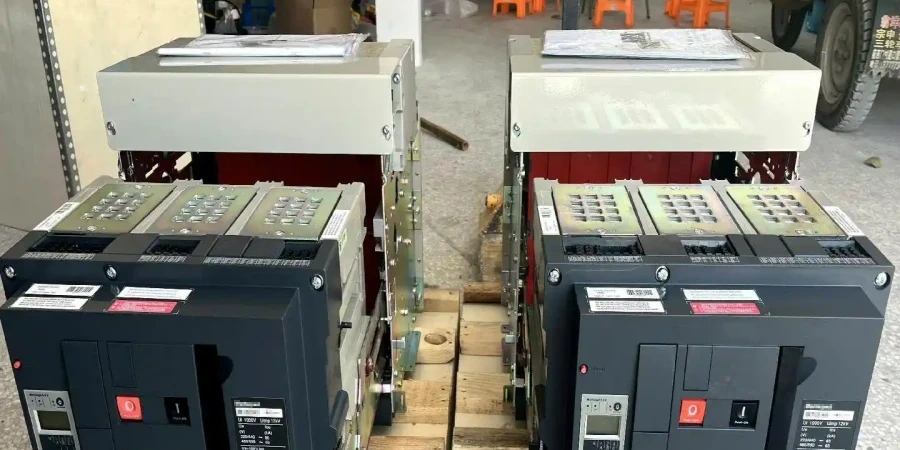
A draw-out ACB consists of two main components: a fixed cradle (or truck) that’s permanently mounted in the switchboard, and a removable breaker body that slides in and out on rails or guides. The brilliance of the design is in the racking mechanism—a mechanical system (typically using a hand crank or ratchet handle) that moves the breaker between several distinct positions: disconnected, test, and connected.
The Racking Mechanism and Position Controls
The racking handle engages a screw mechanism or gear train inside the cradle. As you turn the handle, the breaker body moves along the rails.
-
Disconnected position (fully withdrawn): The breaker is completely isolated. There’s no electrical or mechanical connection to the primary circuit, and you can remove the breaker entirely from the cubicle. This is exactly what the electrician did at the pharma plant.
-
Test position: Here, the breaker’s control circuits are connected, but the main power contacts remain separated from the fixed stabs. You can energize the control circuit, test the trip unit, verify the operating mechanism, and operate the breaker—all without disturbing the main power circuit. Commissioning teams often spend hours in this position, running protection settings and coordination studies while the rest of the switchgear remains in service.
-
Connected position (service position): This is where the breaker lives during normal operation. The racking mechanism pushes the plug-in primary contacts—sometimes called tulip contacts or finger clusters—into engagement with the fixed stabs. These robust, self-aligning contacts are designed for hundreds or thousands of insertion cycles and provide a solid, low-resistance connection comparable to a bolted fixed breaker.
Safety Interlocks and Mechanical Protection
Draw-out ACBs really shine in safety. They include multiple mechanical and electrical interlocks to prevent dangerous mistakes:
-
You typically can’t rack the breaker in or out if it’s closed.
-
You can’t close the breaker unless it’s fully in the test or connected position.
-
Some designs even use key interlocks to ensure the proper sequence is followed.
Most draw-out breakers also have clear position indicators—mechanical flags, windows, or three-color lights—so operators can verify the status at a glance. Isolation plates or automatic shutters block access to energized stabs when the breaker is withdrawn, preventing accidental contact with live components. Safety auditors consistently highlight these features as major risk-reduction measures.
Maintenance Advantages in Practice
The real-world advantage of draw-out ACBs becomes obvious when you consider preventive maintenance schedules. Industry guidance suggests visual checks annually and comprehensive testing every 1-3 years for heavily loaded or critical systems. Studies show that facilities skipping these maintenance intervals can see failure probabilities climb to around 50% over five years. A NETA survey analyzing 340,000 low-voltage breakers found that 43% had mechanical issues, 23% had protective function problems, and 11% completely failed to operate when maintenance schedules weren’t followed.
With draw-out ACBs, that maintenance actually gets done, because it’s so much easier. You schedule a maintenance window, rack the breaker to test position or fully remove it, and work on it at a bench or testing station. Meanwhile, the busbars and adjacent feeders stay energized and in service. You can inspect contacts, measure contact resistance, clean arc chutes, test the trip unit with precision test equipment, exercise the operating mechanism, and verify all mechanical functions—all without exposing yourself to live primary conductors.
If you find a problem, you swap in a spare breaker (many critical facilities keep spares on hand specifically for this purpose), rack it into service, and restore power in minutes rather than hours. The faulty breaker then goes to the shop for repair. I’ve seen data centers execute this swap in under 30 minutes during a planned maintenance window.
The Cost-Benefit Trade-Off
Nobody’s going to pretend draw-out ACBs are cheap. That cradle, racking mechanism, plug-in contacts, and interlocking hardware add real cost—typically 20-30% more than an equivalent fixed breaker. The panels need extra depth too (12-18 inches is common) to accommodate the racking clearance. If you’re designing a new switchgear lineup, that depth requirement impacts the overall footprint and potentially the electrical room size.
But in critical applications, the investment often pays for itself. If your facility loses $10,000 per hour when production stops, and a draw-out ACB lets you complete maintenance in 2 hours instead of 8 hours (by avoiding a full shutdown and allowing faster, safer work), you’ve saved $60,000 on that single maintenance cycle. Over a 20-30 year equipment lifespan with regular maintenance, the avoided downtime can easily repay the premium.
Typical Draw-Out Applications
Draw-out ACBs are commonly used in data centers, hospitals, and other facilities where uninterrupted power is critical. They are typically installed on main incoming lines, tie breakers, and key distribution feeders. Emergency power panels, ICU circuits, operating room feeders, and other critical systems often use draw-out breakers. In industrial plants, critical areas like process control systems, clean rooms, and continuous production lines almost always specify draw-out mounting.
In fact, draw-out ACBs have become the standard choice for mission-critical facilities. Many modern low-voltage switchgear systems now come with draw-out incomers and tie breakers as standard. Manufacturers understand that if you’re investing in a high-quality switchgear system, you’re likely in a situation where easy maintenance and maximum uptime make draw-out mounting worth the extra cost.
Fixed vs Draw-Out ACB: Comparisions
Here’s a side-by-side overview:
| Aspect | Fixed ACB | Draw-Out ACB |
|---|---|---|
| Mounting | Permanently bolted to panel or busbars | Slides in a cradle with racking mechanism |
| Maintenance | Requires panel opening; often a full feeder shutdown | Can be racked out or removed while busbars remain live |
| Safety | Higher exposure risk when working near terminals | Isolation plates, interlocks, and test/disconnected positions improve safety |
| Cost | 20–30% less expensive | Higher due to cradle, racking, and interlocks |
| Space | More compact | Needs extra depth (12–18 inches) |
| Testing | Mostly in-place | Can be tested offline in test or disconnected positions |
| Applications | Small systems, residential, light commercial | Industrial plants, hospitals, data centers, critical systems |
What this means in practice
-
Electrical performance is largely similar for both types: similar current ranges, voltage ratings, breaking capacity, and protection features.
-
Fixed ACBs are simpler and cheaper, suitable for systems where downtime is acceptable.
-
Draw-out ACBs make maintenance faster and safer, reduce exposure to live parts, and minimize downtime—critical in data centers, hospitals, and industrial facilities.
-
The extra cost and space for draw-out designs are often justified when downtime or maintenance risk carries high operational or financial consequences.
Conclusion
Power systems aren’t just about circuits—they’re about control and safety. Breakers that can be easily removed make testing faster and reduce risks, while fixed breakers keep things compact and cost-effective. Picking the right type helps balance efficiency, safety, and uninterrupted service.